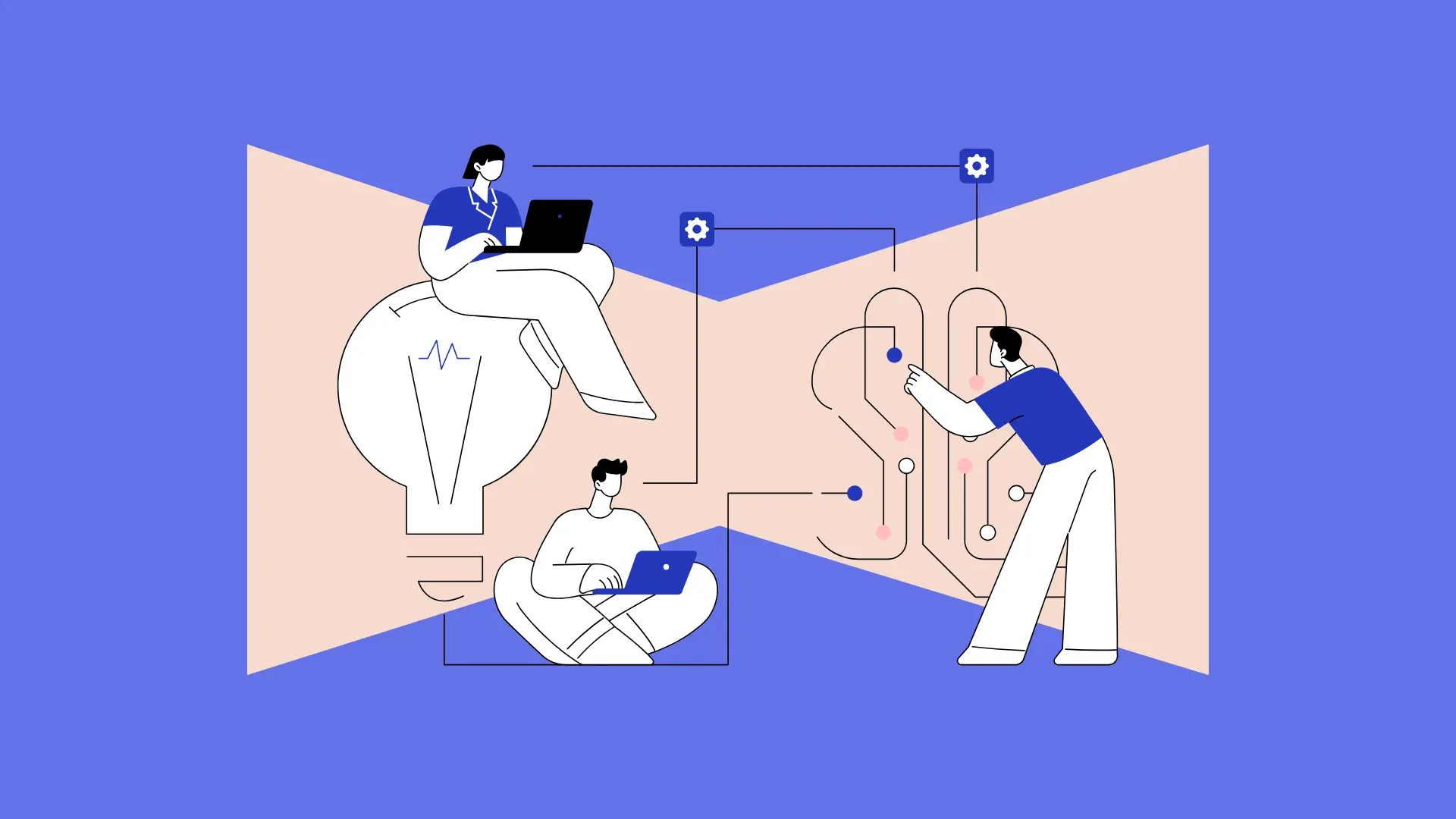
You close the deal. The buyer says yes, contracts are signed… and then momentum drops. Someone asks for a recap. Another team asks for context. The buyer gets new links, a new owner, and a new process to navigate.
What should feel like progress feels like a restart.
This is the gap the Bowtie model is meant to solve. Instead of treating “Closed Won” as the finish line, it frames revenue as a continuous lifecycle – from first conversation through onboarding, expansion, and renewal.
On paper, it’s the right model.
In practice, most revenue teams experience the Bowtie as disconnected phases. Deals stall in the middle. Buying happens between calls with little visibility. And when a deal finally closes, the Bowtie doesn’t widen — it snaps.
The issue isn’t the model. It’s the execution.
The Bowtie assumes continuity: Shared context, clear next steps, and momentum that carries across stages and teams. Most revenue teams operate in fragmentation – CRMs track stages, tools surface signals, and handoffs rely on manual recaps and tribal knowledge.
In this post, we’ll break down where the Bowtie model breaks down in real life, what it actually takes to operationalize it, and how Digital Sales Rooms (DSRs) like Flowla give revenue teams an execution layer that keeps momentum moving – before and after close.
The Bowtie model is a way of thinking about revenue that goes beyond closing deals.
Instead of treating “Closed Won” as the end of the journey, the Bowtie frames revenue as a lifecycle. The left side looks familiar: awareness, discovery, evaluation, and close. The right side mirrors it: onboarding, adoption, expansion, and renewal.
The idea is simple: The work that happens after a deal closes is just as important as the work that happens before it.
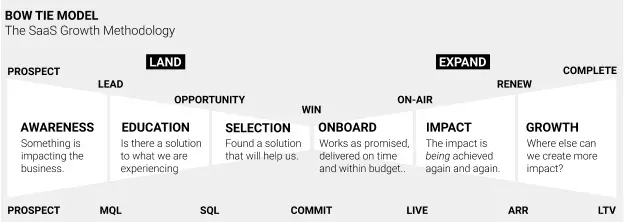
This model emerged because the traditional sales funnel no longer reflected how B2B revenue actually works. Growth today doesn’t come from a steady stream of new logos alone. It comes from retention, expansion, and long-term customer value. Losing customers or failing to expand them can erase the impact of even the strongest pipeline.
That’s why the Bowtie is often described as a revenue model, not a sales model.
It assumes that sales, customer success, and account teams are all contributing to the same outcome — not in isolated phases, but as part of a continuous motion. What’s learned during sales should inform onboarding. What happens during onboarding should influence expansion. And the buyer experience should feel connected from first conversation through renewal.
In other words, the Bowtie assumes continuity.
And that assumption is exactly where things start to break down — which is why understanding the Bowtie is only the first step. Making it work in practice is a very different challenge.
The Bowtie model assumes continuity. Most revenue teams operate in fragmentation.
On the left side of the Bowtie, this shows up as stalled deals and lost momentum. Buying happens between calls, across committees, and inside inboxes you’ll never see. Reps send follow-ups, decks, and next steps — then wait. Engagement signals exist, but they’re scattered across tools and rarely translate into clear action.
This is the “black box” middle of the Bowtie.
Teams know deals are slowing down, but not exactly why. They know buyers are active, but not who’s involved or what’s blocking progress. And because execution between stages is mostly manual, momentum depends on individual reps remembering to nudge, recap, and re-align at exactly the right time.
Then comes the right side of the Bowtie – where the breakdown becomes even more visible.
When a deal closes, context often doesn’t travel with it. Sales moves on. Customer success inherits a new account with partial information, scattered documents, and a buyer who’s already tired of repeating themselves. What should be a widening of momentum turns into a reset.
The problem isn’t intent. Most teams want alignment. They want smooth handoffs, shared context, and a consistent buyer experience.
The problem is that the Bowtie model spans multiple teams but execution lives in silos.
So while the Bowtie model is designed to connect sales and post-sales into one revenue motion, most teams end up running two separate funnels with a fragile bridge in between.
And that’s why the Bowtie doesn’t fail all at once. It fails quietly – in the middle, and at the handoff.
The Bowtie model isn’t powered by stages or dashboards. It’s powered by motion. It assumes that insight turns into action, that action happens at the right time, and that momentum carries forward without constant manual effort.
Most revenue tooling stops short of that.
CRMs tell you where a deal is.
Analytics tell you what happened.
Processes assume humans will decide what to do next.
This turns the Bowtie into a reporting model instead of an operating one.
That approach works when deals are simple and stakeholders are few. It breaks down as soon as sales becomes multi-threaded, asynchronous, and complex — which is exactly the environment the Bowtie was built for.
Without an execution layer, the Bowtie remains a diagram teams agree with, but can’t reliably run.
If there’s one moment that exposes this gap, it’s the handoff after close.
Up to this point, momentum has an owner. After close, continuity depends on transfer. Sales context has to move to customer success without losing meaning, urgency, or intent.
In most teams, that transfer is manual:
For the buyer, it often feels like a reset.
What the Bowtie model assumes is momentum widening after close. What often happens instead is a slowdown — right when trust and confidence should be highest.
This matters because onboarding sets the tone for the entire right side of the Bowtie. Lost context slows time to value. Friction early on makes expansion harder later. And every restart weakens the revenue motion the Bowtie is meant to create.
The Bowtie doesn’t fail here because teams don’t care. It fails because continuity still relies on manual execution.
Operationalizing the Bowtie model isn’t about changing your revenue strategy. It’s about changing how work gets done between stages.
In practice, running the Bowtie means answering a few very concrete questions — consistently:
Most revenue teams try to solve these problems with a mix of tools and good intentions. Reps are expected to send timely follow-ups. Managers rely on dashboards to spot issues. Handoffs happen in meetings or recap docs.
That approach works — until deals get more complex.
Operationalizing the Bowtie means moving these responsibilities out of people’s heads and into the system running the process.
Practically, that looks like:
When this is in place, a few things change immediately:
This is the difference between tracking the Bowtie and running it.
Most traditional revenue tools are built to record what happened or report on performance. They help teams understand the Bowtie — but they don’t operationalize it.
To do that, teams need an execution layer that spans sales and post-sales, works asynchronously, and keeps momentum moving by default — not one that relies on perfect human behavior.
That’s exactly where Digital Sales Rooms come in.
Next, we’ll look at why DSRs fit the Bowtie model so naturally — and how revenue teams use them to keep momentum intact across the entire lifecycle.
igital Sales Rooms work with the Bowtie model because they’re designed for the part most revenue tools ignore: the in-between moments.
The Bowtie assumes that buying doesn’t happen in meetings alone. It happens between calls, across stakeholders, and over time. Decisions are made asynchronously, often without sellers present. For the model to work, buyers and internal teams need a shared place where that work can continue without friction.
That’s exactly what a DSR provides.
Instead of treating sales and post-sales as separate environments, a Digital Sales Room gives revenue teams one evolving space that spans the lifecycle. The same room that supports discovery and evaluation can carry forward into onboarding, expansion, and renewal — without forcing a reset.
Practically, this changes how the Bowtie runs day to day:
Most importantly, DSRs don’t just surface information — they support execution. They make next steps visible. They keep the process structured without turning it into rigid project management. And they allow sales and post-sales teams to work from the same foundation instead of stitching things together after the fact.
This is why DSRs aren’t just a better way to share content. In a Bowtie world, they act as the shared execution layer the model assumes:
When revenue teams use DSRs this way, the Bowtie stops being a conceptual framework and starts functioning as a real operating model.
Next, we’ll walk through what this looks like across each stage of the Bowtie — from first call to renewal — and how teams use DSRs in practice.
When revenue teams operationalize the Bowtie with a Digital Sales Room, the biggest shift isn’t structural – it’s experiential.
Instead of running different tools, links, and processes at each phase, the same workspace evolves as the deal moves forward. With Flowla, that evolution happens without asking reps or buyers to relearn the process at every step.
Here’s what that looks like across the Bowtie.
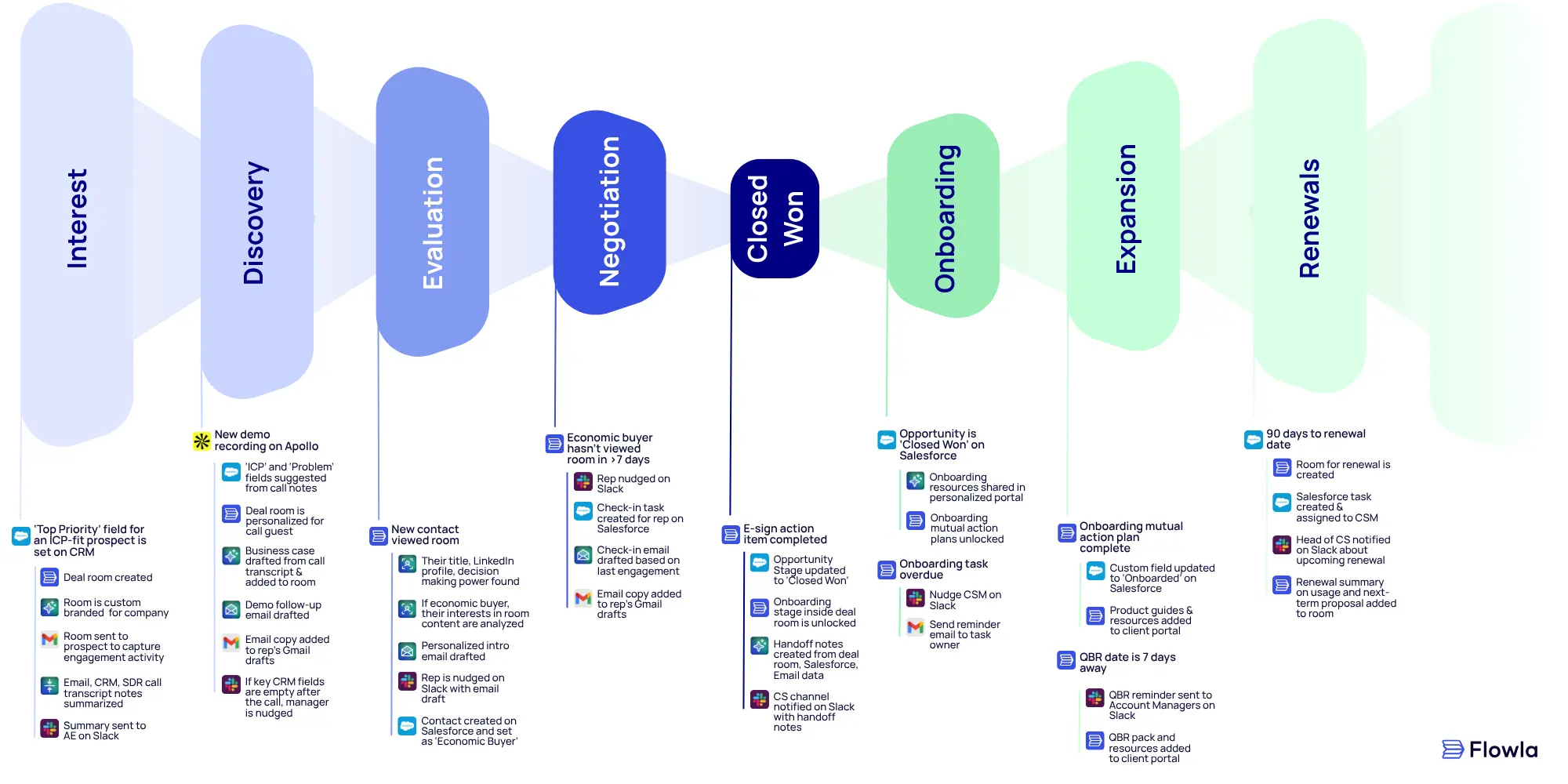
After a discovery or demo, Flowla becomes the place where the deal continues when no one is on a call. Sales teams use the room to:
Instead of guessing when to follow up, reps can act based on real engagement — keeping momentum alive in the most fragile part of the Bowtie.
As more people get involved, the room becomes a shared reference point. Champions don’t have to forward decks or explain context from scratch. New stakeholders can self-serve the information that’s relevant to them.
For sales teams, this reduces friction at the exact moment deals usually slow down:
The result isn’t pressure — it’s clarity.
When the deal closes, the room doesn’t disappear.
Instead of sending a new onboarding link or moving everything into a separate system, Flowla carries the same space forward. Customer success inherits:
This is where the Bowtie either widens or snaps — and continuity makes the difference.
As onboarding progresses, the room continues to evolve. Tasks, milestones, and shared context stay visible to both sides. CS teams don’t need to recreate timelines or re-educate stakeholders.
Because the relationship already has a home, expansion conversations start from a position of trust and shared understanding — not from scratch.
By the time renewal discussions begin, the room reflects the full journey:
That continuity makes renewals feel like a natural extension of the relationship, not a renegotiation.
Across every stage, the pattern is the same. Flowla doesn’t add more steps to the Bowtie. It removes the gaps between them.
By giving buyers and revenue teams one continuous space to work in, the Bowtie stops being something teams report on and becomes something they can actually run — from first conversation through long-term value.
The Bowtie model didn’t replace the funnel because revenue teams wanted a new diagram. It replaced it because revenue today is continuous. Buyers don’t experience sales, onboarding, and expansion as separate motions — and the teams that serve them can’t afford to either.
But adopting the Bowtie as a concept is the easy part.
What separates teams that make it work from those that don’t is execution. Specifically, whether they have a way to carry momentum, context, and next steps across stages and across teams — without relying on perfect human behavior.
That’s where most Bowtie implementations fall short.
They measure the lifecycle.
They report on it.
They talk about alignment.
But they don’t operationalize it.
When revenue teams introduce a shared execution layer — one that buyers and internal teams move through together — the Bowtie stops being fragile. The middle becomes easier to manage. Handoffs stop feeling like restarts. And post-close momentum actually widens instead of snapping.
The lesson isn’t that the Bowtie model needs rethinking. It’s that it needs running.
Because in modern B2B, revenue doesn’t break at the top or the bottom. It breaks in the gaps between stages — and that’s exactly where execution matters most.
See how Flowla supports the Bowtie model across sales, onboarding, and expansion — without changing how your team works.
Book a chatBook a 15-minute chat with a product expert. We'll walk you through every step of the way as you get set up.
.webp)
.webp)
.webp)


.webp)

.webp)
.webp)
.webp)




.webp)
%20(3).webp)
.webp)


.webp)
.webp)
.webp)
.svg)

.webp)
.webp)