.webp)
If you’re searching for the best AI-powered Digital Sales Room (DSR) tools, you’re likely not just comparing interfaces or branding. You’re trying to understand which platforms actually use AI to reduce manual work, maintain deal momentum, and support complex B2B buying processes, not just track page views.
Digital Sales Rooms have become the default way to share content, align stakeholders, and guide buyers through complex purchases. But in 2026, not all DSRs are truly AI-powered. Many tools use AI to summarize content or surface engagement data, while only a few apply AI to execute next steps automatically, such as drafting follow-ups, triggering workflows, or supporting sales-to-onboarding handoffs.
In this comparison, we evaluate the leading AI-powered DSR tools based on how deeply AI is embedded into deal execution – not how often “AI” appears in their marketing. We compare Flowla, Trumpet, Dock, Along, Aligned, GetAccept, and Arrows across AI capabilities, Digital Sales Room fundamentals, and real-world revenue use cases.
By the end of this guide, you’ll have a clear understanding of:
So, let’s dive into our research.
To identify the best AI-powered Digital Sales Room (DSR) tools, we evaluated each platform against a clear set of criteria focused on execution, not just experience.
Rather than treating AI as a checkbox feature, we looked at how and where AI is actually applied in the sales and onboarding process.
Each tool in this comparison was assessed based on the following factors:
1. AI Capabilities
2. Digital Sales Room Foundations
3. Deal Momentum & Execution
4. Sales → Onboarding Continuity
5. CRM & Workflow Integration
This framework ensures the tools in this list are compared based on how effectively they use AI to support real revenue execution, not just how polished the interface looks.
Flowla is an AI-powered Digital Sales Room designed for execution, not just alignment. While most DSR tools focus on organizing content and guiding buyers, Flowla is built to keep deals and onboarding processes moving when human follow-through breaks down.
The Digital Sales Room is the interface, but the real value sits underneath: AI-driven workflows that help teams follow up faster, spot stalled deals, and hand off cleanly from Sales to Customer Success.
Flowla’s AI focuses less on buyer chat or generic content generation and more on turning engagement signals into next steps. For example, after a demo or period of inactivity, Flowla can help draft contextual follow-ups, surface which stakeholders matter most, and prompt the right actions at the right time. Once a deal closes, the same room can continue into onboarding, reducing the “restart” that often frustrates buyers and CS teams.
Flowla is best suited for teams running complex, multi-stakeholder sales motions that don’t end at signature — especially organizations that want AI to remove admin work and enforce consistency, rather than add another tool to manage.
Trumpet is a modern Digital Sales Room platform with a strong focus on buyer experience, stakeholder alignment, and sales enablement. It’s often praised for its clean UI, fast setup, and ease of use for sales teams.
Trumpet positions itself as AI-enabled through features like AI coaching and assistance, which help sellers refine messaging, understand buyer engagement, and prepare next steps. The AI layer is primarily assistive — helping reps think better and work faster — rather than automating execution across the funnel.
Trumpet works well for sales-led teams that want a polished, buyer-friendly DSR and value AI guidance without handing over control to automation. Execution and follow-through still largely rely on reps.
Dock positions itself as a customer collaboration workspace that spans sales, onboarding, and account management. It’s broader than a classic DSR and often appeals to teams looking for a single, shared space across the customer lifecycle.
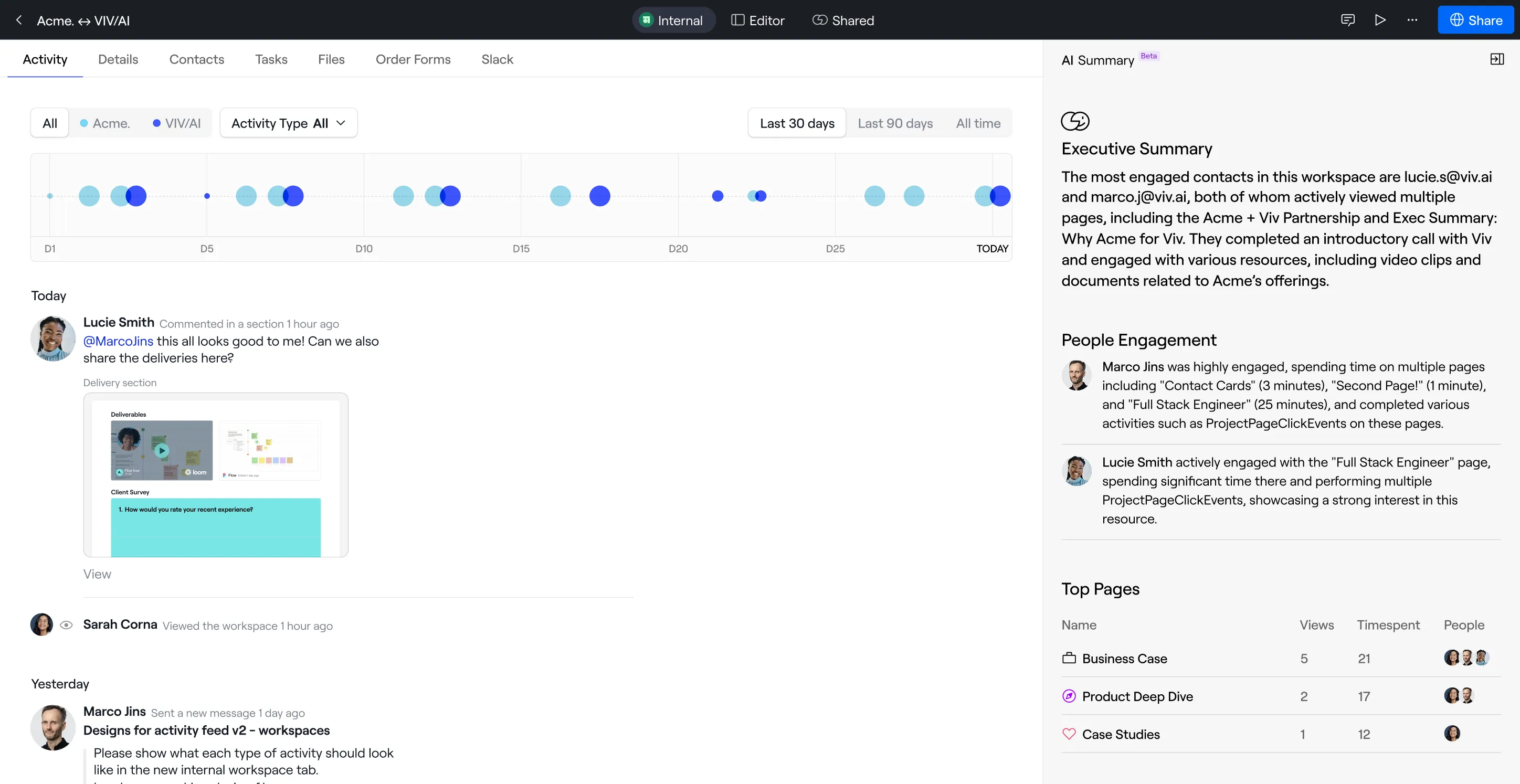
Dock’s AI capabilities focus on enablement and content, including AI-generated customer-facing documents and an AI agent that helps teams find information, follow playbooks, and answer questions. AI here is used to support knowledge access and document creation, rather than orchestrate deal execution.
Dock is a strong option for teams that care about cross-functional collaboration and want AI to help scale documentation and consistency across sales and customer success, even if follow-ups and workflows remain mostly manual.
Along is a Digital Sales Room platform built around buyer engagement insights and guided selling. It emphasizes helping sellers understand buyer behavior and respond with better timing and relevance.
Along’s AI shows up primarily as a sales copilot, analyzing engagement signals and recommending next best actions. Rather than automating workflows, the AI acts as an intelligence layer that helps reps decide what to do next.
Along is a good fit for teams that want AI-powered insights and recommendations inside their DSR, but still prefer to keep execution and follow-through in the hands of sellers.
Aligned is a buyer enablement–led Digital Sales Room with one of the clearest AI stories in the category. Its AI offering is split into two parts: an in-room AI assistant for buyers and an AI insights layer for sellers.
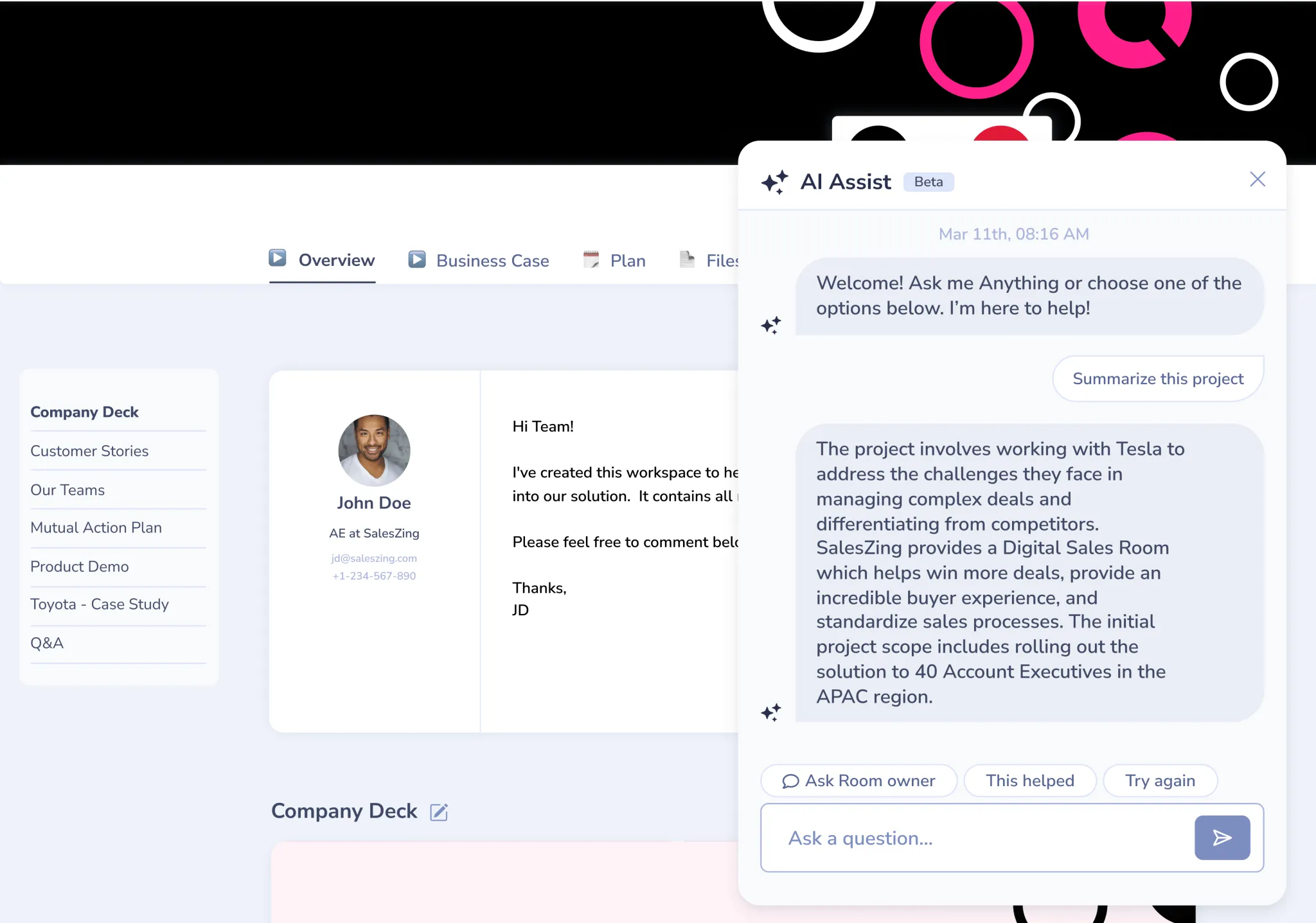
Buyers can interact directly with AI inside the room to ask questions and explore information, while sellers use AI to summarize deal progress, analyze engagement across rooms, emails, and CRM data, and support deal reviews and forecasting.
Aligned’s AI is best described as assistive and analytical, helping both sides make sense of complex buying journeys. It does not focus on automating workflows or post-sale execution, but it excels at clarity, sense-making, and buyer self-service.
GetAccept is best known as a proposal, e-signature, and deal-closing platform that also offers Digital Sales Room functionality. Its AI capabilities are strongest around content and document generation.
The platform uses AI agents to help generate business cases, executive summaries, and proposal content, speeding up late-stage sales work. AI here is focused on creating and refining sales materials, rather than guiding buyers through an ongoing workspace or automating execution after engagement.
GetAccept is a strong choice for teams whose primary bottleneck is proposal creation and deal documentation, and who want AI to reduce the time spent preparing closing materials.
Arrows is a CRM-native Digital Sales Room tool, built closely around HubSpot and Salesforce. Its strength lies in automatically creating and updating rooms based on CRM data and customer activity.
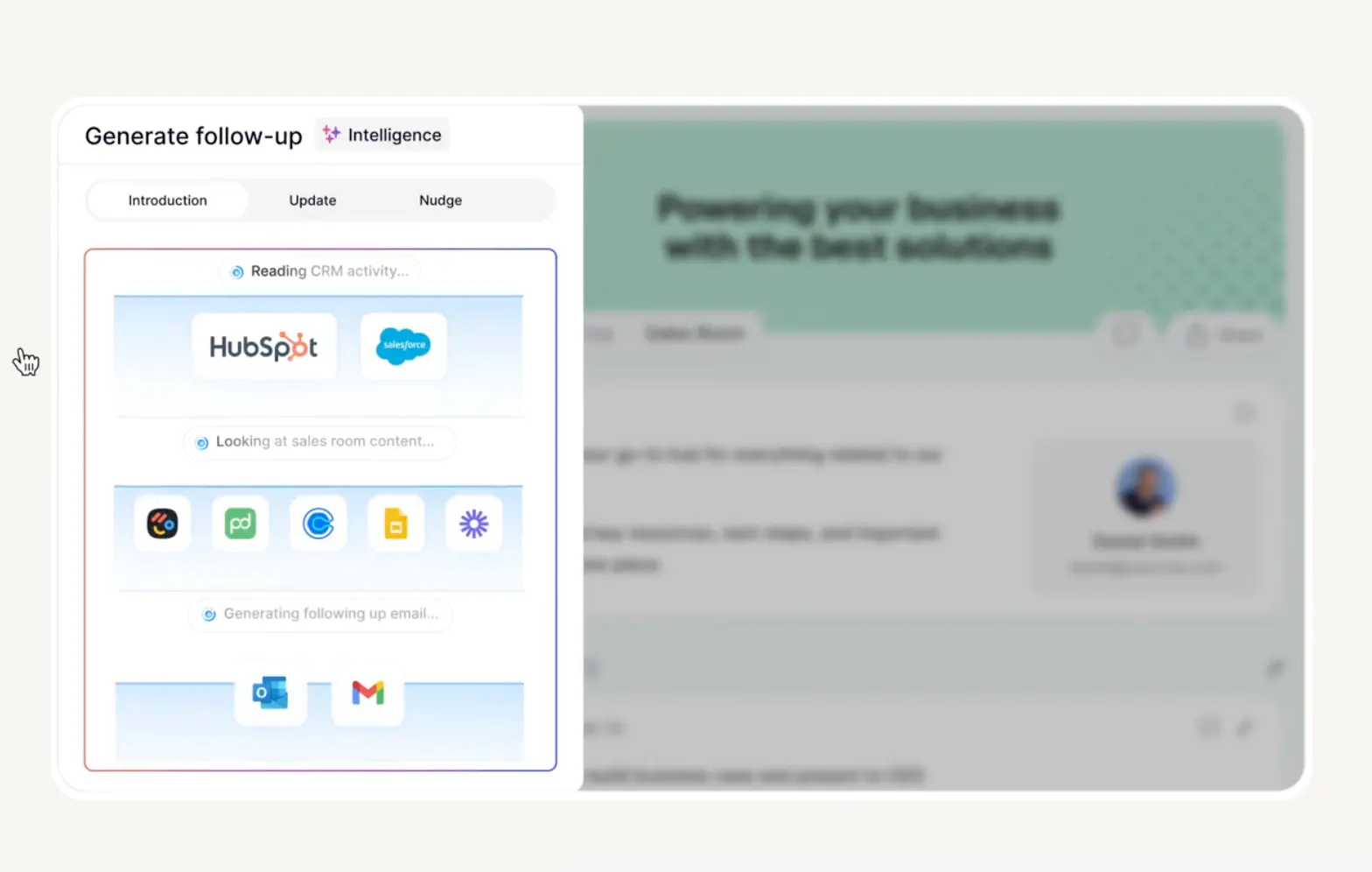
Arrows’ AI focuses on CRM-driven automation, such as suggesting room updates or drafting follow-up emails based on sales activity. It also supports onboarding plans that sync back to CRM objects, making it appealing to operations-heavy teams.
Arrows is best suited for teams that want DSRs to be deeply connected to their CRM and are looking for lightweight AI assistance tied directly to existing workflows, rather than a full execution engine.
Not all “AI-powered” Digital Sales Rooms are built for the same job. The right choice depends on where your revenue process breaks down today — insight, content creation, buyer clarity, or execution.
Below is a practical guide to help you choose based on real-world use cases.
Best for: Deal execution, stalled opportunities, sales → onboarding handoffs
If your biggest problem is that deals go quiet after demos, follow-ups slip, or onboarding feels like a restart, Flowla is built for that gap. Its AI focuses on turning engagement signals into action — drafting next steps, prompting follow-ups, and keeping momentum across sales and customer success.
Best for: Buyer enablement, self-service buying, deal sense-making
Aligned is a strong choice if you want AI inside the room to help buyers ask questions and sellers understand complex buying journeys. Its AI shines as a copilot and intelligence layer, not as an automation engine.
Best for: Sales teams prioritizing UX and AI-assisted coaching
Trumpet works well if you want a clean, modern DSR and AI support to help reps think, prepare, and communicate better — while keeping execution manual and rep-driven.
Best for: Sales + CS collaboration, standardized customer docs
Dock is ideal when the goal is one shared workspace across the customer lifecycle, with AI helping generate and manage documentation rather than orchestrate deal execution.
Best for: Understanding buyer behavior and improving timing
Along’s AI helps reps interpret engagement data and decide what to do next. It’s a good fit for teams that want recommendations, not automation.
Best for: Late-stage sales, proposals, and closing documentation
GetAccept’s AI is strongest in generating business cases and proposal content. It’s less about guiding an ongoing buyer workspace and more about speeding up closing materials.
Best for: HubSpot/Salesforce-native teams and ops-led workflows
Arrows is a good option if you want Digital Sales Rooms created and maintained directly from CRM data, with light AI assistance for follow-ups and onboarding plans.
AI-powered Digital Sales Rooms are no longer a nice-to-have. As buying processes get more complex and face time with buyers decreases, teams need a shared workspace that does more than organize content — it needs to help deals and onboarding move forward when momentum is at risk.
What this comparison shows is that “AI-powered” doesn’t mean the same thing across tools.
Some platforms use AI to:
Others go a step further and use AI to:
There’s no universally “best” AI-powered DSR — only the best one for your specific source of friction.
The key is to look past AI buzzwords and ask a simple question:
Does this tool help us understand what’s happening — or does it help us make sure the next step actually happens?
That distinction is where the real value of AI-powered Digital Sales Rooms shows up in 2026 and beyond.
No scripts. No heavy setup. Just clearer execution.
Explore FlowlaBook a 15-minute chat with a product expert. We'll walk you through every step of the way as you get set up.
.webp)
.webp)
.webp)


.webp)

.webp)
.webp)
.webp)




.webp)
%20(3).webp)
.webp)

.webp)

.webp)
.webp)
.webp)
.svg)

.webp)
.webp)