If you work in Customer Success, you know the drill. A QBR is coming up. Your calendar is blocked. A deck starts taking shape. You pull usage charts. Support stats. Adoption graphs. Maybe a roadmap slide if there’s time. The meeting runs. You walk through the slides. Everyone nods along.
Then the call ends. And if you’re honest… nothing really changes. No new decisions. No clear commitments. No momentum coming out of the conversation.
A few weeks later, you’re back in execution mode, and the QBR already feels like a box you checked rather than a moment that moved the relationship forward.
So when people say, “QBRs are dead,” it’s easy to see why. But QBRs aren’t the problem. Boring, status-update, slide-heavy QBRs are.
When QBRs are treated like a quarterly ritual instead of a strategic process, they lose their impact. Data gets shared without a story. Metrics get reviewed without meaning. Meetings end without ownership or follow-through.
And the biggest red flag? Everyone leaves feeling like the QBR was “done” without anything actually being different afterward.
That’s not a QBR problem. That’s an execution problem.
In this post, I’ll break down how to rebuild the QBR into what it was always meant to be: a strategic, outcome-driven conversation that reinforces value, drives alignment, and creates real momentum between meetings.
At their core, QBRs aren’t about reporting. They’re about alignment and decision-making.
A strong QBR should help you and your customer pause, zoom out, and answer a few critical questions together:
When QBRs do this well, they stop feeling like a status update and start feeling like a business conversation.
More specifically, QBRs should:
If a QBR doesn’t lead to at least one decision, one commitment, or one clear next step, it’s probably doing too much reviewing and not enough shaping. And that’s where most teams get stuck.
Not all QBRs have the same job, and treating them the same is a common mistake.
Your first QBR after onboarding is about validating momentum. This is where you:
At this stage, the focus isn’t what you implemented. It’s what’s starting to change because of it.
As the relationship matures, succeeding QBRs should shift from validation to optimization. These sessions are about:
One best practice that applies to both: share the QBR materials in advance. Treat them as a pre-read or executive summary so the live session can focus on discussion, decisions, and forward planning, not slide narration.
When QBRs feel like strategy conversations instead of walkthroughs, they naturally earn more engagement and higher-level attention.
Who’s in the room has a huge impact on how strategic your QBR can actually be. If the room is filled only with day-to-day users, the conversation will naturally stay tactical.
Sometimes that’s appropriate. But if you want the QBR to drive real outcomes, you need the people who actually care about outcomes and can unblock progress.
At a minimum, you want to have:
Then work toward:
These are the people who care most about outcomes and they’re the ones who ultimately decide whether your partnership continues to grow.
Not every QBR will include executives, and that’s okay. Use early QBRs to build trust and demonstrate value first. Then, position the session as a business review tied to outcomes, not a product check-in, and partner with your champion to bring the right leaders into the conversation.
When the right stakeholders are present, QBRs stop being updates and start driving decisions.
A strong QBR doesn’t need a massive deck. It needs clarity, focus, and follow-through.
Most QBRs quietly balloon into 30–40 slides because teams try to document everything: every usage chart, every ticket trend, every training session, every roadmap update. The result is predictable:
The problem is not the amount of work you did. The problem is signal-to-noise.
If the purpose of a QBR is alignment and decision-making, then your format should force alignment and make decisions easy. That is why a one-page, outcome-driven snapshot is often more effective than a long deck. It makes the story obvious, it surfaces what matters, and it creates a natural bridge into next steps.
Use a single slide to anchor the conversation around six things that actually move the relationship forward:
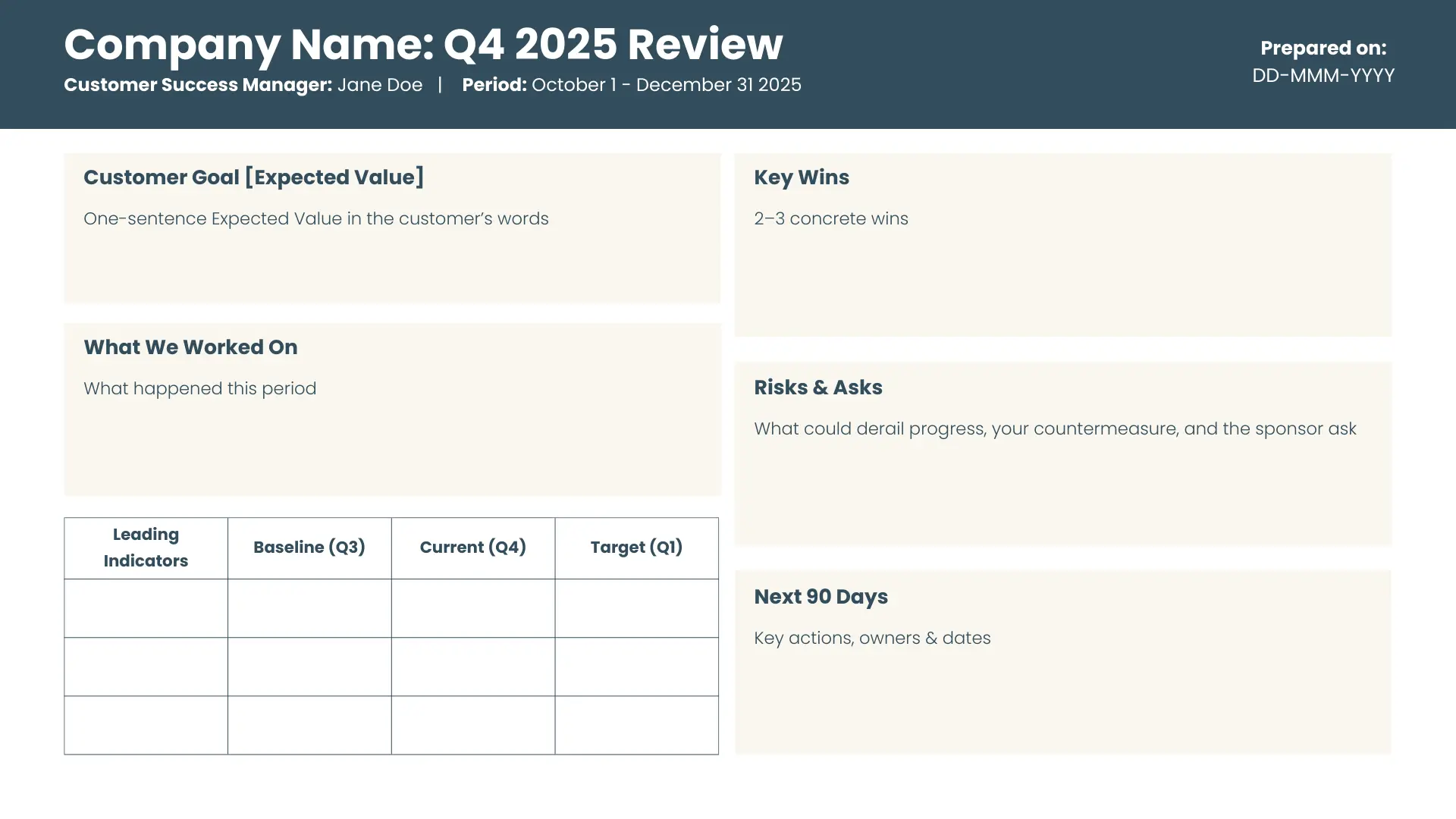
If you want QBRs that drive real impact, stop optimizing for completeness and start optimizing for decisions. A single, well-structured snapshot makes it easier for customers to see the value, understand the risks, and commit to what happens next.
When your QBR fits into a simple, repeatable structure, it becomes easier to run and far more impactful for the customer.
Even with the right structure, QBRs can fall flat if they’re treated as one-off meetings. A few practical habits can make them far more effective before, during, and after the session.
When QBR prep and follow-through are treated as part of the process, QBRs start compounding value over time.
If your QBRs feel like status updates, your customers will treat them like one.
But when QBRs are designed as strategic checkpoints that’s grounded in customer goals, focused on outcomes, and followed by clear action, they become one of the most powerful tools in your Customer Success motion.
When you prepare with purpose, run the session as a business conversation and capture decisions in a way both teams can return to, QBRs start compounding momentum instead.
-----

About the author:
Angeline Gavino is the Founder & CEO of CS RevSpeak and a former VP of Customer Success. She helps Customer Success leaders who carry a revenue number turn messy, high-pressure realities into clear, scalable systems that drive retention, expansion, and growth. With experience leading CS teams across startups at different stages, Angeline is known for her practical, execution-focused approach to building high-performing teams and revenue-driven CS motions. She’s also the host of the CS RevSpeak Podcast and a Top 100 Customer Success Strategist (2025).
Book a 15-minute chat with a product expert. We'll walk you through every step of the way as you get set up.
.webp)
.webp)
.webp)


.webp)

.webp)
.webp)
.webp)




.webp)
%20(3).webp)
.webp)


.webp)
.webp)
.webp)
.svg)

.webp)
.webp)