Imagine having a $500K enterprise deal underway. Your champion just looped in procurement. They need the security questionnaire you sent three weeks ago. You search "security" in your sent folder and get 14 results across 8 email threads. Was it the PDF attachment or the Google Doc link? Did you send version 2.1 or 2.3?
Meanwhile, the CFO asks your champion for ROI projections. Your champion forwards your deck, but it's missing the updated pricing from the last call. The deal stalls while everyone hunts for the right version of the right document.
For decades, this wasn’t an edge case. Complex B2B deals ran on mile-long email threads and scattered attachments. The result was predictable chaos.
Sales teams tried to impose order. They created well-organized Google Drive folders with labeled subfolders for each deal stage. They wrote detailed follow-up emails with 15 attachments and instructions. They invested in proposal software that generated beautiful but static documents.
These were seller-centric solutions to a buyer-centric problem. They made sending information easier. Actually using it remained a hassle. A shared folder with 40 files still required buyers to know which file answered which question. An email with 12 attachments still disappeared into cluttered inboxes. Proposals still captured a moment in time rather than evolving with the conversation.
That’s why Digital Sales Rooms felt like such an obvious next step.
The promise was simple and powerful. One shared space instead of dozens of emails. Centralized content. Clear next steps. Visibility into engagement. A single link champions could confidently share internally.
.webp)
The category took off quickly, accelerated by the rise of virtual selling during the pandemic. Last year, 61% of buyers reported preferring seller-free experiences over traditional interactions. At the same time, complex deals have been growing more chaotic: The majority (86.4%) of buyers are now taking up to 6 months and up to 5 stakeholders to make a purchase decision while also relying on their own research as the primary source of the information.
The solution seemed obvious. Create a single, persistent workspace where buyers and sellers could collaborate digitally throughout the entire relationship – from first touch through post-sale.
Gartner captured this vision in their 2022 Innovation Insight report, defining DSRs as micro-sites "privately formed for a vendor and a customer to collaborate digitally, from lead right through the customer life cycle."
The initial promise included:
Gartner's analysts were bold in their estimates. They predicted that by 2026, 30% of B2B sales cycles would be managed through DSRs. Revenue teams rolled DSRs out across sales orgs. Adoption surged. In a 2021 Gartner survey, 23% of sales leaders had already included DSRs in their budget. Venture capital poured into the category. Platforms proliferated. Adoption accelerated.
The category was becoming foundational infrastructure for modern revenue teams.
Yet, the gap between promise and practice was widening. Some teams reported transformative results. Others abandoned their DSR initiatives entirely. Most fell somewhere in between – using the tools, but struggling to extract their full value.
Forrester Research captured the moment in 2023: "DSRs belong to a class of innovations that can only be understood when you use them...Those who 'get it' are obtaining some remarkable results." But the analysts also warned of significant implementation challenges.
The predictions proved prescient, at least in terms of market growth. The global digital sales room market reached $1.2 billion in 2024 and is projected to hit $6.5 billion by 2033, growing at a 20.7% CAGR. North America leads with 38% market share, while Asia Pacific is tracking the highest growth rate at 24.3%.
By the numbers, DSRs have arrived. Strategic capital continues flowing into the category with several of the leading players securing solid funding rounds.
Our own survey of 100+ practitioners further proves this: Over 54% of the surveyed sales professionals actively use them across all deals. Only ~30% have never used a deal room in their revenue processes.
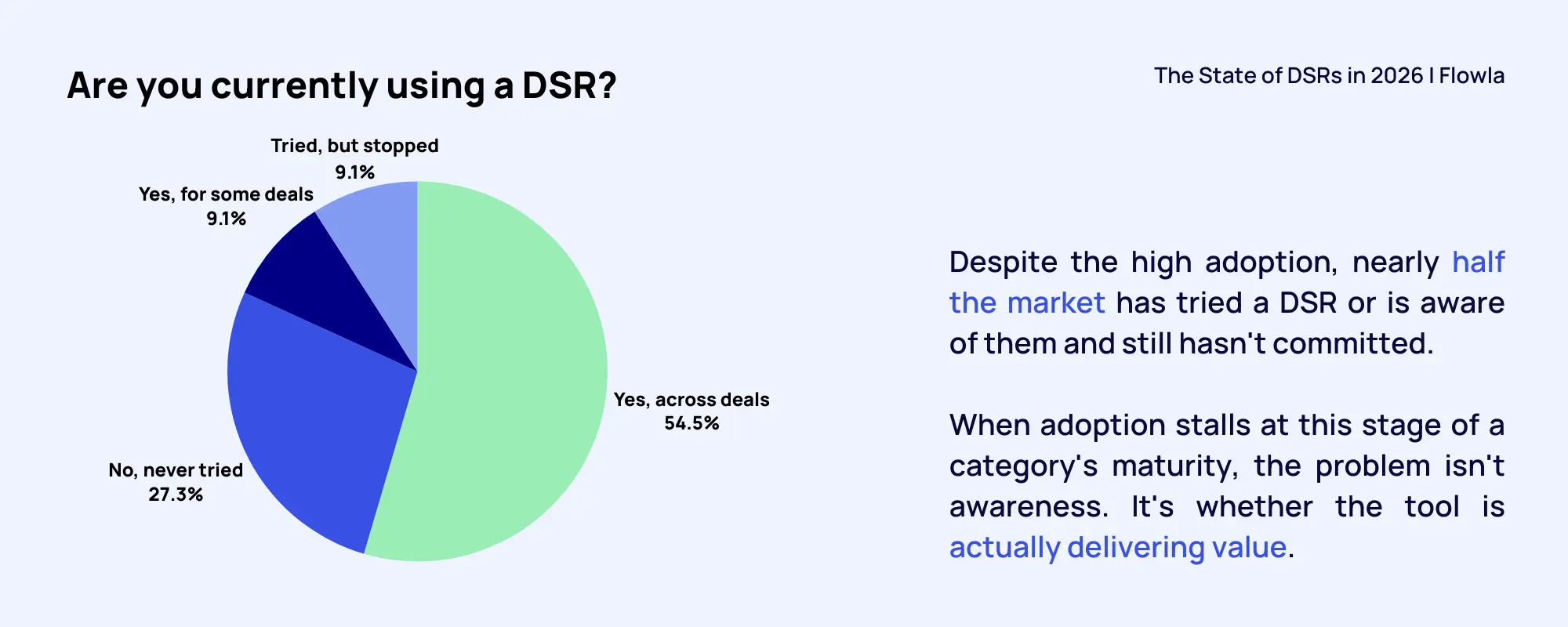
But market size tells only part of the story. Revenue growth and platform sophistication don't necessarily translate to value realization. Adoption rates measure deployment, not effectiveness.
The gap between vendor roadmaps and practitioner reality is often stark. Despite sophisticated capabilities and multi-billion-dollar market growth, DSRs might be facing a fundamental crisis.
Across sales communities on LinkedIn and Reddit, the discussions reveal certain frustration with DSRs. The primary complaint is added complexity. Teams struggle to teach champions how to use the platform, who then become responsible for educating their entire buying committee. Our own research shows the same pattern, as ~48% of deal rooms created never get any engagement.
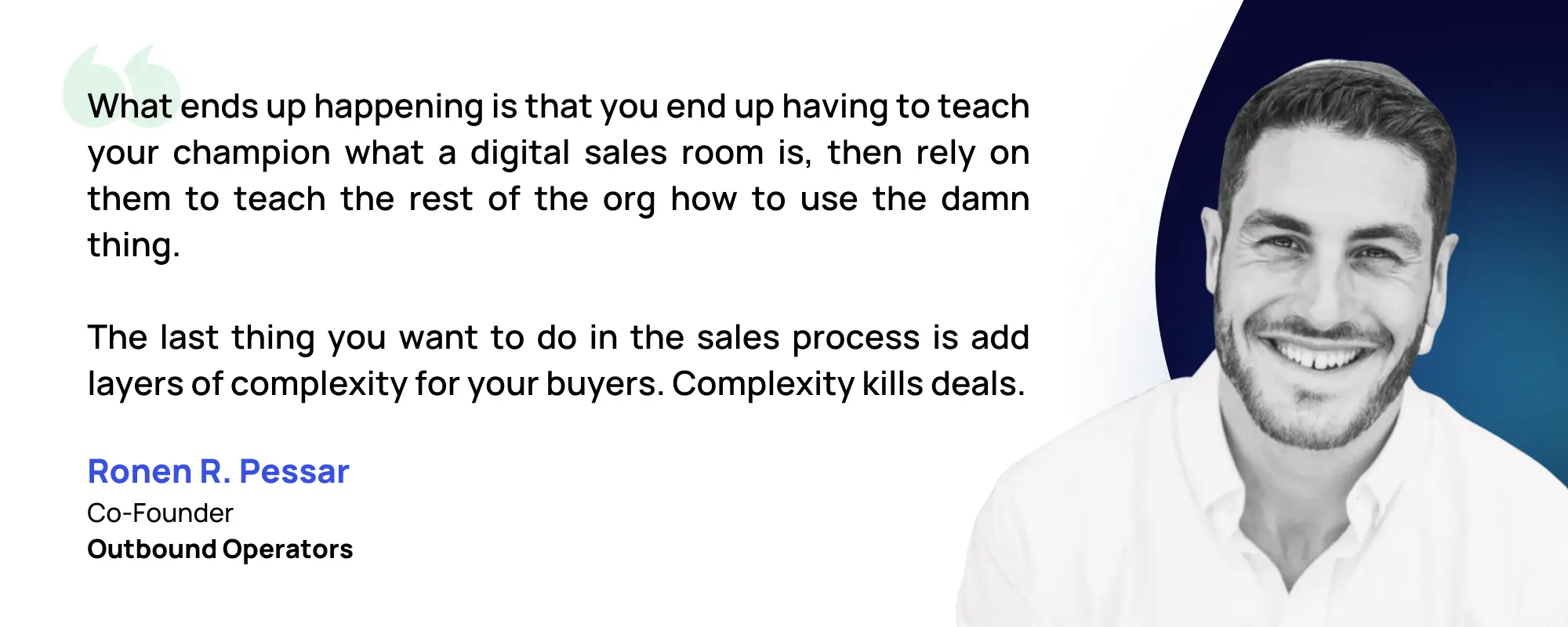
The surveillance concern surfaces repeatedly. Buyers hesitate when they know every click is tracked and reported back to sellers. The psychological barrier is real – stakeholders don't want to signal interest prematurely or feel like they're being monitored while evaluating vendors.
%20(20).webp)
Yet the debate isn't one-sided. Enterprise sellers working complex, multi-department deals describe DSRs as essential. Room activity becomes their primary deal health indicator. When stakeholders actively engage, deals progress. When rooms go silent, deals stall.
%20(19).webp)
As a result, some teams reported transformative results. Others abandoned their DSR initiatives entirely. Most fell somewhere in between – using the tools, but struggling to extract their full value.
The execution gap is clear. Most platforms focus on content management – uploading documents into organized folders – without addressing what happens next. How does centralized content actually help close deals? How does it enable buyers to navigate internal consensus? The tooling exists, but the playbooks don't.
%20(23).webp)
We surveyed revenue operators to understand how DSRs are being used today: What's expected, what’s working, and where teams are still struggling. The findings tell a story of a category that's directionally right but architecturally incomplete.
What people expect DSRs to solve
Teams aren't confused about what DSRs should do. When we asked why they're using or evaluating them in the first place, the top three responses were clear: Make the buying experience easier for customers, track buyer engagement and activity, and keep deals moving forward between calls. Those three motivations map almost perfectly to what a mature DSR should deliver.
.webp)
Even more telling is another fact: Standardizing the sales process and supporting onboarding handoffs ranked at the bottom (cited by ~20% respondents). In our opinion, it’s not because teams don't value those outcomes, but because they haven't connected the dots yet. The teams using DSRs to enforce consistent playbooks and bridge the gap between sales and customer success are still a small minority, but they're the ones getting disproportionate value.
The intent is pointed in the right direction. The gap is in execution.
The top priorities for people using DSRs
When we asked what users prioritize most in a DSR, customer experience and presentation came out on top by a wide margin (almost 90% of responses), followed by engagement analytics, ease of use for reps, and CRM integration.
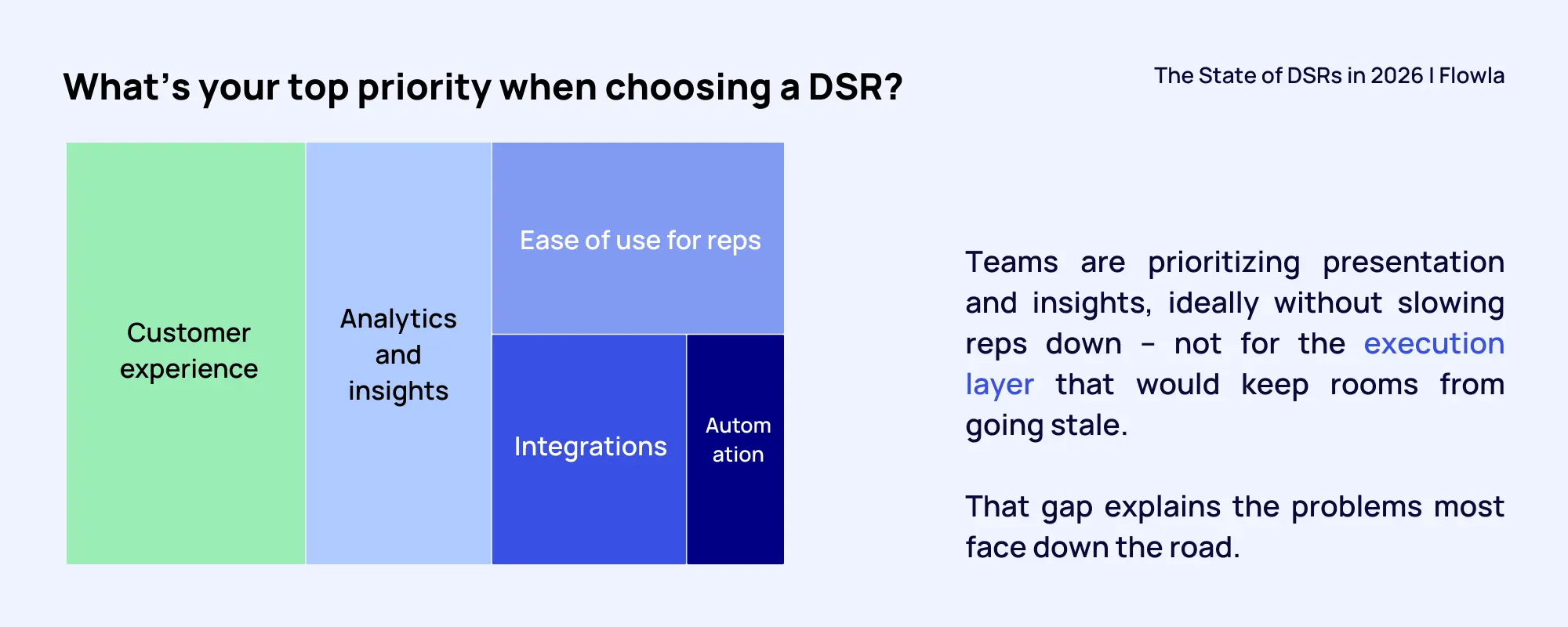
That prioritization makes sense. Teams want to show up professionally. They want visibility into buyer behavior. They want tools that don't slow reps down.
But the most revealing response is what ranked last: Automation and workflows, cited by fewer than 10% of respondents.
This is the blind spot that explains everything else. Teams want better engagement but overlook the feature most likely to drive it. Workflow automation is what could transform a DSR from a static destination into an active participant in the deal cycle.
The priorities reveal a category focused on observation rather than orchestration. Teams want to see what buyers do. They haven't yet built the infrastructure to systematically act on it.
The main problem with DSRs
Ask users what's actually preventing DSRs from delivering impact, and the answer is consistent: Rooms go stale.
Reps not keeping them updated was the top problem by a significant margin (cited by ~60% respondents). The scenario is predictable: A neglected room becomes a static content library. A static library gives buyers no reason to return after the initial share. A room buyers don't revisit can't be connected to deal progress. The tool built to replace email chaos quietly becomes another thing that gets deprioritized when quota pressure hits.
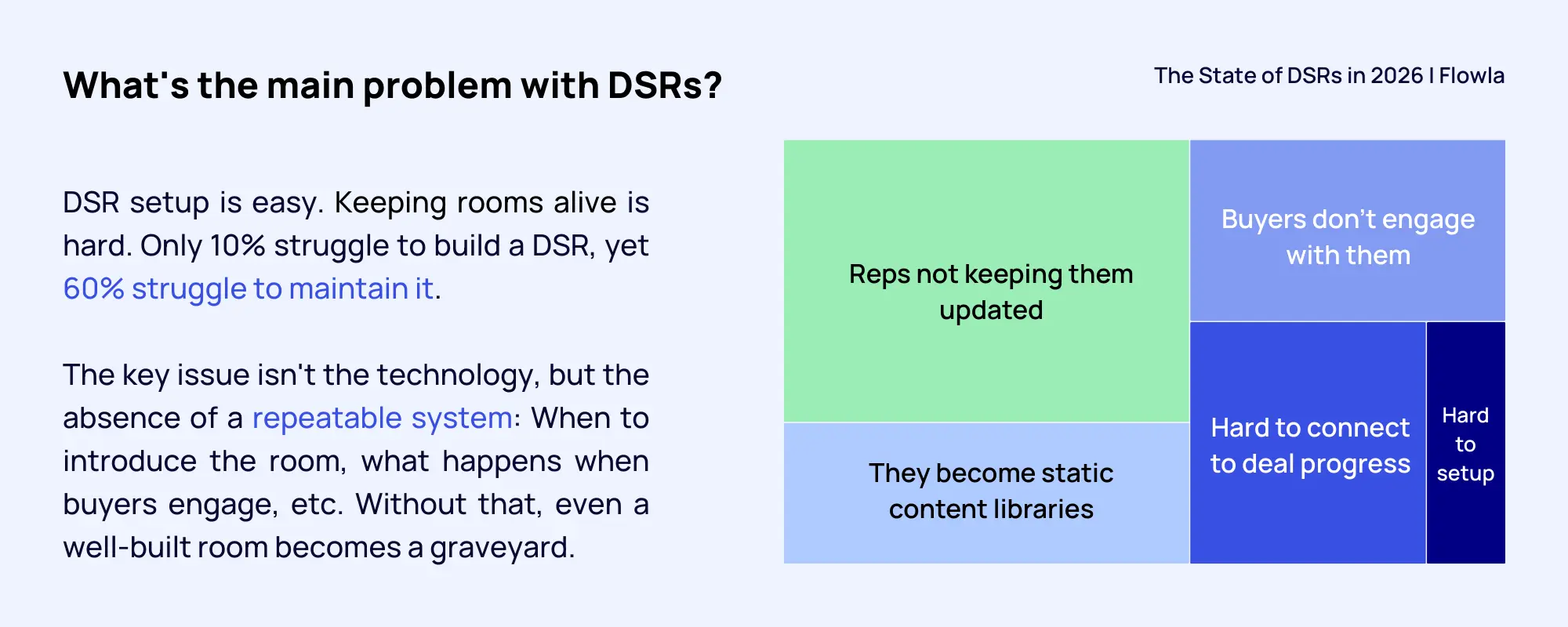
But the inconsistency runs deeper than maintenance. When we asked at which stage of the sales process teams typically deploy DSRs, responses were spread almost evenly across early stage, mid-funnel, and late stage. This means there's no established playbook for when a room should enter the deal.
On a positive note, only around 10% of the respondents cited setup friction, which means most DSRs are pretty easy to build and administrate.
This means the barriers to DSR impact aren't technical. They're behavioral and structural. Teams are missing a repeatable process for how rooms get created, introduced, maintained, and connected to deal motion. Without that process, even the best platform becomes a passive destination – somewhere deals go to die, rather than a system that actively drives them forward.
Many leading DSR vendors have started to recognize the execution gap. The response has been a race toward AI-powered capabilities designed to bridge the distance between deployment and value. By 2026, nearly every major DSR platform has integrated some form of artificial intelligence into their core offering.
Yet, vendors across the category have meaningfully different bets on what the core problem actually is.
Highspot's latest launch is perhaps the clearest signal of where the category is heading at the enterprise level. Their Deal Agent analyzes CRM data, buyer engagement signals, and meeting intelligence to create a real-time view of every active opportunity, then surfaces data-backed recommendations on how to advance it. The intelligence layer connects what's being said on calls, what's happening in the room, and what the CRM shows, translating fragmented signals into a coherent picture of deal health.
Aligned decided to focus on helping buyers buy. Their embedded AI copilot lives inside the room itself, giving buyers instant answers to questions without waiting for the rep to respond. Champions can self-serve information, explore content at their own pace, and share context internally, all without scheduling another call.
Trumpet focuses its AI on making the seller more effective rather than automating what happens next. Their Casey AI functions as an always-on deal coach, analyzing buyer engagement patterns inside the room, identifying which stakeholders are active or missing, flagging risks, and recommending specific plays for the rep to act on. Semantic search lets reps surface the right case study or playbook using natural language rather than folder navigation. Execution stays in human hands, but the rep arrives at every touchpoint better informed and better prepared.
Dock tries to solve the content problem. Their AI tackles this at both ends. Dock AI generates business cases, sales proposals, meeting recaps, and mutual action plans directly from call transcripts or Gong recordings, turning a post-meeting summary into a fully populated workspace in seconds.
On the management side, their AI Enablement Agent automatically tags library assets, archives outdated files, and surfaces the right content through natural language search, effectively giving enablement teams a dedicated administrative assistant for their content library.
Flowla focuses on the playbook execution as the core problem, taking a broader workflow automation approach. Its automation layer - the AutoPilot – is designed to keep deals moving across the entire sales cycle, not just at close. Where Highspot tells you what to do and Trumpet improves what buyers experience, Flowla automates what actually happens next.
When a buyer engages with the room, AutoPilot triggers follow-up sequences, updates CRM records, notifies the rep, and advances the deal to the next stage without manual intervention. The room stops being a passive destination and becomes an active workflow layer. Deals that would otherwise go quiet get nudged forward automatically, removing the dependency on reps to catch every signal and act on it before momentum is lost.
As you can see, the approaches differ, but the diagnosis is the same: DSRs left to chance don't deliver. Whether the bet is smarter intelligence, better buyer experience, stronger coaching, cleaner content, or automated execution – every vendor is trying to solve for rooms that go stale, buyers who disengage, and reps who don't know what to do with the signals they're seeing.
What the vendor innovation wave makes clear is that technology alone won't close that gap. The teams getting the most out of DSRs aren't the ones with the most sophisticated platform but the ones who've thought carefully about how the room fits into their deal motion – what goes in it, how it evolves with the deal, and what happens when buyers engage.
Which brings us to what actually works.
To understand what separates high-performing DSRs from the ones that go quiet after the first share, we analyzed over 30,000 deal rooms created in Flowla, looking at structure, content, engagement patterns, stakeholder behavior, and deal outcomes. What emerged wasn't a list of features. It was a set of repeatable behaviors that show up consistently in rooms that keep deals moving.
Here's what the data says (and what to do about it).
The average deal room in our dataset contains 5.94 sections, 18 content pages, and 18.96 action items – roughly 37 structured elements per room. These aren't lightweight link drops. They're deliberately designed deal environments, and they generate an average of 18.8 sessions per room.
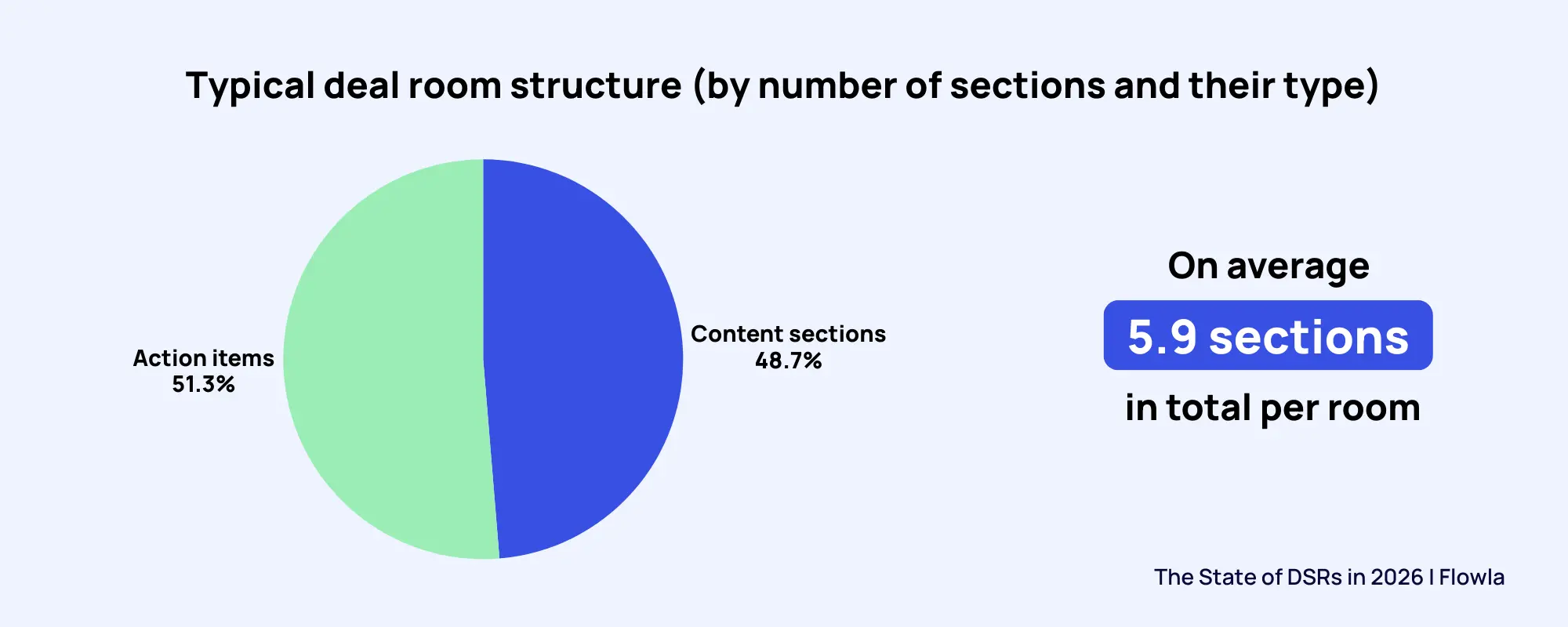
The implication is clear: Buyers return to rooms that give them something to return to. A single-page PDF dump doesn't warrant 18 visits. A well-structured room that evolves with the deal does.
Don't optimize for simplicity at the expense of substance. Build rooms with enough depth to support the full evaluation journey, from problem framing through validation, commercials, and close.
Pro tip: The biggest barrier to building deep, structured rooms is setup time. Flowla's instant demo follow-up workflow triggers automatically when a call ends in Gong or Fireflies, drafting a personalized follow-up email and pre-populating a branded room with content relevant to the buyer's pain points. Reps review and approve; the room arrives fully formed. 30 minutes saved per call, and no more half-built rooms sent in a rush after the demo.
Depth only holds up if someone is maintaining it. Every room needs a named owner at each stage of the deal. It’s typically the AE during sales and a CS lead during onboarding. Without ownership, even well-built rooms quietly degrade into content dumps. This is the root cause behind most ghost rooms.
Most underperforming rooms fail on structure before they fail on content. The instinct is to organize by asset type – decks, case studies, contracts – but buyers don't think in file formats. They think in decisions.
A proven structure mirrors how buyers actually evaluate and commit:
This layout creates a narrative arc. Instead of simply consuming content, buyers progress through it. When structure is intentional, the room guides the decision rather than leaving buyers to self-orient.
We looked at which asset types drive the most engagement time across all rooms analyzed. Text-based content came first (220,273 seconds), video second (197,845 seconds), and slides third (197,801 seconds) – all by a significant margin over documents and embedded links.
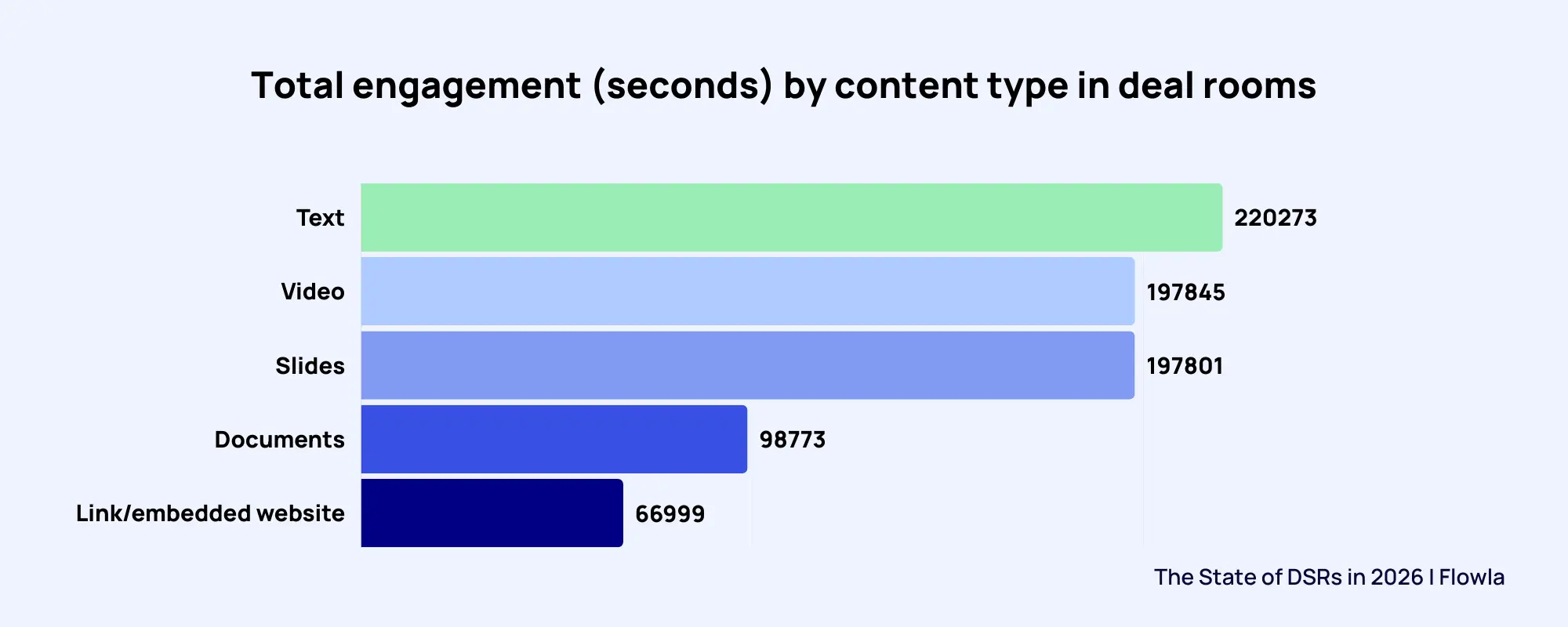
Surprisingly, one of the least-used asset types turned out to be interactive demos, appearing in just 2.9% of the rooms analyzed. This runs counter to the instinct to wow buyers with sophisticated interactive experiences. What the data shows is that buyers engage most with formats they already know how to use. Text they can skim. Video they can watch async. Slides they can share internally.
One more pattern worth noting: Slides rank fifth in usage frequency but third in total engagement time. Buyers who encounter slides spend disproportionately more time with them than their prevalence suggests making them one of the highest-value formats when used deliberately.
The takeaway: Build rooms around familiar, accessible, engaging formats. Save the interactive walk-through or something as complex for the live call where you can walk through it together (or share it as a link, not an embedded demo).
The top stakeholder titles engaging with deal rooms in our dataset: CEO/Founder (1,084), Director-level (640), VP/Head of (530), Manager (520), C-Suite (480).
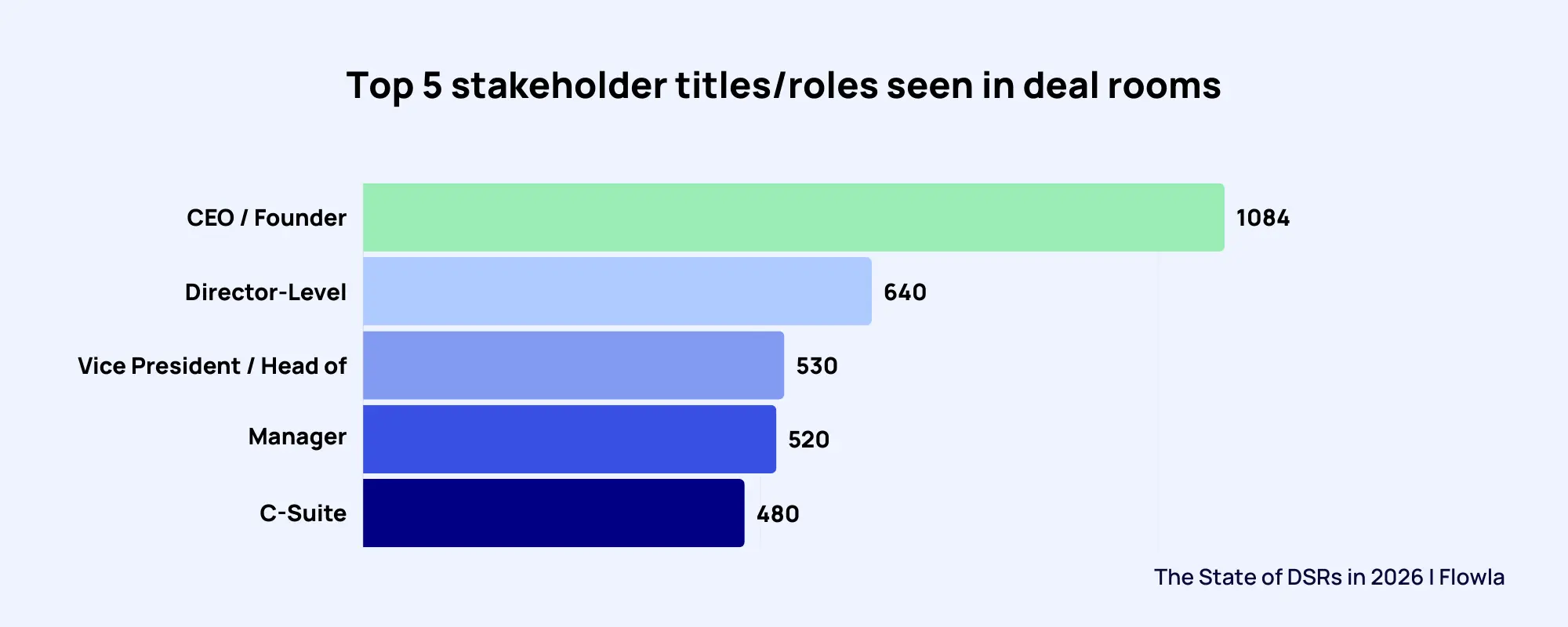
Decision-makers are in these rooms, often without the rep present. That means the room has to do the selling when you're not there to guide it.
Start every room with an executive-ready intro: A short face-to-camera welcome video that sets context and a pinned executive summary that reflects what you heard from the buyer, frames the business case in plain language, and focuses on outcomes rather than product features. This section is especially critical when new senior stakeholders join late – it brings them up to speed without requiring another call.
Pro tip: With platforms like Flowla, this summary can be auto-generated from discovery and demo call notes using AI blocks, keeping it current as the deal evolves.
The average room contains 18.9 action items – nearly as many as content pages. The most common action item type is "fill form" (56,998 rooms), followed by "go to URL" (18,565 rooms) and "book meeting" (11,571 rooms).
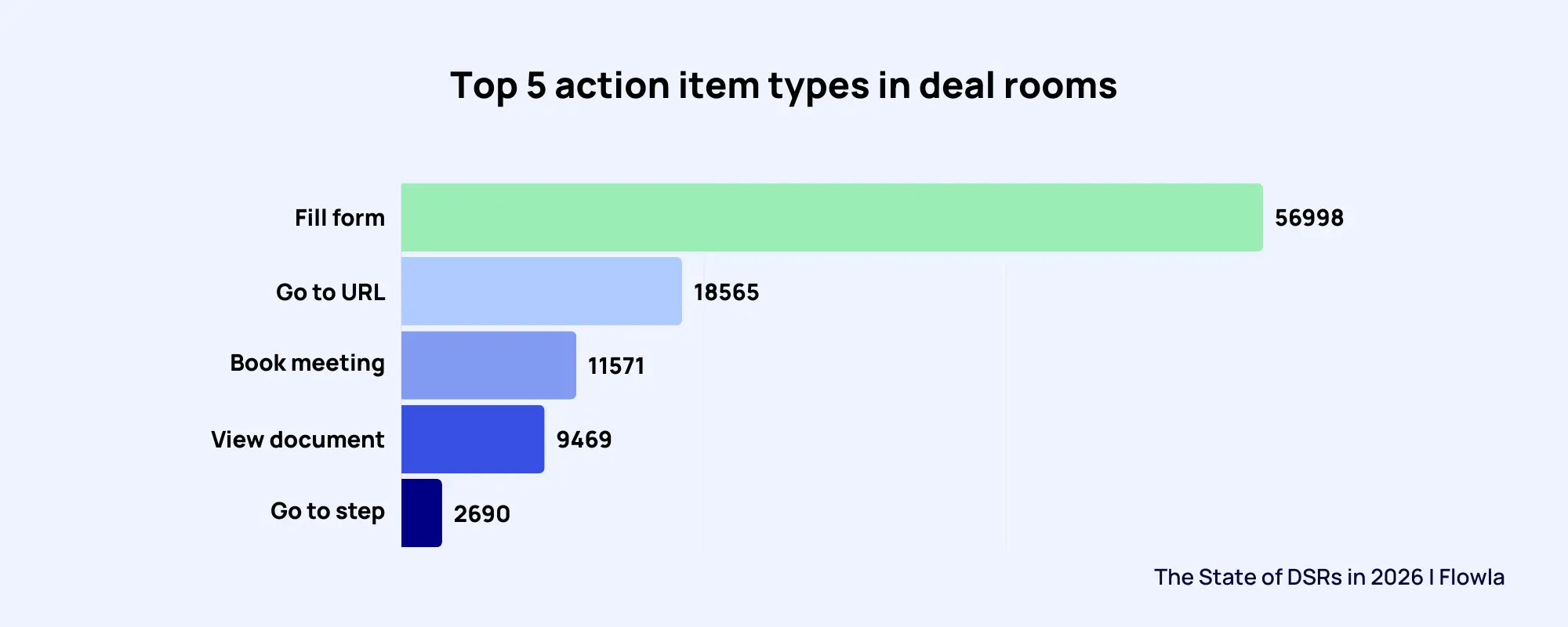
Rooms that close deals don't just inform, they direct. A static timeline gets ignored. An embedded mutual action plan with assigned owners, due dates, and buyer-facing tasks turns the room from a reading list into a shared project plan. When buyers have tasks assigned to them with notification reminders, they participate in advancing the deal rather than passively reviewing it.
The "book meeting" action appears in just 38.5% of the analyzed rooms – surprisingly low, and a signal worth sitting with: Buyers are using rooms primarily for async research and evaluation, not as a direct conversion mechanism. The room's job isn't to replace the sales call. It's to make the next one worth having.
Pro tip: Buyer tasks with deadlines don't have to rely on reps to chase completion. Flowla can trigger automated reminder emails when assigned actions haven't been completed by their due date, keeping buyers accountable without the rep having to manually nudge each stakeholder every few days.
The stakeholder list tells the story: CEOs, Directors, VPs, Managers, C-Suite, Finance, IT, HR, and Engineering all showing up in the same rooms. These are not people with the same questions, priorities, or risk tolerances.
When a single room tries to serve everyone equally, it ends up serving no one well. Champions either hesitate to forward it internally (too much noise) or the wrong stakeholders bounce because they can't find what's relevant to them.
The fix is simple: Label content tracks clearly by persona. "For Finance: ROI, Pricing & Commercials." "For IT: Architecture, Security & Compliance." This respects stakeholders' time, makes internal sharing easier for champions, and dramatically reduces the drop-off that happens when someone opens a room and can't immediately find why it matters to them.
Based on our data, the average deal room involves 2.9 stakeholders and 2.4 share actions per room – numbers that are almost perfectly correlated and almost certainly an undercount of who's actually involved in the buying decision. In complex B2B deals, the real buying committee is larger than what's visible to the seller. The problem is that internal sharing happens invisibly: Your champion forwards the room, but you never know who opened it.
Gating solves this. Keep most of the room open and accessible. But require an email entry form to access decision-critical assets – detailed pricing, security documentation, architecture diagrams. When your champion forwards the room internally, new stakeholders must identify themselves to access the most important content.
The result: You learn who's actually involved, which roles are reviewing which sections, and what matters most to each person. What was invisible becomes actionable.
Pro tip: Flowla's stakeholder multithreading workflow takes this further: When a new viewer accesses the room for the first time, it automatically sends a Slack alert to the rep with context about who just engaged, and drafts an intro email ready for review and send. Hidden stakeholders surface themselves, and the rep is ready to act within minutes.
Here's one of the more striking findings in the dataset: The average time between room creation and first view is 7 days.
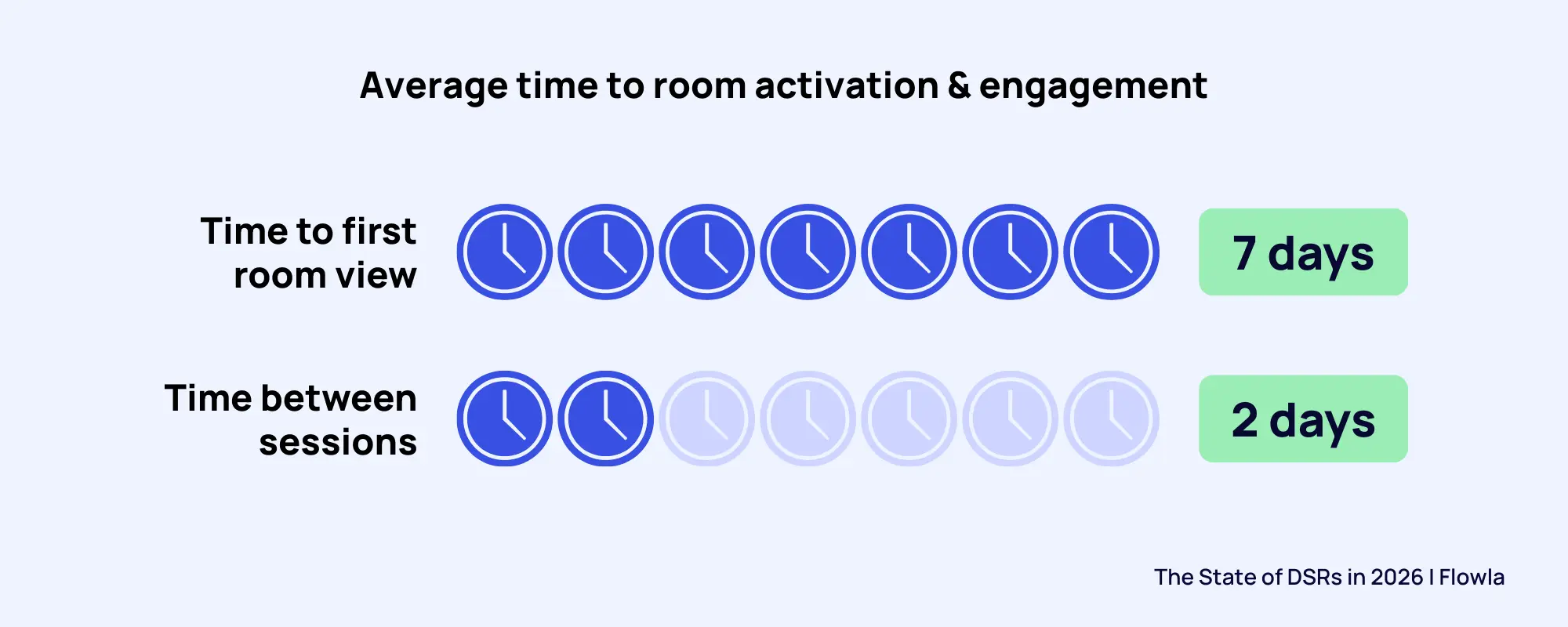
That's a week of dead air between the moment a rep builds a room and the moment a buyer actually opens it. In deal terms, that's a week of lost momentum, often right after a promising call when context is freshest and engagement is highest.
The gap is clearly a workflow problem. Rooms that get introduced at the right moment – during the call, with a specific reason to open them ("I've already added the security doc your CTO asked for") – get opened faster. Rooms that get sent as a generic follow-up link get opened a week later, if at all.
Introduce the room during the conversation, not after it. Give the buyer a specific reason to open it today, not eventually.
Pro tip: If the room hasn't been viewed within a set number of days after creation, Flowla's reengagement workflow triggers automatically, drafting a context-aware nudge referencing what's inside the room and queuing it for rep review. The gap closes without requiring reps to track open rates manually. Teams using this workflow report a 9% revive rate on rooms that would otherwise have gone quiet and save up to 40 minutes per follow-up.
9. Follow up on signals, not schedules
Buyers are active in rooms between calls. With an average of 18.8 sessions per room and a 2-day average cadence between visits, buyers are returning regularly, often without the seller knowing why.
The reps who convert that activity into momentum are the ones treating engagement signals as intent data. If a stakeholder revisits the pricing section three times in one day, that's clearly a buying signal. The wrong response is "just checking in." The right response is: "I added an ROI calculator to the pricing section to help you build the business case internally."
This is also a great automation opportunity. Flowla can draft context-aware follow-ups triggered by specific engagement signals, e.g., a stakeholder revisiting a section multiple times, a new contact opening the room, a proposal being viewed, etc. Reps stay in control of what gets sent; the system handles the detection and drafting. Signal-led follow-up at scale, without requiring reps to monitor dashboards manually.
Signal-led follow-up works even better when it's paired with a room refresh. After a discovery call, after a new stakeholder joins, after the deal moves to a new stage – each update gives you a natural reason to re-engage with new context, rather than chasing a buyer who has nothing new to look at.
Win rates often drop late in the process (even if there’s a clear match) because of uncertainty about what happens after the deal closes. Buyers who are close to committing can stall indefinitely on unspoken questions about implementation complexity, onboarding timelines, and team disruption.
A dedicated post-sale section inside the room removes that friction before it becomes an objection. Include a high-level implementation timeline, a short introduction video from the Customer Success Manager, and a "What to expect in the first 30 days" overview.
The psychological effect is significant: It shifts the conversation from "should we buy?" to "how will this work when we do?" It also signals continuity – that the experience doesn't reset at signature – which matters increasingly to buyers who've been burned by post-sale drop-offs before.
Pro tip: Flowla's Sales-to-CS handoff workflow triggers automatically when a deal moves to Closed Won in the CRM, generating a handoff summary from call notes and deal data, notifying the CS team in Slack, and creating a pre-populated onboarding room from a template. The post-sale section doesn't need to be built manually after the deal closes. It's ready before CS even picks up the account. Teams using this workflow report 25% fewer kickoff delays.
The story of the digital sales room so far is a story of good intentions running into execution reality. Teams adopted DSRs to replace email chaos, centralize content, and create a better buyer experience. The tools delivered on the first two. The third one – actually moving deals forward – has proved harder.
Most DSRs were built as destinations – a place to send buyers, a place to store content, a place to track who clicked what. The distinction sounds subtle but the implications are significant. A passive room waits. An active deal layer responds.
This is the architectural shift from content hub to playbook execution layer. The room stops being a place deals go to be reviewed. It becomes the system that keeps deals moving when no one is in the room.
This is the shift Flowla was built around – the DSR as the connective tissue between every signal, every touchpoint, and every next step across the deal cycle, not just a better-looking link to send after a demo.
DSRs as a category are at an inflection point. The market has grown. The tools have matured. AI has given every major platform something new to announce. But the fundamental question – what should a DSR actually be? – is still being answered differently by different vendors.
The teams that figure that out first will look back on 2026 as the year DSRs became genuine revenue infrastructure.
Ready to see what that looks like in practice? Explore Flowla or book a demo.
Get a 30-minute walk-through to see Flowla up close. We will contact you asap for a personalized session.
Book a demoBook a 15-minute chat with a product expert. We'll walk you through every step of the way as you get set up.
.webp)
.webp)
.webp)


.webp)

.webp)
.webp)
.webp)




.webp)
%20(3).webp)
.webp)
.webp)
.webp)

.webp)
.webp)
.webp)
.svg)

.webp)
.webp)