.webp)
You ran a great discovery call. You've built rapport, mapped the stakeholders, and your champion is genuinely excited. They tell you: "I just need to get a few people aligned internally, shouldn't take long."
Two weeks pass.
You follow up. They're "still working on it." The deal that felt like a sure thing is now stuck somewhere in a meeting you'll never be invited to, with a CFO asking questions you've already answered, or a procurement team that doesn't understand why this is urgent.
This is where most deals actually die. Not in your calls. In the ones you're not on.
The problem usually isn't that your champion isn't bought in. It's that they walk into that room without the right ammunition. They remember the product. They believe in it. But when someone asks "what's the ROI?" or "why now, not next quarter?" they're improvising. And improvised business cases don't close deals.
The good news: This is a solvable problem. A strong internal business case doesn't need to be a 20-slide deck or a detailed financial model. It needs to be something your champion can present confidently in 10 minutes – clear on the problem, sharp on the outcome, and easy to defend under pressure.
This post breaks down exactly what that looks like.
A business case your champion can present in 10 minutes isn't a shorter version of your sales deck. It's a different document entirely, one written for an internal audience that hasn't been on any of your calls, doesn't know your product, and has two or three other priorities competing for their attention in that meeting.
The good ones tend to follow a predictable structure. Not because business cases are formulaic, but because internal decision-makers – whether that's a CFO, a COO, or a procurement lead – are always asking the same questions. A strong business case answers them in the right order, before anyone has to ask.
Here's what that structure looks like in practice.
1. Executive summary
This is the paragraph that determines whether the rest of the document gets read. Its job is to demonstrate that you've been listening to your buyer’s needs and requirements. Open by naming the strategic initiative or business priority the company is already working toward, then position the purchase as the logical next step toward something they've already committed to.
A useful test: if you removed every mention of your product from this paragraph, would it still read like an accurate description of their business situation? If yes, you've got it right.
2. The before/after comparison
This is the most persuasive element in the whole document and the easiest to get wrong. The goal here is to describe the current state of things (problems or struggles the buyer is facing) so accurately that everyone in the room nods. When your champion's colleagues see their own daily frustrations reflected back at them, the case for change makes itself.
Structure each row around a specific workflow area – sales, handoffs, onboarding, oversight – and map the current pain to a concrete operational outcome, not a feature. The after column should answer "what actually changes for us?" not "what does the product do?"
3. Implementation steps
This is the section most business cases skip and the one that often decides whether a cautious stakeholder votes yes or abstains. Decision-makers want to know the operational cost of saying yes, not just the financial one. How long will this take? Who needs to be involved? What changes on day one versus month three?
Keep it short and milestone-based rather than exhaustive. Three to four phases with clear owners and timeframes is enough to signal that this has been thought through, without overwhelming the room. The goal is to make "yes" feel manageable, not daunting.
4. Investment options
Presenting a single price point forces a yes/no conversation. Presenting two clearly scoped options shifts the internal discussion to "which one fits us right now" which is a much easier conversation for your champion to facilitate.
Each option should have a defined scope, a named user set, and a stated goal. Be direct about cost – champions who dance around pricing lose credibility fast. And if there's a reason to move quickly, say so explicitly rather than leaving your champion to manufacture urgency on your behalf.
4. ROI analysis
Vague ROI claims ("significant efficiency gains," "improved productivity") do more harm than good. They signal that the numbers haven't been thought through. The standard to aim for is three to five concrete metrics, each tied to a specific mechanism and expressed as a business consequence, not just a percentage.
Time saved matters more when you connect it to what that time gets redirected toward. Faster onboarding matters more when you frame it as churn protection. The number is the headline; the consequence is what makes it stick.
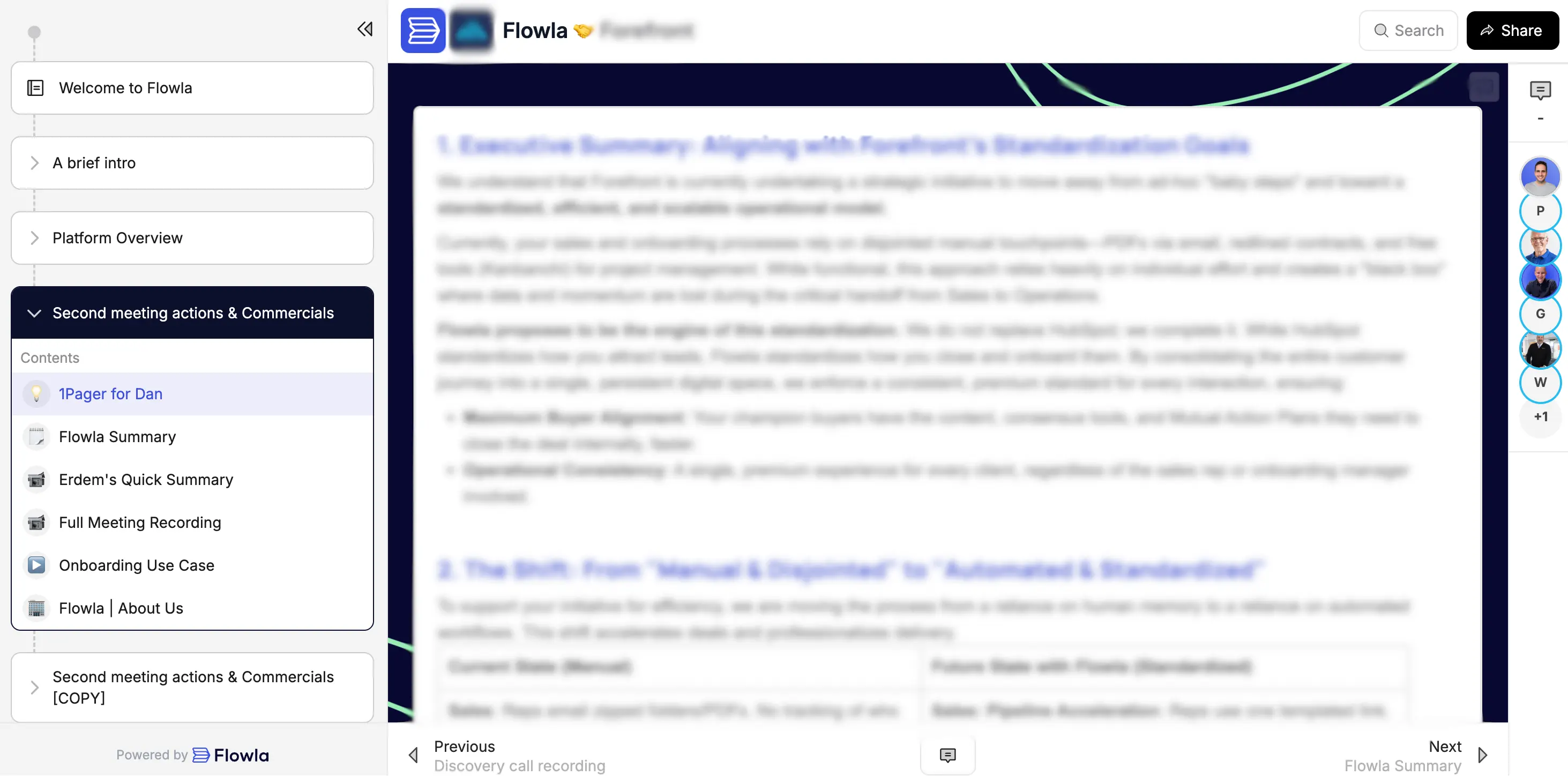
Below is a real business case generated for a sales deal, anonymized for use as a template. The company in question – a growing services business – was in the middle of a standardization initiative and evaluating whether a dedicated deal execution tool was worth the investment alongside their existing CRM.
Use it as a starting point. The structure is transferable; the specifics should always be yours.
1. Executive Summary
We understand that [Company] is currently undertaking a strategic initiative to [describe their core business goal — e.g.,"standardize their sales and onboarding processes" / "scale operations without adding headcount" / "reduce time-to-revenue across the team"].
Currently, [describe the current situation in their words — e.g.,"your sales and onboarding processes rely on disjointed manual touchpoints, creating a black box where data and momentum are lost during critical handoffs"]. While functional, this approach [describe the core limitation — e.g.,"relies heavily on individual effort and doesn't scale"].
[Your solution] proposes to [describe the role it plays in their strategy — e.g.,"be the engine of this standardization"]. We do not replace [existing tool]; we complete it. While [existing tool] handles [its core job], [your solution] handles [your core job] — ensuring [the outcome they care about].
3. Implementation Steps
4. Investment Options
Option A: [Name — e.g.,"The Focused Pilot"]
Option B: [Name — e.g., "The Full Rollout"]
5. ROI Analysis
Everything in the previous section assumes one thing: That someone has done the work of pulling the deal together – the discovery notes, the agreed pain points, the ROI numbers, the stakeholder map – and translated it into a coherent, compelling document.
In most deals, that someone is the AE. And it usually happens at the worst possible time: late in the process, under time pressure, when the champion says "I need something I can take to my CFO by Thursday."
This is where Flowla's AI changes the dynamic entirely.
Flowla's deal rooms capture the entire customer journey in one place – every interaction, every piece of content shared, every stakeholder who's entered the room, every signal of engagement or hesitation. When your champion needs a business case, the raw material is already there. Flowla's AI agent pulls from that – along with your call recordings from Gong, Fireflies, or Fathom, and your CRM data from HubSpot, Salesforce, or Attio – and generates a first draft automatically.
Not a generic template with blanks to fill in. A business case that reflects the actual deal: the prospect's strategic priorities in their own language, the specific pain points surfaced in discovery, the ROI framing that resonated in your calls, the objections that were already addressed.
The result is a document your champion can walk into any internal meeting with, one that sounds like it came from inside the company, not from a vendor trying to close a quarter.
For sales teams using Flowla, this translates to 3–5 hours saved per rep per week on deal admin, and a 15% increase in deal velocity. The business case that used to take an afternoon now takes minutes and it's better, because it's built from the full context of the deal rather than whatever the AE can remember on a Friday afternoon.
The best part: your champion doesn't have to ask for it. By the time the internal conversation comes up, it's already ready.
Winning a deal isn't just about the conversations you're in. It's about how well you prepare your champion for the ones you're not.
A strong internal business case does more than justify a purchase – it gives your champion a narrative they can own. One that connects the decision to something the business already cares about, makes the current pain feel undeniable, and answers the hard questions before anyone has to ask them. When those five building blocks are in place – a sharp executive summary, an honest before/after comparison, a credible implementation plan, transparent investment options, and ROI that actually sticks – your champion walks in prepared, not improvising.
That's the difference between a deal that closes and one that goes quiet for two weeks and never comes back.
The template in this post gives you a starting point. But the deals that move fastest are the ones where the business case is built from the real context of the conversation – the actual pain points, the specific language, the objections already addressed. That's what Flowla's AI does: it takes everything captured across your deal room and call recordings and turns it into a business case your champion can use immediately, without the AE spending an afternoon pulling it together.
If you want to see what that looks like in practice, book a demo and we'll show you a live example from a real deal.
See Flowla up close. An expert will contact you immediately for a personalized session.
Book a 30-minute demoBook a 15-minute chat with a product expert. We'll walk you through every step of the way as you get set up.
.webp)
.webp)
.webp)


.webp)

.webp)
.webp)
.webp)




.webp)
%20(3).webp)
.webp)
.webp)

.webp)
.webp)
.webp)
.webp)
.svg)

.webp)
.webp)