Your sales team probably has an AI problem.
The notes get summarised, the follow-up gets drafted, the account context gets pulled. The output is genuinely useful. Better than what the rep would have written in the same ten minutes. Then the rep copies it, pastes it into an email, attaches a PDF, and sends it to the buyer.
The AI did its job. The rep became the messenger anyway.
According to Salesforce's State of Sales report, reps spend only 28-30% of their week on actual selling. The rest disappears into admin, tool-switching, and manually transferring output from one place to another. That number has not meaningfully moved in years, despite the investment in AI tools.
Most AI lives inside your tools. The output it produces still has to be carried across to the buyer by a human, and until that changes, the rep is always the bottleneck. MCP is what changes it.
If you have been seeing MCP everywhere lately and quietly skipping past it, you are not alone. It sounds technical. But the idea behind it is straightforward, and it matters for anyone running a sales or CS team in 2026.
MCP stands for Model Context Protocol. Anthropic introduced it in November 2024 as an open standard, and since then OpenAI, Google DeepMind, and most major AI platforms have adopted it. It is now maintained openly under the Linux Foundation, which means no single company owns it. It is infrastructure, not a feature.
AI models like Claude are genuinely powerful inside a conversation. They can reason, summarise, draft, and advise. But until recently, that is where their usefulness stopped. Claude could tell you what to do. It could not do it. It had no way to reach into your CRM, check what happened in your deal room last week, update a mutual action plan, or send a live link to a buyer. Every action still required a human to carry the output from the AI to the tool that would act on it.
The reason was fragmentation. Every AI model and every external tool had its own way of connecting. Building a bridge between Claude and your deal room platform required custom engineering work on both sides. So the AI stayed in one box, the tools stayed in another, and humans lived permanently in the gap between them.
MCP closes that gap. Think of it the way most people think of USB-C. Before USB-C, every device had its own proprietary connector. Your phone charger did not fit your laptop. Your laptop cable did not fit your monitor. The hardware was fine. The connectors were the problem. USB-C replaced all of that with one universal standard. One cable works everywhere.
MCP does the same thing for AI and software. It is a single, universal standard for how AI agents connect to external tools. Instead of building a custom connector for every combination of AI model and SaaS platform, you build one MCP server per tool and it works with any MCP-compatible AI client: Claude, ChatGPT, Gemini, Cursor, all of them.
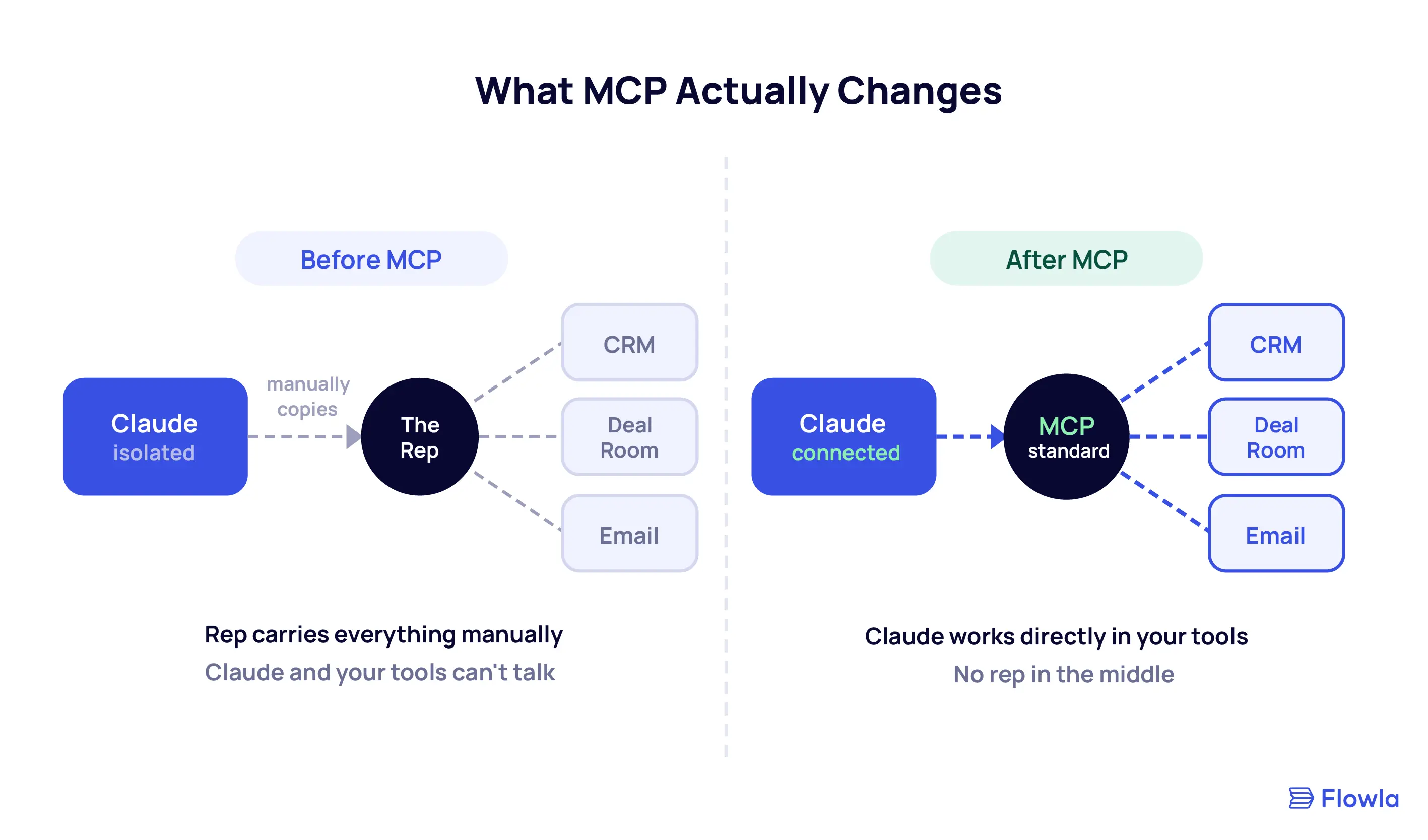
When Flowla builds an MCP server and Claude supports MCP (which it does), your rep can ask Claude to do things inside Flowla without opening Flowla. Check who viewed the deal room. Create a new room for an account. Pull a specific case study. Update the mutual action plan. Claude reaches into Flowla, does the thing, and the rep never leaves their AI.
That is the shift. From AI that advises to AI that acts. From a rep who carries output between tools to a rep who stays in one place and directs.
MCP adoption went from niche to near-universal in about eighteen months. By early 2025, major developer tools like Cursor, Replit, and Sourcegraph were supporting it. By 2026, it had become the default way serious AI products connect to the outside world. The pace of adoption matters because it means your buyers, your competitors, and your own reps are all going to be working inside AI-connected workflows whether or not you build for it. The question is whether your tools show up inside that workflow or stay invisible to it.
A deal room with no MCP is a deal room that Claude cannot see, cannot act on, and cannot recommend. For a rep living inside their AI, that is roughly equivalent to not existing.
Here is what the current reality looks like for most sales teams running AI tools.
The rep finishes a discovery call. Claude summarises it, flags the key risks, drafts a follow-up email, recommends the right case study for this specific prospect. The output is good. Better than what the rep would have written in the same ten minutes. Then the rep reads it, reformats parts of it, copies the relevant bits, pastes them into an email, and attaches a PDF proposal they built last week.
The buyer receives the email on Tuesday afternoon. There is a PDF attachment. Maybe they open it. Maybe they forward it to two colleagues who were not on the call. Maybe they open it again on Thursday. The rep has no idea. The AI has no idea. Nobody has any idea, because a PDF in an email does not tell you anything about what happens after you hit send.
This is the gap. Your AI is getting smarter, but your buyer's experience is not keeping up.
73% of B2B buyers actively avoid suppliers who send irrelevant outreach (Gartner, 2025). And 69% report frustration from inconsistencies between what sellers say and what is on the vendor's website. A PDF the rep manually assembled from AI output is a consistency risk the moment it leaves their hands. It cannot be updated. It cannot be tracked. If pricing changes, if a new case study lands, if the rep learns something new about the account: none of it reaches the buyer unless someone sends another email with another attachment.
Meanwhile, 51% of buyers say the content they receive from sellers is too generic and irrelevant to their needs (Demand Gen Report, 2024). That number was 38% the year before. It is getting worse, not better, precisely because AI has made it easier to produce more content without making it easier to deliver the right content to the right person at the right moment.
The buyers who feel that most acutely are increasingly the ones making the decisions. Millennials and Gen Z now make up 71% of all B2B buyers (Shopify/Forrester, 2025), a generation that grew up expecting Netflix-level personalisation and Amazon-level immediacy. A generic PDF sent 48 hours after a call is not meeting that bar.
A B2B buying decision rarely happens in a single conversation. It happens between meetings, inside the buying committee, when the rep is not in the room. 40% of B2B buyers will frequently share vendor content with fellow decision-makers (Mixology Digital). That means the materials your rep sends circulate further than the rep ever sees. A static PDF circulates as a frozen snapshot. A live deal room circulates as something the whole committee can navigate, question, and return to.
A deal room can be updated after it is sent. It shows the buyer exactly what the seller has prepared for them. It tracks who viewed what and when, so the rep knows which stakeholders are engaged and which sections are getting attention. It gives the buying committee a shared place to work rather than a scattered thread of email attachments.
But here is the problem. Building and sending a deal room takes time a rep does not always have. It means opening another tool, building the room from scratch or from a template, finding the right content, personalising the intro, copying the link, and going back to their email to send it. The AI finished its job ten minutes ago, but the rep is still doing admin.
So most reps send the PDF, because the friction is real.
MCP removes the friction entirely.
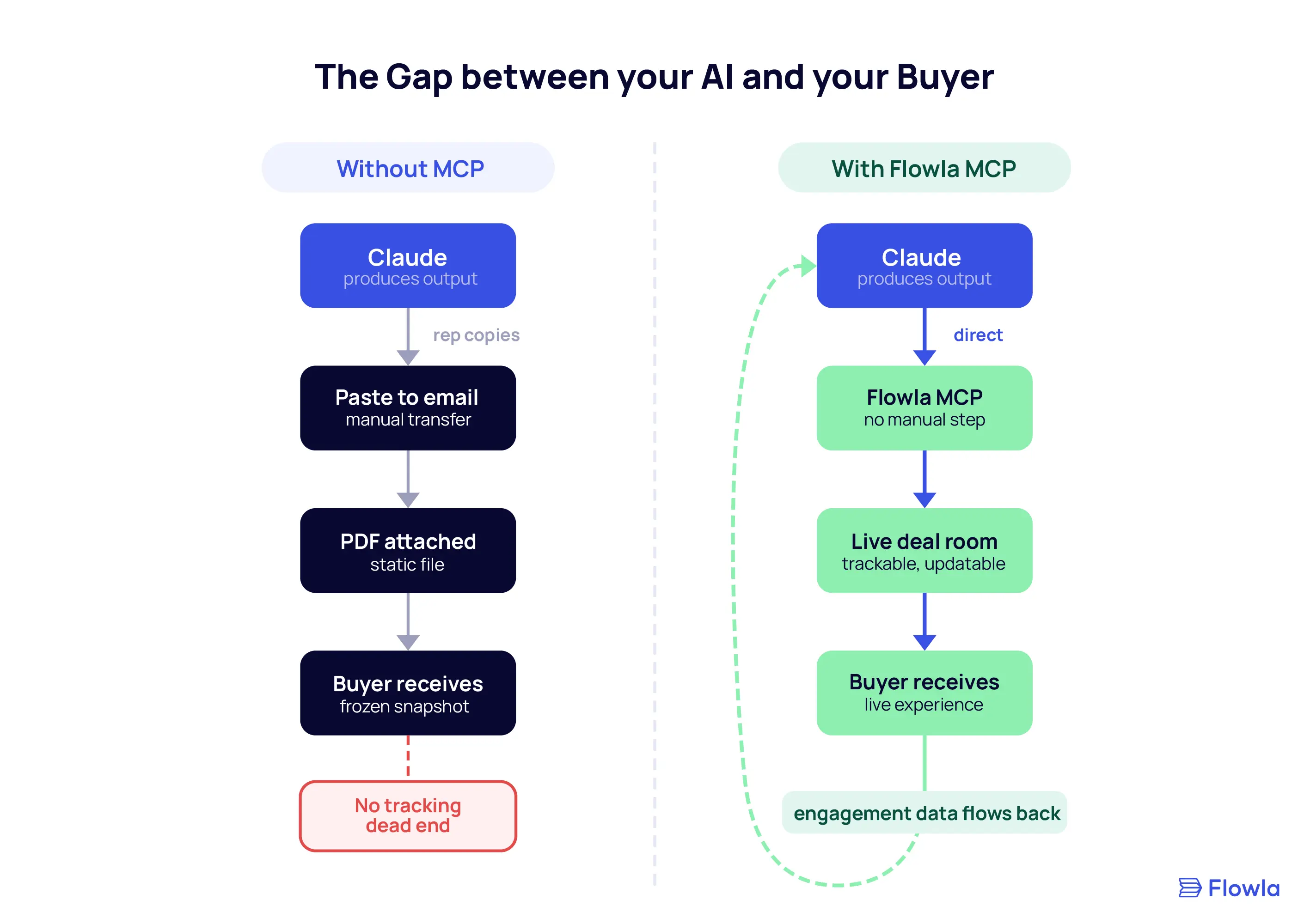
When Flowla is connected to Claude via MCP, the rep does not leave their AI to send a live room. They ask Claude to do it. Claude builds the room, pulls the relevant content, and the buyer receives something trackable and live rather than a static file. The AI's output goes directly to the buyer-facing tool without a human carrying it across.
The gap closes. The rep stops being the bridge between what the AI knows and what the buyer sees. And the buyer gets an experience that actually reflects the conversation they just had, not a generic document that could have been sent to anyone.
Buyers are sharing vendor content further than sellers realise, getting more frustrated with generic materials, and making decisions in rooms the rep never enters. A live deal room is built for exactly that reality. A PDF is not. MCP is what makes sending the room as frictionless as sending the attachment.
The rep-as-messenger problem does not live in one moment. It runs the full length of the customer relationship: from the first follow-up after a discovery call to a renewal conversation eighteen months later. Here is what changes at each stage when the deal room is connected to your AI.
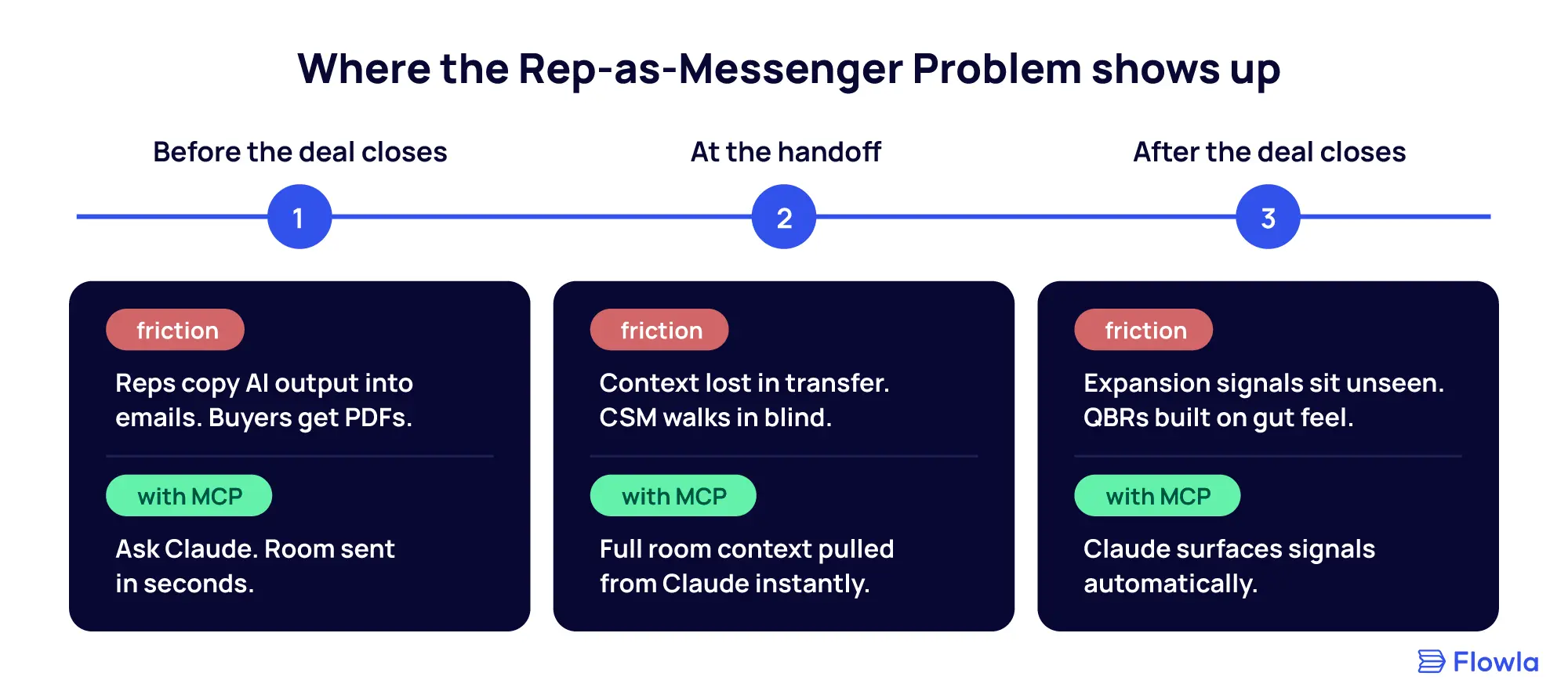
This is where most of the friction is visible. Reps are context-switching constantly between their AI, their CRM, their content library, their email client, and their deal room. The buyer is on the receiving end of whatever makes it through that gauntlet.
A rep finishes a call on Tuesday. By Wednesday morning they have five other calls, a pipeline review, and three deals that need proposals. The follow-up for Tuesday's call gets drafted in Claude, looks good, and then sits while the rep builds a deal room in a separate tab, searches for the right case study, realises the one they want is buried three folders deep, settles for a slightly less relevant one, copies the link, pastes it into the email, and finally sends it Wednesday afternoon.
The buyer, who was genuinely interested on Tuesday, has already had seventeen other interactions since then.
With Flowla MCP: The rep asks Claude to create a room for the account straight after the call. Claude builds it, pulls the most relevant case study based on what was discussed, and the rep sends a live, personalised room within minutes without opening a single additional tab. Speed matters here. Research consistently shows that response time after a sales interaction is one of the strongest predictors of conversion.
Pro tip: Ask Claude to pull the call summary and use it to personalise the room intro automatically. The buyer receives something that reflects the specific conversation they just had, not a generic template.
One of the most frustrating moments in a sales cycle is not knowing whether a deal is actually dead or just slow. The rep sends materials, but nothing comes back. They do not know if the champion is internally selling on their behalf, if the legal team is reviewing the contract, or if the opportunity has simply gone cold.
Most reps handle this by sending a check-in email based on gut feel. Some do not follow up at all because they cannot justify the interruption without knowing whether it is warranted.
With Flowla MCP: The rep asks Claude: "Did anyone view the ROI calculator in the Acme room?"
Claude: "Yes. Your CFO opened it Monday at 2pm and spent twelve minutes on it."
This becomes a targeted, timely follow-up with full context. The rep knows exactly who engaged, with what, and when. The message they send is relevant because it is based on what actually happened, not a hunch.
Pro tip: Set a regular cadence of asking Claude for engagement updates across your active deal rooms. Think of it as a pipeline review that happens inside your AI rather than in a spreadsheet.
B2B buying committees have grown significantly. More stakeholders means more people who need different content, different levels of context, and different reasons to say yes. Reps who try to manage this manually end up either sending the same generic materials to everyone or spending hours building bespoke emails for each stakeholder. Neither scales.
With Flowla MCP: The rep asks Claude: "Do we have an enterprise security case study I can add to the Acme room for their IT lead?"
Claude finds it. "Here it is. Want me to add it to the room and create a separate section for the IT team?"
The right content reaches the right stakeholder without the rep rebuilding the room from scratch. The buying committee gets a room that feels tailored to them, while the rep does not spend their afternoon on document management.
The moment a deal closes should feel like a beginning. Too often it feels like a reset: for the rep, the CS team, and especially for the customer.
The AE sends a Slack message to their CS counterpart: "Great news, Acme just signed. I'll send you a summary." The summary arrives two days later as a bullet-pointed email written from memory. It covers the headline use case and the main contact. It misses the three concerns the legal team raised, the specific integration the champion cared most about, and the mutual action plan the rep and buyer had been working from for six weeks.
The CSM goes into the first onboarding call having read the email. The customer, expecting continuity, has to repeat half of what they already told the AE. Their first impression of the post-sale experience is starting over.
Over four-fifths of buyers feel let down by their providers at some point in the relationship (Sopro, 2026). The handoff is one of the most common places that disappointment begins.
With Flowla MCP: Before the first onboarding call, the CSM asks Claude: "What's the full context on the Acme account?"
Claude pulls the deal room. It surfaces everything: what the buying committee engaged with, which sections got the most attention, what the mutual action plan looked like, which concerns came up during the legal review. The CSM walks into the call with the same level of context the AE had on their best day.
The customer does not have to repeat themselves, so the relationship starts with continuity rather than a reset.
Pro tip: Make it standard practice for CSMs to pull the deal room summary from Claude before every handoff call. It takes thirty seconds and it changes the entire tone of the first conversation.
The gap between internal AI and buyer experience does not disappear once the contract is signed. For CS teams, it shows up differently: in missed expansion signals, QBRs built on incomplete data, and customers who churn quietly because no one spotted the early signs.
The handoff went fine: the CSM has the context, and now comes the actual work.
Most onboarding programmes run on a combination of spreadsheets, Slack threads, and weekly status emails. The CSM builds a success plan manually, usually from a generic template, then spends the next eight weeks chasing the customer for updates, logging blockers in a doc nobody reads, and sending "just checking in" emails to keep the project moving.
The customer, meanwhile, has no clear view of where things stand unless the CSM explicitly tells them. Which the CSM does, via another email, because the alternative is a phone call they do not have time for.
It is a lot of coordination overhead for what should be a straightforward process: here is what we agreed to, here is where we are, here is what needs to happen next.
With Flowla MCP: The CSM asks Claude: "Based on the Acme deal room, draft a success plan with the goals they mentioned, the integrations they flagged, and a 90-day onboarding timeline."
Claude builds it from the actual deal context. The CSM has a draft in minutes rather than starting from a blank template. From there, they ask Claude to build an onboarding room the customer can actually navigate: milestones visible, blockers flagged, next steps clear.
As the onboarding progresses, the CSM updates the room from inside Claude rather than sending a status email. The customer opens the room and sees exactly where things stand. The CSM spends less time on coordination and more time on the conversations that actually move things forward.
Pro tip: Structure the onboarding room around milestones, instead of just content. Each milestone the customer hits gets marked as complete in the room. It gives both sides a shared picture of progress without anyone having to ask for a status update.
Quarterly business reviews should be built around what the customer actually cares about. In practice, most QBR prep involves a CSM spending a Wednesday afternoon pulling data from several different places: room engagement from Flowla, usage stats from the product, notes from the last call, CRM updates from the AE. They stitch it together into a slide deck that is already partially outdated by the time they present it.
With Flowla MCP: The CSM asks Claude: "What has the Acme team been engaging with in their room over the last 90 days, and what sections have they come back to most?"
Claude surfaces the engagement data. The CSM has the foundation for a genuinely customer-specific QBR agenda in minutes. The meeting reflects what the customer has actually been doing, instead of what the CSM assumes they care about.
Pro tip: Cross-reference room engagement data with product usage data before every QBR. The combination tells a much richer story than either source alone. Claude can hold both in context if your product analytics tool also has an MCP.
Expansion revenue is often sitting in plain sight, invisible to the team that should be acting on it. A customer's champion starts sharing the onboarding room with colleagues from departments the CSM has never spoken to. Three people from the finance team start viewing the pricing section. A new stakeholder from a different business unit opens the room for the first time.
These are buying signals, already sitting in the deal room. Most CS teams miss them because nobody is checking the room analytics regularly enough, and there is no system to surface the signals proactively. Our State of Digital Sales Rooms research found this is one of the most common missed opportunities across revenue teams.
With Flowla MCP: Claude flags it, or the CSM asks: "Who has been active in Acme's room this month that we have not spoken to before?"
Claude: "Three contacts from the finance team have viewed the pricing section in the last two weeks. None of them are in your CRM."
The CSM builds a targeted room for those stakeholders from inside Claude. The expansion conversation starts while the interest is live, not three weeks later when someone finally spots the analytics.
Pro tip: Treat unexpected room activity from new stakeholders as a warm signal, not a cold outreach situation. They have already found you, the job is to meet them where they are.
Individual reps saving ten minutes per deal is a real benefit but it is not the argument that should matter to a sales leader. The argument that matters is this: your team is currently making decisions based on incomplete, manually assembled, partially outdated information. Which deals to prioritise. When to follow up. Which accounts are at risk. Whether this quarter's forecast is real.
All of that gets answered by instinct, habit, and whatever the rep chose to log in the CRM after their last call. And CRMs, as any honest sales leader knows, only reflect what reps enter, not what buyers actually do.
Most sales organisations struggle to achieve forecast accuracy above 75%, a gap that has not meaningfully closed despite years of investment in revenue intelligence tools, because most of those tools still depend on reps self-reporting. When your deal room is connected to Claude via MCP, buyer behaviour flows into your AI's context automatically. The data gap narrows because the system is capturing more.
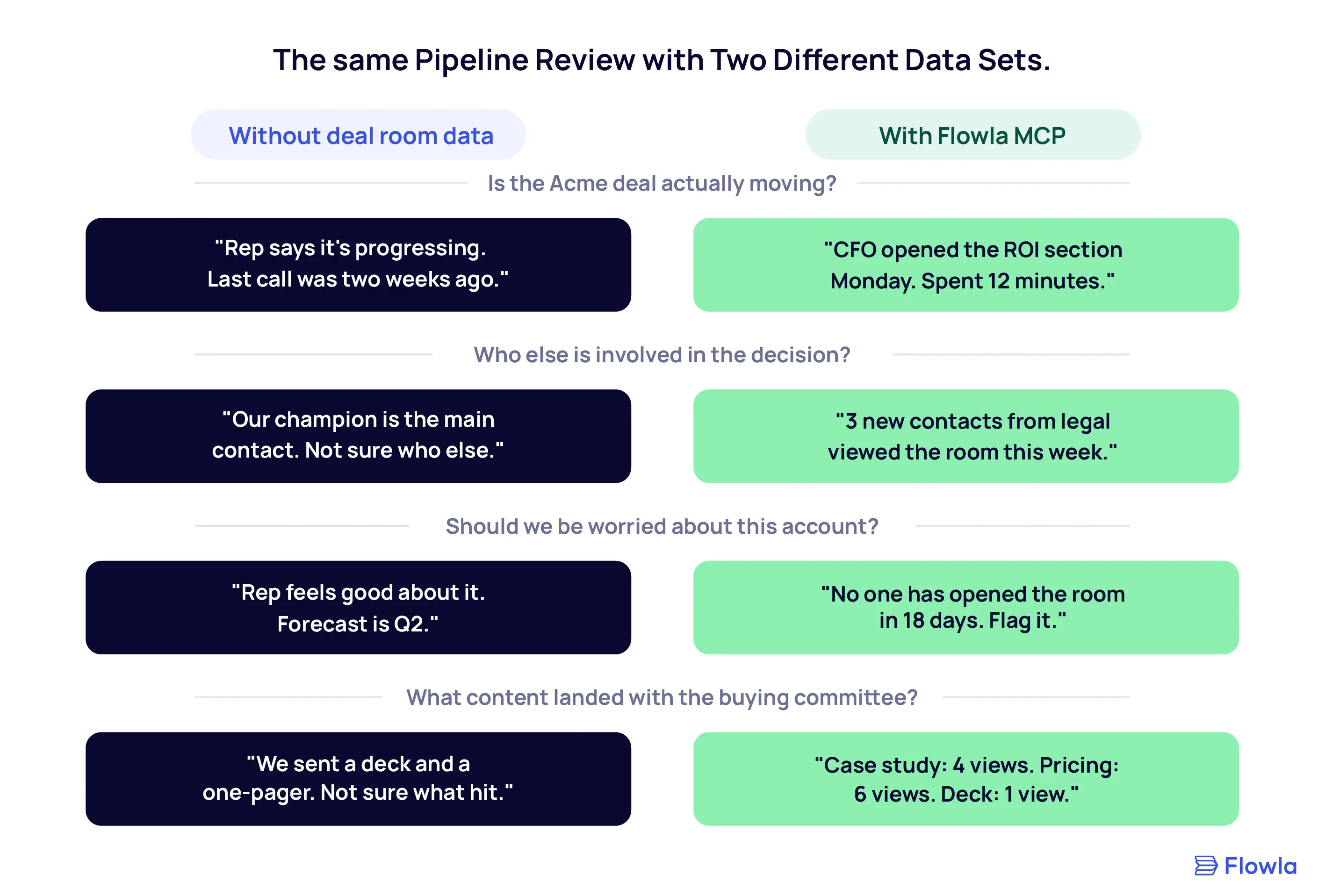
The gap between what your CRM says and what is actually happening in your deals is, for most teams, enormous. Buying groups now include 5 to 16 people across four different functions (Gartner, 2025), yet most reps are single-threaded through a single champion. The deal room is where the rest of that committee shows up: reviewing content, sharing materials internally, revisiting the business case. If your leaders cannot see that activity, they are forecasting blind. For a deeper look at how GTM teams are building systems around this, see our post on GTM engineering.
When your deal room is connected to Claude, deal room engagement becomes part of the information your team works with daily, not something someone has to remember to pull. A rep asking Claude about a deal gets back not just CRM notes but real buyer behaviour: who viewed what, when they came back, which stakeholders have gone quiet. A manager running a pipeline review can ask Claude for an account summary that includes actual buyer engagement, rather than just stage and close date.
Pro tip: Use deal room engagement data as a leading indicator in your pipeline reviews. A deal where the CFO has been active in the room three times this week is a different conversation than a deal where nobody has opened the room in fourteen days, regardless of what stage it is sitting in the CRM.
New reps are expensive to onboard and slow to reach full productivity. A significant part of that slowness is tribal knowledge: the context that lives in the heads of experienced reps and gets transferred informally, incompletely, or not at all. Which case studies work for which industries. What objections come up at which stage. How a specific account relationship developed over time. It is one of the core challenges covered in our guide to scaling your sales processes.
AI cuts new rep ramp time from most of a year to a few months when it is genuinely embedded in the workflow (Monday.com, 2026). The key phrase is genuinely embedded. An AI tool that a new rep has to remember to open separately is not embedded. An AI that a new rep asks questions inside their daily workflow, and that can pull context from deal rooms, past account history, and content libraries, is.
When your deal room is connected to Claude, a new rep can ask Claude for context on any account, any deal, any customer, without needing a handover meeting or a knowledge transfer document. The room holds the history. The AI surfaces it on demand.
Pro tip: Make pulling deal room context from Claude a standard part of your onboarding process for new reps. It is faster than shadow calls and more complete than a briefing doc.
Forecast accuracy is one of the metrics sales leaders care most about and have historically had the least reliable data for. The reason is structural: most forecasting tools aggregate what reps report, and reps report what they believe, which is based on the last conversation they had rather than on a complete picture of deal health.
Buyer engagement data changes this. A deal where the legal team has been active in the room for the past week is moving, regardless of what the rep said in the last forecast call. A deal where no stakeholder has opened the room in three weeks is at risk, regardless of how confident the rep sounds.
Teams coached weekly achieve 76% quota attainment versus 56% for monthly coaching (MySalesCoach, 2026). The reason, as MySalesCoach points out, is not the coaching itself but the cadence of looking at real data and acting on it before things go wrong. Deal room engagement data gives managers something real to anchor those conversations to, rather than whatever the rep feels confident enough to say on a forecast call.
Pro tip: Add deal room engagement as a standing item in your weekly pipeline review. Ask reps not just what stage a deal is in, but who has been active in the room this week and what they were looking at. The answers will change which deals you spend time on.
The same visibility gap that costs deals during the sales cycle costs revenue after the contract is signed. CS teams are managing large books of business with limited time to proactively monitor every account. The signals that predict churn: engagement dropping off, key stakeholders going quiet, renewal conversations not starting early enough. They are sitting in your deal rooms, but most teams miss them.
The signals that predict expansion are there too. New stakeholders showing up in the room uninvited. The pricing section getting revisited six months into a contract. A champion sharing the room with someone from a new department.
With MCP, a CS leader can ask Claude for a summary of accounts where engagement has dropped significantly in the last thirty days. That is a churn risk list that did not require anyone to build a report. They can ask which accounts have had new stakeholders engaging with pricing content recently. That is an expansion pipeline that nobody had to manually identify.
The data has always been there. What was missing was a way to surface it without someone having to go looking.
The infrastructure described in this post is not theoretical. It is live today.
Flowla launched its MCP this week, making it one of the first digital sales room platforms to ship a working MCP integration. Your reps and CSMs can connect Claude to their Flowla rooms today and start working the way the scenarios above describe: inside their AI, with the deal room right there alongside them.
The timing matters. MCP adoption across the sales technology category is still early. Most platforms are aware of the standard but have not built for it yet. Teams that connect their deal rooms to their AI now are doing more than saving time on individual tasks. They are building a workflow that compounds as more of their stack becomes MCP-connected.
Here is what you can do with Flowla MCP today:
The rep-as-messenger model had a good run. The infrastructure to replace it is here.
Ready to connect Flowla to Claude? Setup takes a few minutes. Read the getting started guide.
MCP (Model Context Protocol) is an open standard that lets AI agents like Claude connect to external tools and take action inside them. Anthropic introduced it in November 2024 and it is now supported by every major AI platform including OpenAI and Google DeepMind. For sales teams, it means your AI can read deal room data, create rooms, pull content, and check buyer engagement, all without the rep switching tabs or copying output manually. It turns Claude from an advisor into an executor.
Most sales AI produces output inside your team's tools. A rep still has to translate that output, reformat it, and send it to the buyer, usually as a static PDF or email. By the time it reaches the buyer, it has lost its tracking, its update capability, and its connection to what the AI originally produced. MCP closes that gap by letting Claude act directly on buyer-facing tools like Flowla, without a human carrying the output across.
A deal room is a live, shared workspace between a seller and a buying team. Unlike a PDF, it can be updated at any time, tracks who viewed which sections, and shows how content is being shared across the buying committee. A PDF is a snapshot. A deal room is a conversation that continues after the call ends. You can read more about how to build a sales presentation that leads naturally into a room.
Yes. AEs use it to create rooms, pull content, and track buyer engagement during the deal. CSMs use it to pick up context at handoff, prep for QBRs, and spot expansion signals post-sale. The MCP connects Claude to Flowla across the full customer journey, not just the sales cycle.
The MCP standard is open and supported by all major AI platforms including Claude, ChatGPT, and Gemini. Flowla's MCP server is built to the open standard, which means it is designed to work with any MCP-compatible AI client, not just Claude.
Connect Claude to your deal rooms and let your reps work the way they actually think. Book a demo to see Flowla MCP live.
Book a demoBook a 15-minute chat with a product expert. We'll walk you through every step of the way as you get set up.
.webp)
.webp)
.webp)


.webp)

.webp)
.webp)
.webp)




.webp)
%20(3).webp)
.webp)
.webp)
.webp)

.webp)
.webp)
.webp)
.svg)

.webp)
.webp)