
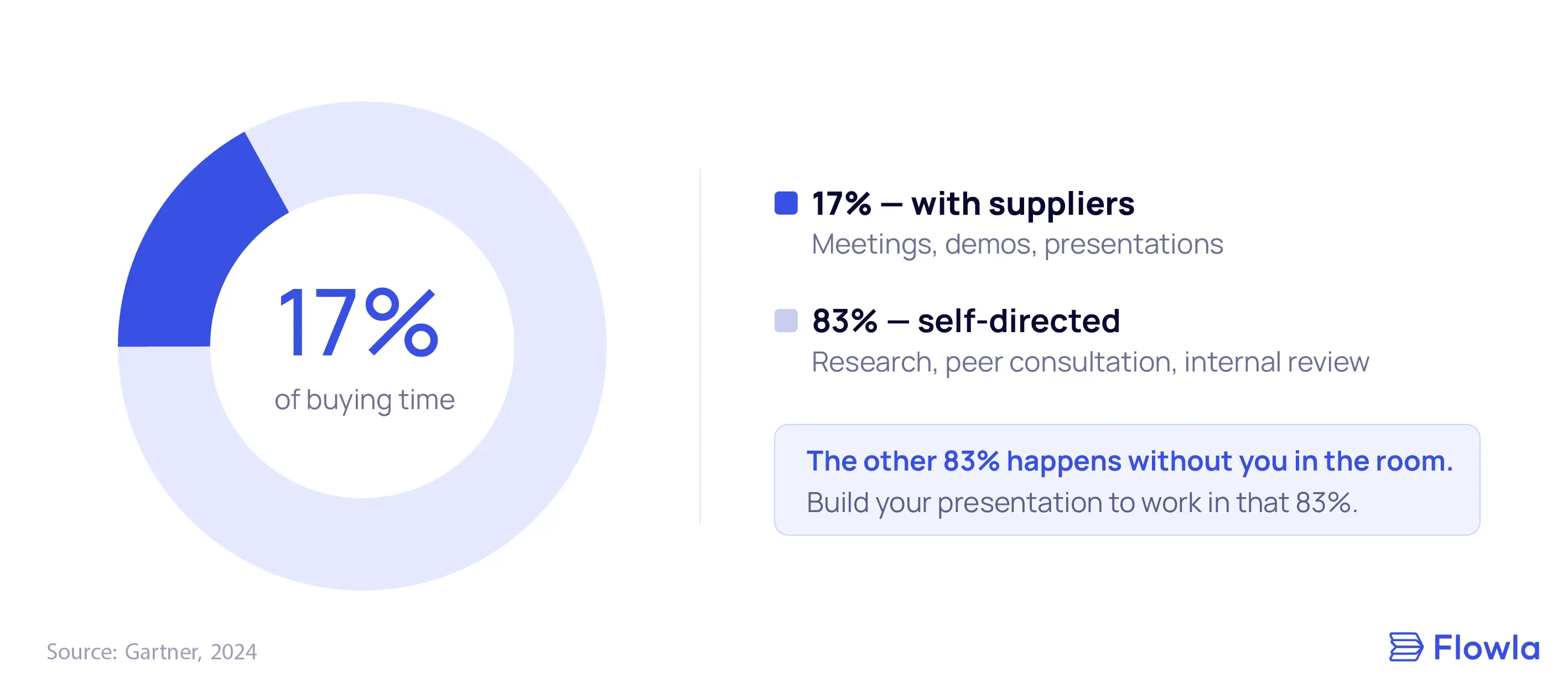
According to Gartner, B2B buyers spend only 17% of their total buying time meeting with potential suppliers. If they are evaluating three vendors simultaneously, each one gets roughly 5 to 6% of their calendar.
That number should change how you think about a sales presentation. Think of it not as a performance you have prepared, but as one of the few chances you get to shape how a complex buying decision unfolds. The buyers doing the other 83% of their journey without you are the ones you need to reach. And they are mostly doing it through whatever materials you left behind after the meeting ended.
This guide covers all three phases: how to build a presentation that earns attention when you do have it, how to deliver it in a way that moves the deal forward, and what to actually do after the meeting ends.
Most presentations are built from the seller's side of the table. Here is what the product does. Here is what the company has achieved. Here is why you should care. That structure makes sense to the rep preparing it. To the buyer receiving it, it reads like something sent to every company on their list.
Gartner's 2025 research found that 61% of B2B buyers now say they would prefer to complete a purchase without a sales rep involved at all, and 73% actively avoid suppliers whose outreach they consider irrelevant. The bar for relevance has moved. A presentation that could have been sent to any company in your segment is exactly what buyers are filtering out.
The six elements below build a presentation from the buyer's side of the table. They are ordered by what matters to the people evaluating you, not by what feels most natural to present.
Not your product category, or the pain points your ICP typically reports. The specific friction this buyer described during discovery, in their own words where possible.
Gong's research found that if your story describes a buyer's problem better than they can describe it themselves, they automatically assume you have the best solution. It is a pattern Gong identified across nearly 2 million recorded B2B sales calls. The rep who opens by naming the buyer's situation precisely earns a level of trust the rest of the presentation cannot manufacture from scratch.
Two minutes on a company overview kills that trust before it starts. Gong's data shows a sharp drop in win rates the moment you go past that mark. Buyers are not there for your origin story.
Reps move quickly from "here is your problem" to "here is our solution" without making the status quo feel painful enough to justify a decision.
Forrester's State of Business Buying 2024, which surveyed more than 16,000 global buyers, found that 86% of B2B purchases stall at some point during the process. Most of those stalls are not because the buyer chose a competitor. They happen because the urgency to decide quietly evaporated. A deal that stalls is almost always one where the cost of doing nothing was never made concrete enough to overcome inertia.
Put a number on it where you can. Time spent on manual work that should not be manual, revenue at risk from the current approach, cost per quarter of the problem continuing. Abstract pain is easy to defer. A specific number is harder to ignore in a budget meeting.
A selective answer to the specific problems they raised in discovery, in the order they matter to this buyer, will have more impact than a complete feature walkthrough.
If the discovery call surfaced four pain points, your solution section should address those four. The rep who walks through every feature because they are not sure which ones matter is the rep who loses the room halfway through. What you choose to show says as much about how well you listened as anything else.
A case study earns its place when it is close enough to the buyer's world that they can see themselves in it. A story about a company in a different industry, at a different scale, with different problems does not land the way most reps think it does.
Lead with the outcome, not the origin story. "A mid-market SaaS company with a five-person sales team reduced their sales cycle by 30% in 90 days" is more useful than two paragraphs about how the customer came to you. The buyer's rational brain needs the number. Their decision-making brain needs to see their own situation reflected.
Research on information retention found that stories increase recall by 60 to 70%, compared to 5 to 10% for statistics presented without narrative context. Use both, but lead with the story.
One action. A specific ask with a specific timeline. "Let's get 30 minutes with your VP of Sales before the end of the month" is a next step. "Feel free to reach out with any questions" is an off-ramp.
Almost nobody mentions this one, and it is probably the most important of the six.
Gartner's research found that B2B buyers are 1.8 times more likely to complete a high-quality deal when they engage with supplier-provided digital materials alongside their conversations with a rep, rather than conducting their evaluation independently. The presentation you deliver in the meeting is the human interaction; what you leave behind is the digital layer. Both matter. One without the other leaves the buyer doing the hardest part of their decision-making with less support than they need.
Part 3 covers what that follow-up room looks like in practice.
.webp)
The short answer is not better design and more confident delivery, even though both help at the margins.
What consistently separates presentations that move deals from ones that get polite thank-you emails and then silence is whether they were built for the full buying committee, not just the person on the call. Gartner puts the average number of people involved in a B2B purchasing decision at 6.8. More than half of them, in most organizations, are VP-level or above. Most of them will never attend your presentation.
The CEO of an HR software company described what he noticed when a vendor sent him a well-structured follow-up room during their own sales process: "They don't have to ask us, hey, what's the implementation timeline? Check the link. You have everything. You see the faces."
He didn't reach that conclusion during the presentation. He reached it afterward, in exactly the 83% of his buying time that happened without the rep in the room. That's the test worth building toward. Could a senior stakeholder who missed your demo get up to speed from what you left behind? Would they have what they need to decide, or would they have questions your champion cannot answer?
If the answer is no, the presentation is not done yet.
A demo shows the product. A presentation makes the case for why the product matters to this specific buyer. In practice, the two are often blurred together, which tends to weaken both.
The more useful distinction: both are meetings, and the decision almost never gets made in a meeting. It gets made in the conversations your champion has internally, at the moments you are not present for. The presentation and the demo shape what those conversations start from. Neither closes the deal on its own. The conversations they feed into are what do.
Most reps deliver a presentation as a monologue with questions at the end. That format works for a keynote. For a sales meeting, it is about the worst possible structure.
Gong's analysis of more than 67,000 recorded sales demos found that no deal that ended in a closed win involved more than 76 seconds of uninterrupted pitching. Winning demos had 21% more speaker switches per minute than losing ones. And in the second half of those calls, the rate of back-and-forth conversation accelerated by 36% as the meeting shifted from a pitch to a genuine dialogue.
The five points below are what that actually looks like in practice. The goal in each one is the same: keep the meeting feeling like a conversation the buyer is part of, not a presentation they are sitting through.
Most reps open a demo by sharing their screen and starting the product tour. The better move is to start by showing the buyer what you understood from the last conversation, and asking them to correct it.
In a recent Flowla demo, the rep opened not with the product but with a summary slide of everything taken from the discovery call. He told the buyer: "I've jotted down how I've understood everything. I want to make sure I haven't missed anything, and that we're showing you the most critical stuff today."
The buyer said the summary looked accurate. The rep asked anyway: "You say pretty much. What did I miss?"
That question is the thing. It surfaced context the buyer had been carrying into the meeting, before a single feature had been shown. Top-performing reps do this consistently: they distribute questions naturally throughout the call rather than clustering them at the start, which can make the opening feel like an interrogation rather than a continuation of an existing conversation.
When your audience includes an operator, a RevOps lead, or anyone responsible for setting up and managing the tool, showing only the end-user experience is showing half the product.
After a recent Flowla demo, the buyer was asked what made it stand out compared to the two competing demos she had already seen. Her answer: "Showing me both sides. So like you showed me what it would look like for you to create it. That's really what I want to see. I need to know how easy is it to build, how complicated is it?"
She was a revenue operations manager evaluating three platforms. The rep had walked her through both the buyer-facing room and the admin setup: the workflow builder, the automation engine, the HubSpot integration. The other two vendors had only shown the customer view. She called this demo the most comprehensive of the three.
This is not a universal principle. For a VP of Sales focused on pipeline visibility, the admin setup may not be the deciding factor. The point is to know who is in the room and what their actual evaluation criteria are, then build the demo around that.
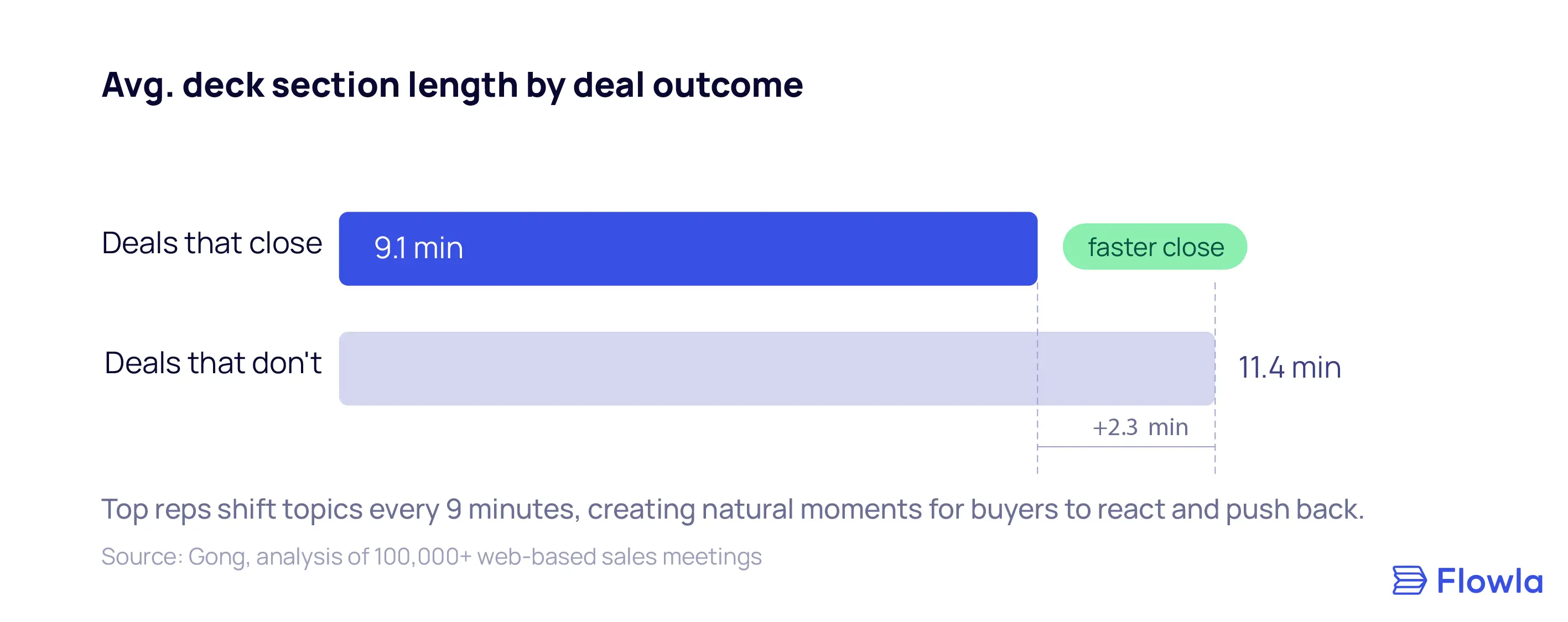
Gong's analysis of more than 100,000 web-based sales meetings found that deals that close use 9.1-minute deck sections on average. Losing deals use 11.4-minute sections. After nine minutes, attention does not just drift. Neuroscience research suggests the brain has a built-in stopwatch that disengages around the nine-to-ten minute mark.
The practical application is not to time yourself with a stopwatch. It is to build your presentation in sections that each have a natural re-entry point: a question, a story, a format shift. Every section should give the buyer a reason to respond before you move forward.
Most reps talk through their best slide without stopping. They are in flow and keep going. That is usually the wrong call.
In the same Flowla demo, after walking through the automation engine, the rep stopped mid-demo and said: "I'm going to take a pause here because I've touched on a couple of automations. There are a few more I'd love to show you, but I want to hear some initial thoughts first."
That pause changed the shape of the rest of the call. The buyer confirmed the automations made sense, added a specific question about how they would work with her CRM, and the second half of the meeting became a targeted conversation rather than a product tour.
The same principle applies to objections. Gong's research found that top-performing reps pause five times longer than average after an objection, and respond by asking a question 54% of the time compared to 31% for average reps. The pause signals you are taking it seriously. The question gets you real information rather than starting a defensive exchange.
In the fastest-closing deals Gong analyzed, sellers spent 53% more time discussing next steps during the first meeting than in average deals. The next steps conversation is not the wrap-up. For top performers, it is a substantial part of the meeting itself.
Toward the end of the same Flowla demo, after walking through pricing, the rep asked: "Would it make sense to get a placeholder in towards the end of next week?" The buyer agreed. The rep said: "Let me put a placeholder in quickly now" and opened his calendar on the call.
He did not say "I'll send you some times." The invite was sent before the call ended. That is a small thing with a non-small effect. The follow-up email requires the buyer to make a decision. The calendar invite means the decision is already made.
Those five points cover what separates good delivery from average. The three below are the basics, cited briefly because the numbers behind them are harder to ignore than the generic advice usually makes them sound.
Turn your camera on. Gong found that deals are 127% more likely to close when video is used at any point in the sales process.
Use the buyer's exact words, not a polished paraphrase. When you reflect back what someone said in discovery, their precise phrase lands differently than your cleaned-up version. "You mentioned being worried about the handoff between sales and implementation" is not the same as "you mentioned process continuity concerns." The exact language signals you actually listened.
Say "you" and "your team" more than "we" and "our product." The most important person in any sales conversation is always the one you are selling to.
With something specific to this buyer, drawn from discovery. Reference a goal they mentioned, a problem they described in a particular way, a number they said they are trying to hit. Then check whether it still reflects their current situation before moving on.
Gong's data shows a sharp drop in win rates after two minutes on a company overview. Buyers care far less about your company history than most reps assume. They care about whether you understood what they told you.
Plan for 20 to 30 minutes of actual presentation, with the rest of the meeting for questions and real conversation. Build a 10-minute version for situations where the buyer's 60-minute block gets cut to 25 minutes at the last second. Decide in advance what you would drop.
One number worth holding onto: people retain roughly 10% of what they hear after three days. The presentation you delivered will largely be gone by the time your buyer's CFO asks about it Thursday afternoon. That is not an argument for making the presentation longer. It is an argument for thinking carefully about what you leave behind.
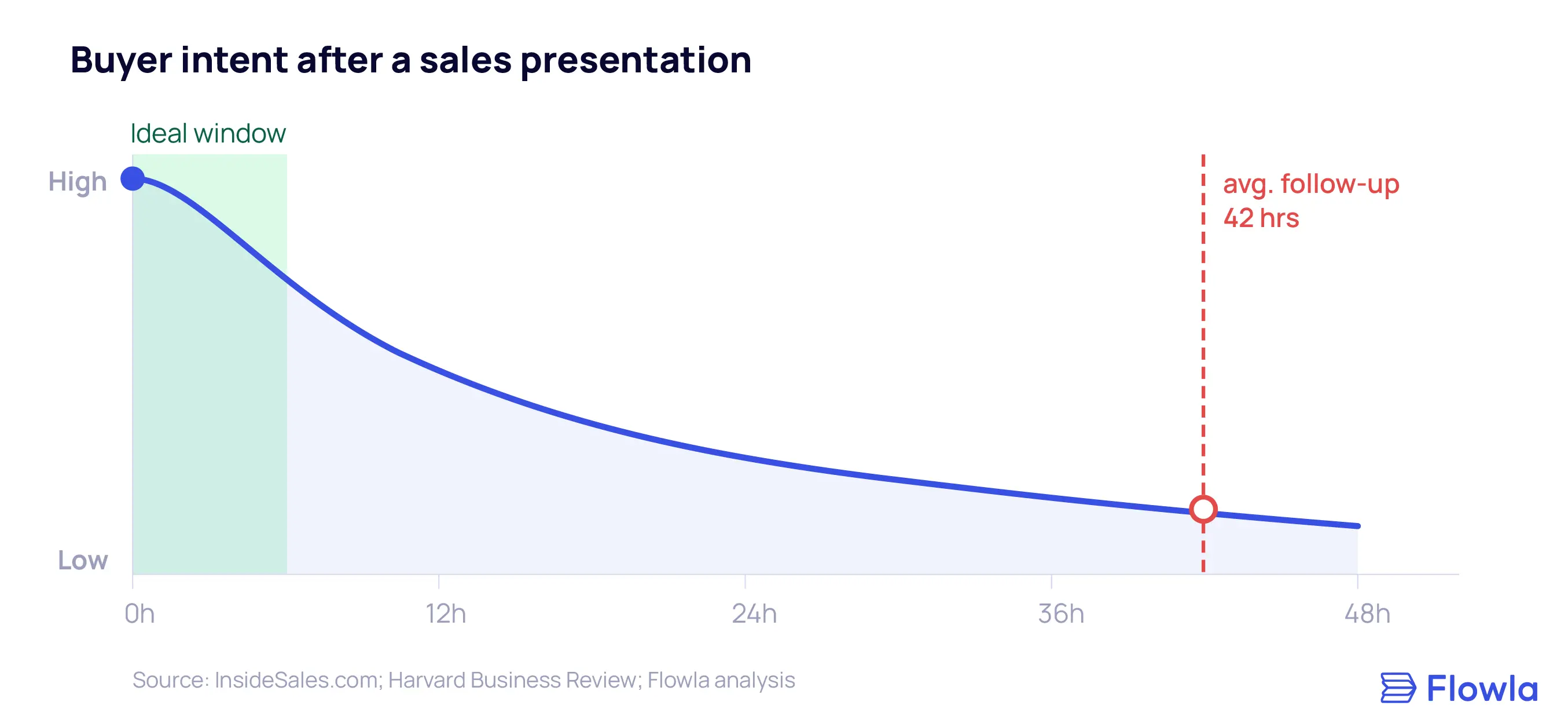
The average B2B company takes 42 hours to respond to a new inbound lead, according to research cited in the Harvard Business Review and consistently replicated since. Responding within five minutes makes you 21 times more likely to qualify that lead.
The same logic applies after a presentation. Your buyer just spent time with you. Their attention and intent are at their highest point the moment the call ends. Most reps send a follow-up email that evening or the next morning. Some attach the deck. Almost none send something that actually helps the buyer do the hardest part of what comes next.
Forrester's State of Business Buying 2024 found that 86% of B2B purchases stall at some point during the process, and 81% of buyers end up dissatisfied with the provider they ultimately chose. These are not failed deals. They are deals that dragged, lost momentum, and closed on terms that felt like a compromise. The post-meeting gap is where that pattern usually begins.
The same day, within a few hours of the call.
Flowla's research across more than 30,000 active deal rooms found that 48% of rooms created never get any engagement. The most common reason is not that buyers were uninterested. It is that the room arrived too late, with too little context, built as an afterthought rather than as a structured continuation of the meeting. A room sent two days after a demo, containing a generic deck and a pricing sheet, is barely different from an email attachment.
The teams that see measurable results automate the room send while the context is still fresh, with an opening that references the specific conversation they just had. The buyer is still in the mode of thinking about your product. That window closes fast.
After your presentation, your buyer goes back to their desk and effectively becomes the rep. They have to explain what you do to colleagues who were not there, answer questions you were never asked, and make a case for budget to people who have never heard of you. A follow-up email with the deck attached does not help with any of that. The deck was designed to be walked through with narration. It does not explain itself.
Gartner found that 74% of buying committees experience unhealthy internal conflict during a purchase decision. When committees do reach genuine consensus, they are 2.5 times more likely to call it a high-quality outcome. Your job after the meeting is not just to stay visible. It is to help a fractured group of people get aligned on a decision you are not present for.
What that looks like in practice:
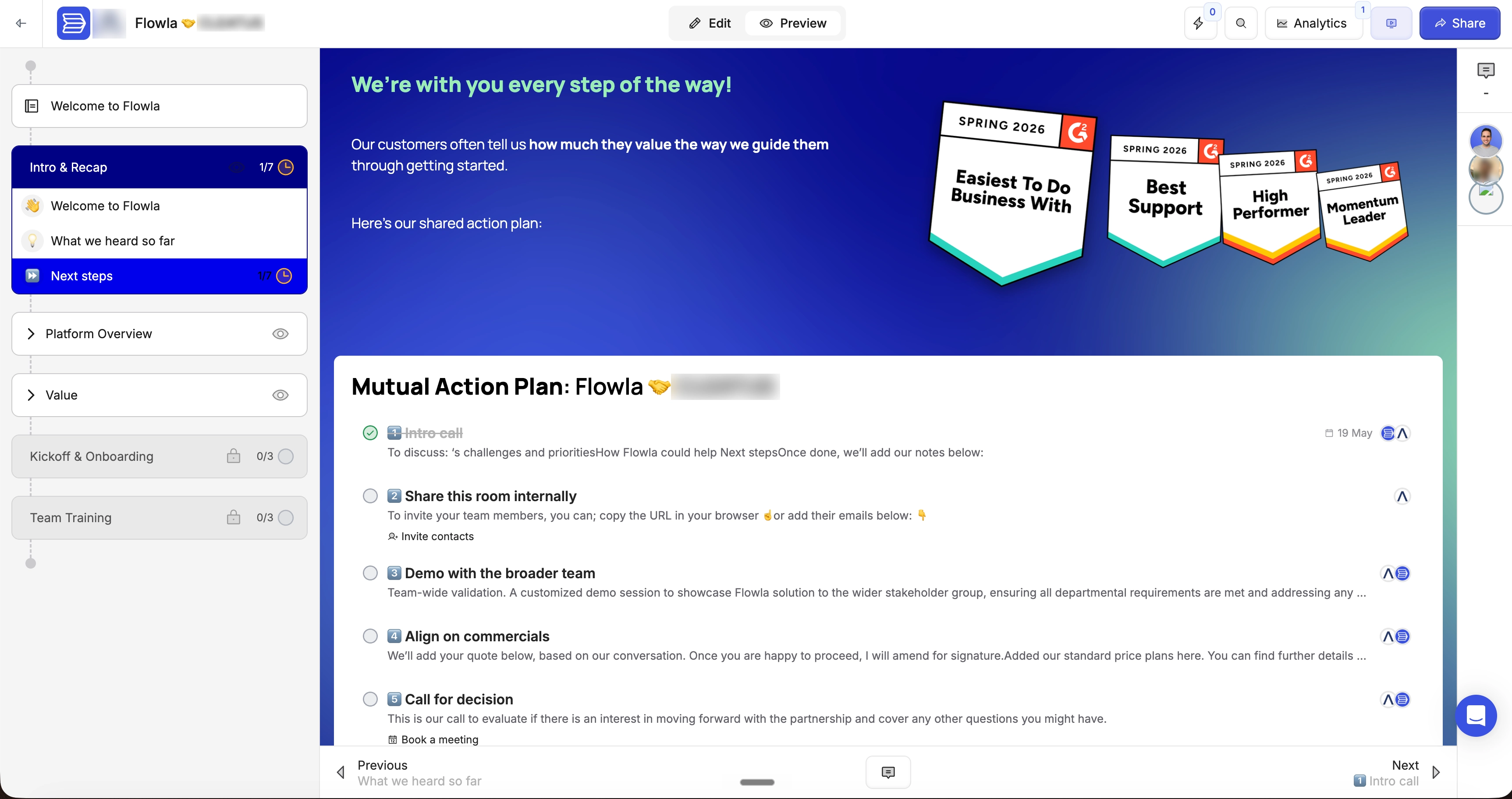
A revenue operations manager who evaluated Flowla against two competing platforms described what she looked at first when she received the room: "The first thing I checked was the mutual action plan. Because I know that's important for the team and I liked that it was easy to kind of see like exactly where it was."
She was managing a vendor evaluation alongside everything else in her job. A room that told her exactly where things stood and what happened next was practically useful, not just impressive. That is the standard worth building toward.
Your champion needs more than your slides to advocate for you internally. They need something that frames the problem in terms their organization already cares about, shows the value in numbers their leadership will find credible, and handles the objections that will come up in the rooms you are not invited to.
Their credibility is on the line when they recommend you. The easier you make it for them to make that case, the better your chances.
At minimum, this means putting together a document that:
Flowla has a practical guide on how to build one that works across different buyer contexts, and a breakdown of the five assets your champion needs to win internal buy-in.
One thing that changes when you move from email follow-up to a shared room: you can see what is actually happening.
When your buyer forwards the room link to their CFO, you know. When a new stakeholder opens it from a domain you do not recognize, you know. When the room has been quiet for 10 days after a period of active engagement, you know that too.
Erdem Gelal, Flowla's co-founder and CEO, describes what this visibility looks like in practice: "You'll finish your demo call and move on with your life. You go to your email inbox, you see a draft follow-up email ready for you. It's personalized. Inside the room, you can already see who your stakeholders are: who forwarded it, what they looked at."
These signals change how you prioritize. A room with multiple new stakeholders engaging is a deal worth pursuing hard right now. A room nobody has opened since you sent it needs a direct conversation about whether it is still alive, not another "just circling back" email.
Companies using structured post-meeting rooms typically see a 30 to 35% reduction in sales cycle length and a 10 to 25% increase in win rates, particularly on larger deals involving multiple stakeholders. Non-technical buyers see the biggest gains, because the room removes the friction that would otherwise slow their internal process.
What is a sales presentation?
A sales presentation is a structured conversation, usually supported by a slide deck, designed to persuade a prospective buyer to take the next step in a purchasing decision. The goal is not to close the deal in the meeting. It is to build enough confidence that the buyer wants to move forward and give you access to the rest of their buying committee. In B2B sales, the presentation typically feeds into an evaluation process involving several stakeholders who were not on the call.
What should a sales presentation include?
Six elements: the buyer's problem in their own language, the cost of leaving it unsolved, your solution mapped to what they told you in discovery, proof from a relevant case study, a specific next step, and a follow-up room the buyer can share internally without you there to explain it. Most presentations cover the first five. The sixth is where deals are won or lost.
What makes a great sales presentation?
A great presentation accounts for the full buying committee, not just the person on the call. It makes it easy for your champion to advocate internally. According to Gartner, B2B buyers spend only 17% of their buying time with potential suppliers. The other 83% happens without you. A great presentation shapes what happens in that 83%.
How do you open a sales presentation?
With something specific to this buyer, drawn from discovery. Reference a goal they mentioned, a problem they described, a number they are trying to hit. Then check whether your read of their situation still holds before moving on. Gong's data shows that spending more than two minutes on a company overview at the start correlates with a sharp drop in win rates.
How long should a sales presentation be?
Plan for 20 to 30 minutes of actual presentation and use the rest of the meeting for conversation. According to Gong's research, top-performing reps shift topics or formats every 9.1 minutes to keep the meeting interactive. Build a 10-minute version for situations where time gets cut at the last minute.
What is the difference between a sales presentation and a demo?
A demo shows the product working. A presentation makes the case for why it matters to this specific buyer. Both are meetings, and neither is where the final decision typically gets made in a complex B2B sale. The decision happens in the conversations your champion has internally. What you leave behind after the meeting shapes those conversations more than what you said during it.
The advice in this guide only works if the follow-up matches the standard of the meeting.
Book a demoBook a 15-minute chat with a product expert. We'll walk you through every step of the way as you get set up.
.webp)
.webp)
.webp)


.webp)

.webp)
.webp)
.webp)




.webp)
%20(3).webp)
.webp)
.webp)
.webp)

.webp)
.webp)
.webp)
.svg)

.webp)
.webp)