
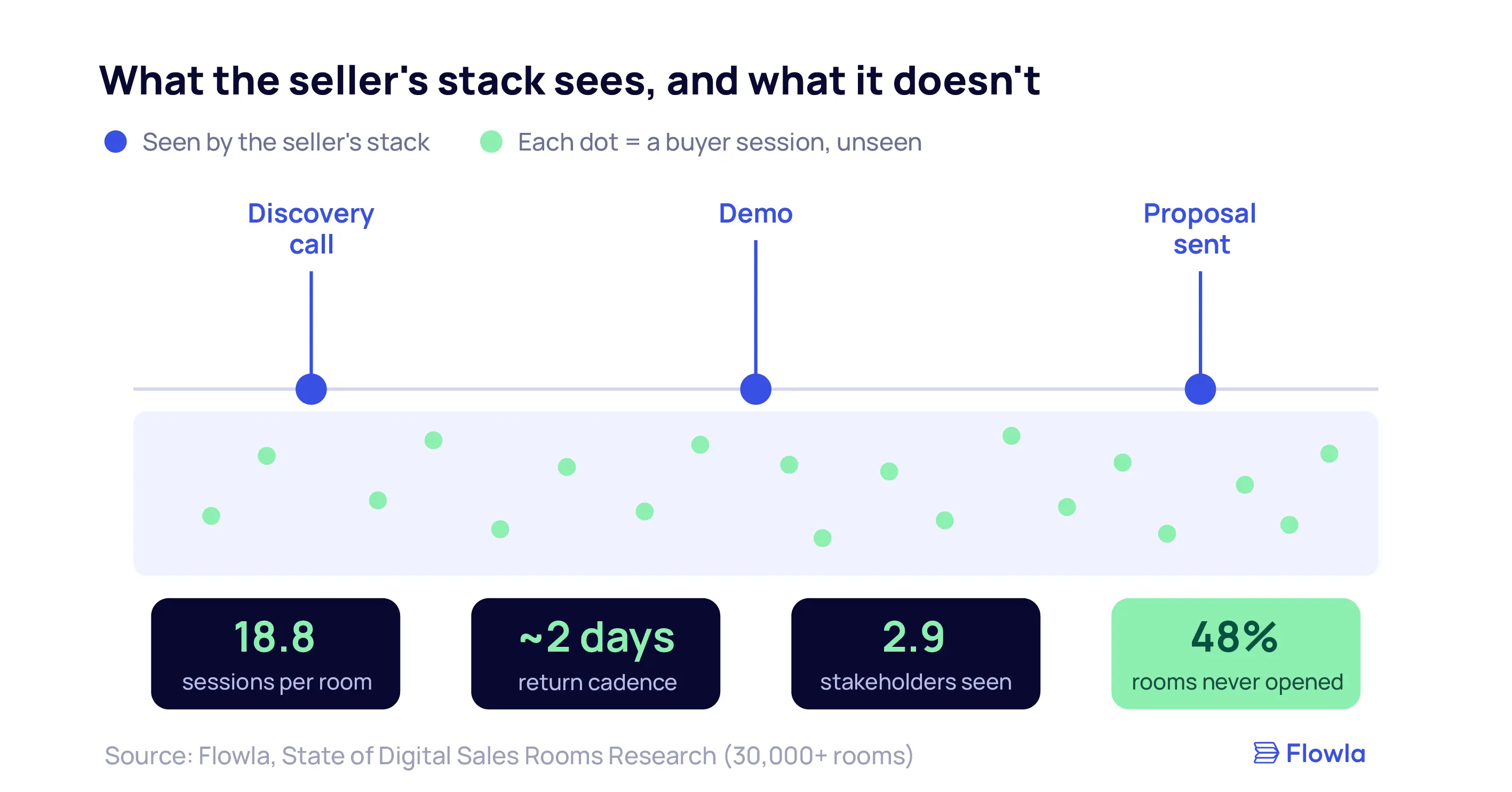
We looked at 30,000 deal rooms to see what buyers actually do when they evaluate a vendor. The average room was opened 18.8 times, on a roughly two-day rhythm, usually between sales calls. The titles showing up most often were director, then VP. A lot of that activity happened with no rep anywhere near it.
That is the part of a deal that every revenue action orchestration tool cannot see. RAO is the newest and loudest category in sales tech, and its promise is real: catch every signal and make sure someone acts on it. Gartner named the category and built a Magic Quadrant around it. The problem is where the idea stops.
The tools in this space are very good at watching and still bad at acting, and the acting they do reaches the rep, not the buyer. That is the argument this piece makes, in full.
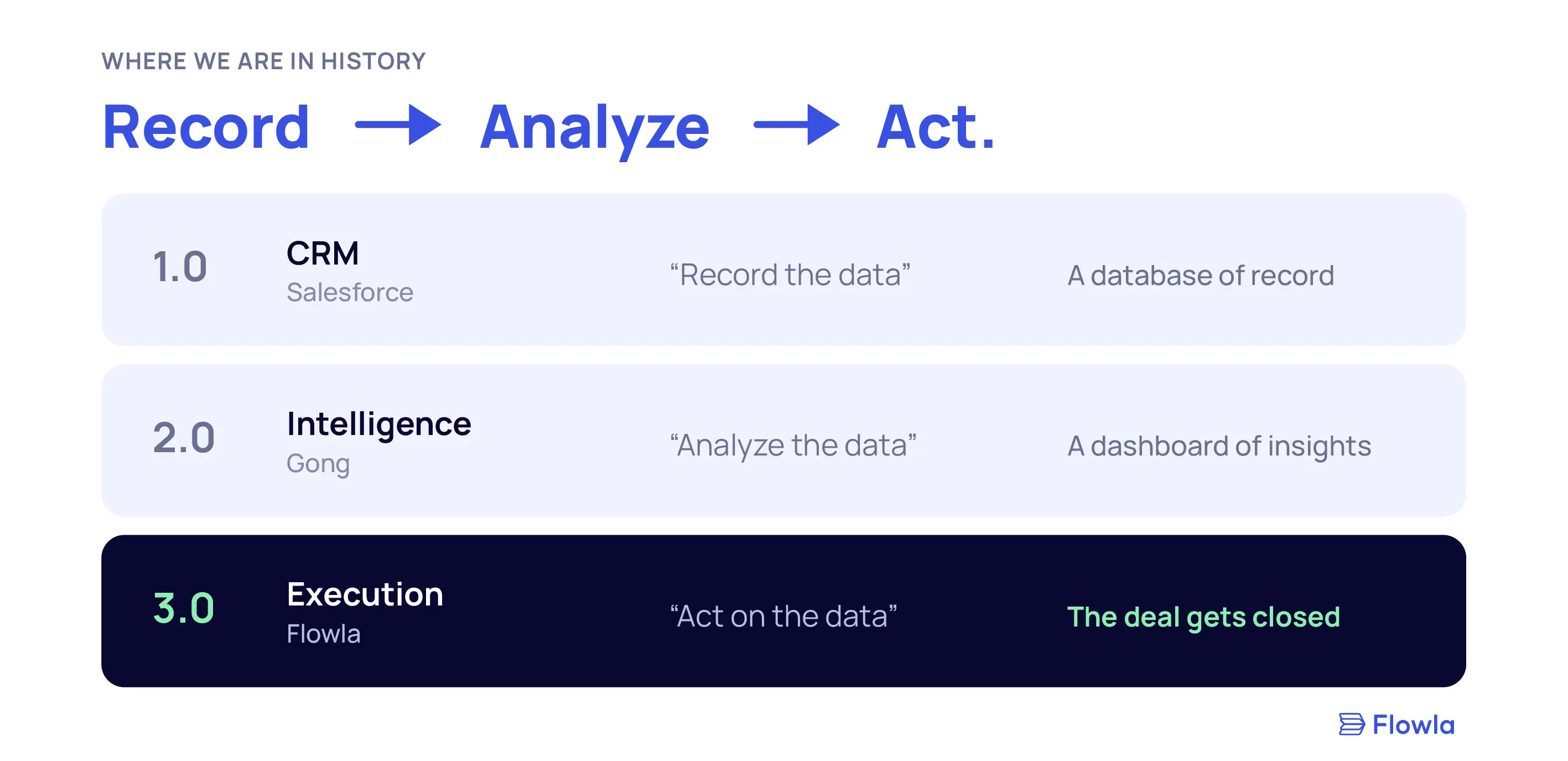
Sales tech has worked through three jobs in twenty years. The CRM recorded the deal. Revenue intelligence analyzed it. The newest wave acts on it. RAO is the label for that third wave, and it is arriving now because AI has finally made acting on the data possible at scale.
Revenue action orchestration is an AI-driven approach that connects sales data, insights, and real-time actions so a seller knows the right next step and takes it without leaving their workflow. Gartner defines it as a market that merges sales engagement, revenue intelligence, and sales force automation into one system, replacing scattered dashboards with guided actions delivered in the moment.
The word doing the work in that definition is orchestration. A dashboard reports. A sequencer fires on a schedule. Orchestration is supposed to read the state of a specific deal and coordinate the right move across your tools, so the rep is not left to stitch the picture together by hand.
RAO did not appear because someone invented a new feature. It appeared because three older categories stopped making sense as separate purchases, each solving a slice of the same problem while reps paid the tax of moving data between them by hand:
Two things tipped it into a category. First, buyers changed. Gartner reports that B2B buyers now spend only 17% of their purchase time meeting with any supplier, and 61% say they prefer a rep-free experience. When the rep is in the room for a shrinking share of the decision, the old model of "arm the rep with more dashboards" hits a ceiling. Second, AI got good enough to act, not just summarize. That is the unlock that turns analysis into orchestration, and it is why Gartner moved RAO from a 2024 Trend Insight report to a full Magic Quadrant by December 2025, where Gong was named a Leader.
It helps to see RAO as the third era of a longer arc.
Record and analyze were hard engineering problems with clean boundaries. Act is harder, because acting means touching the outside world: sending the message, updating the record, reaching the buyer. That last step is where most of the category quietly stops, and it is the whole subject of this piece.
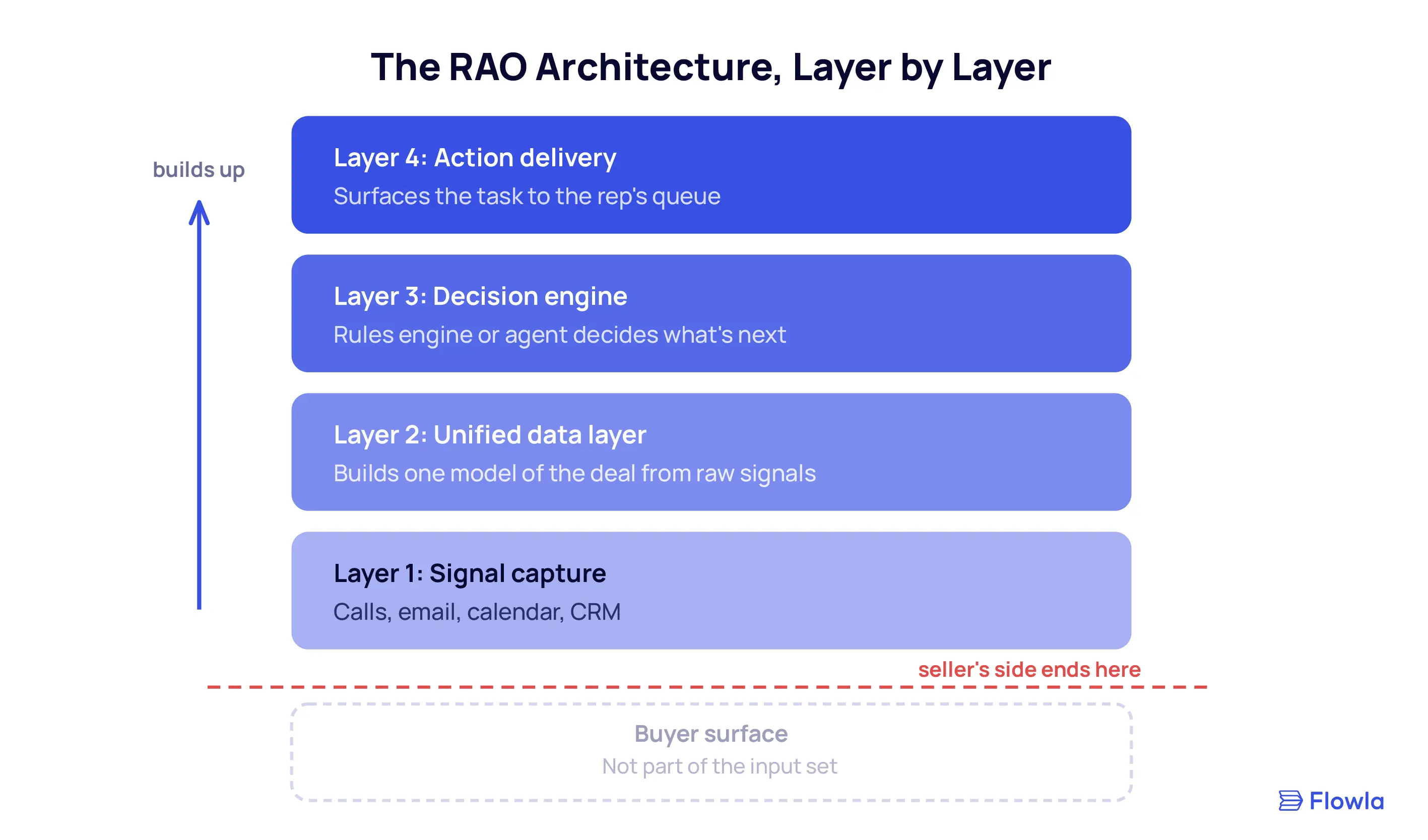
Vendors describe RAO differently. Revenue.io talks about a four-part flow of data capture, insight, action, and execution. Outreach frames it as engage, capture, analyze, and optimize. Strip the branding away and every serious platform is built from the same four layers.
The system ingests activity from across the seller's stack: calls (often through a conversation intelligence integration), email, calendar, and the CRM. Some platforms add web and product data. The quality of everything downstream depends on how complete this capture is.
This is the layer that decides how good the whole system can be, and the one vendors talk about least in plain language. Raw signals are messy: the same person shows up as three different contacts, and a call transcript, a CRM stage, and an email thread all describe one deal but live in three schemas. The unified data layer resolves identities, links activity to the right opportunity, and builds a single model of the deal that the AI can reason over. Outreach makes a real point of this when it argues that agentic selling needs a unified data architecture underneath it, and they are right. An agent is only as smart as the model of the world it is given.
Here is the quiet consequence. The model of the deal can only include what the capture layer fed it. If the inputs are the seller's calls, emails, and CRM, then the "unified" picture is a unified picture of the seller's side. It is complete in the way a map that stops at your property line is complete.
On top of the data model sits the part that decides what should happen next, ranging widely in sophistication:
Both get marketed as "AI." They are not the same thing, and telling them apart is one of the most useful things a buyer can do, which we come back to later.
Finally, the system delivers the action. In practice, for almost every RAO platform, "delivery" means surfacing the recommendation to the rep: a task, a flag, a drafted email waiting in their queue. The rep is the last mile. They review it, maybe edit it, and send it.
That design is not an accident, and it is not always wrong. But it means the action terminates at the seller. The orchestration is real right up until the moment something has to reach the buyer, and then it hands the baton back to a human. Hold that thought, because it is the seam the rest of this piece pulls on.
It would be easy to treat RAO as marketing froth on top of tools that already existed. That read is wrong, and understanding why is the fastest way to understand the category. RAO caught on because it names a real and expensive problem, and because the timing finally lined up to solve it.
The modern seller's real problem is coordination, not selling. A single rep is expected to:
All of that, across five or six tools that do not talk to each other. Salesforce has reported for years that reps spend under a third of their week actually selling, and that number has barely moved despite a decade of point solutions, because each new tool added another tab rather than removing one.
That fragmentation compounds. Context gets lost in the gaps between tools, so the follow-up is slower and less relevant than it should be. Good plays live in the heads of top reps and never make it into a repeatable motion. Managers forecast off a CRM that only contains what reps remembered to type. RAO's core promise is to collapse that sprawl into one guided surface where the next step is obvious and most of the busywork underneath it is handled. When it works, a rep spends their day on judgment and conversation instead of data entry, and the whole team runs closer to how the best rep runs.
The fragmentation problem is old. What made RAO urgent is that the buyer stopped waiting for the seller to get organized. Gartner reports that B2B buyers now spend only 17% of their purchase time meeting with any supplier, and better than three-quarters describe their most recent purchase as complex or difficult. The buyer is doing more of the work themselves, across more people, on their own schedule, and the window where a rep can influence them directly keeps shrinking.
That reframes what orchestration is for. The real value is making sure that in the sliver of attention a buyer gives you, every action is the right one and nothing falls through, not shaving minutes off a rep's admin. When you only touch a deal 17% of the time, the cost of a missed follow-up is far higher than it was when selling was a series of meetings you controlled. RAO is the category's answer to a buyer who has taken the wheel.
The knock-on effect is a shift in what a sales team even is. The old model rewarded individual heroics: the rep who worked the hardest and remembered the most won. The RAO model rewards operational discipline, where the system carries the process and the rep brings the human judgment on top.
That is a genuine step forward, and any honest account of the category has to grant it. The critique in the rest of this piece has a narrower target: this progress has a ceiling, and the ceiling is the edge of what the seller can see.
If your motion is high velocity, an SDR floor working outbound at volume, a transactional close in one or two calls with a single decision-maker, then the seller's activity is most of the deal. Orchestrating it well may be all the orchestration you need, and a buyer-side surface would be overhead you do not use. RAO is a strong fit there, and any honest comparison should say so.
The critique is narrow and specific. RAO defines "the deal" as the part the seller can see. On a simple deal that is fine. On a complex one, that definition leaves out most of what actually decides the outcome.
The blind spot is baked directly into Layer 1's architecture. A system that captures the seller's calls, emails, and CRM builds a model of the seller's side, and then acts on that model. Everything the buyer does on their own time, in a channel the rep does not sit in, is invisible to it. Our room data shows exactly how much of the deal lives there. Let us walk the deal stage by stage.
A rep finishes a strong discovery call on Tuesday. The RAO tool summarizes it, flags the risks, and drafts a follow-up. Good output, genuinely better than what the rep would write in ten rushed minutes. Then the rep reformats it, attaches a PDF built last week, and sends it. It lands in an inbox next to forty others.
A founder who talks to more than a hundred brands a month described this exact moment as the hard part of his job. His words: "Even if we do send out all of these materials, then comes the follow up. That is the nightmare." He was not asking for a smarter draft. He wanted, in his words, "some process into this madness."
What acting on the buyer's surface changes: instead of a static attachment, the follow-up is a live room the buyer opens, returns to, and shares. Our data shows the average room is opened 18.8 times on a two-day cadence, so the follow-up stops being a single send and becomes a place the deal keeps happening.
The most expensive moment in a cycle is the silence. The rep sent materials and heard nothing. Is legal reviewing the contract, is the champion selling internally, or is the deal dead? A seller-side tool cannot answer, because nothing has happened in its inputs. No email, no call, no CRM change. So the rep sends a "just checking in" note based on a hunch, which is the weakest message in sales.
The buyer, meanwhile, is often very much alive. In our dataset buyers return to rooms every couple of days, frequently without the seller knowing why. When a stakeholder opens the pricing section three times in one afternoon, that is the clearest buying signal in the entire deal. On the seller's stack it does not exist.
What acting on the buyer's surface changes: the silence gets a signal underneath it. A tool watching the room can tell the rep the CFO spent twelve minutes on the ROI section on Monday, and can draft the relevant follow-up automatically. Teams using automated re-engagement on quiet rooms report reviving about 9% of deals that would otherwise have gone cold, and saving up to 40 minutes per follow-up.
This is where the gap becomes structural. Gartner puts a complex buying group at six to ten decision-makers. Each one arrives with four or five pieces of independent research. Forrester's State of Business Buying 2024 puts the average at 13, with 89% of decisions crossing departments. Yet our rooms show only 2.9 identified stakeholders and 2.4 shares on average, and we are confident that is a serious undercount, because internal forwarding is invisible. Your champion passes the room around and you never learn who opened it.
An account executive selling into HR described the trap precisely: "Even sometimes when you think you're speaking to the final decision maker, then you find out they still need to scale that up to the owner of the business." A seller-side RAO tool orchestrates the one thread the rep is on. It has nothing to say about the rest of the buying committee quietly deciding the deal, because it cannot see them.
What acting on the buyer's surface changes: the room becomes the place hidden stakeholders reveal themselves. Gate the sensitive assets behind a short email step, and when the champion forwards the room, the new viewer identifies themselves. The system can then map that stakeholder, alert the rep, and route the right content to them. The committee stops being a black box.
Revenue does not stop at signature, and neither does the blind spot. Most RAO tooling is built for the sales motion and goes dark the moment a deal closes. The AE sends a summary from memory, the CSM walks into the first call half-informed, and the customer repeats what they already said. Their first taste of the post-sale relationship is starting over.
What acting on the buyer's surface changes: because the buyer used one room through the whole evaluation, the context carries into onboarding on the same surface. A handoff built from the actual deal, rather than a bullet-point email, cuts kickoff delays by around 25% for teams that automate it. The momentum from the sale does not reset.
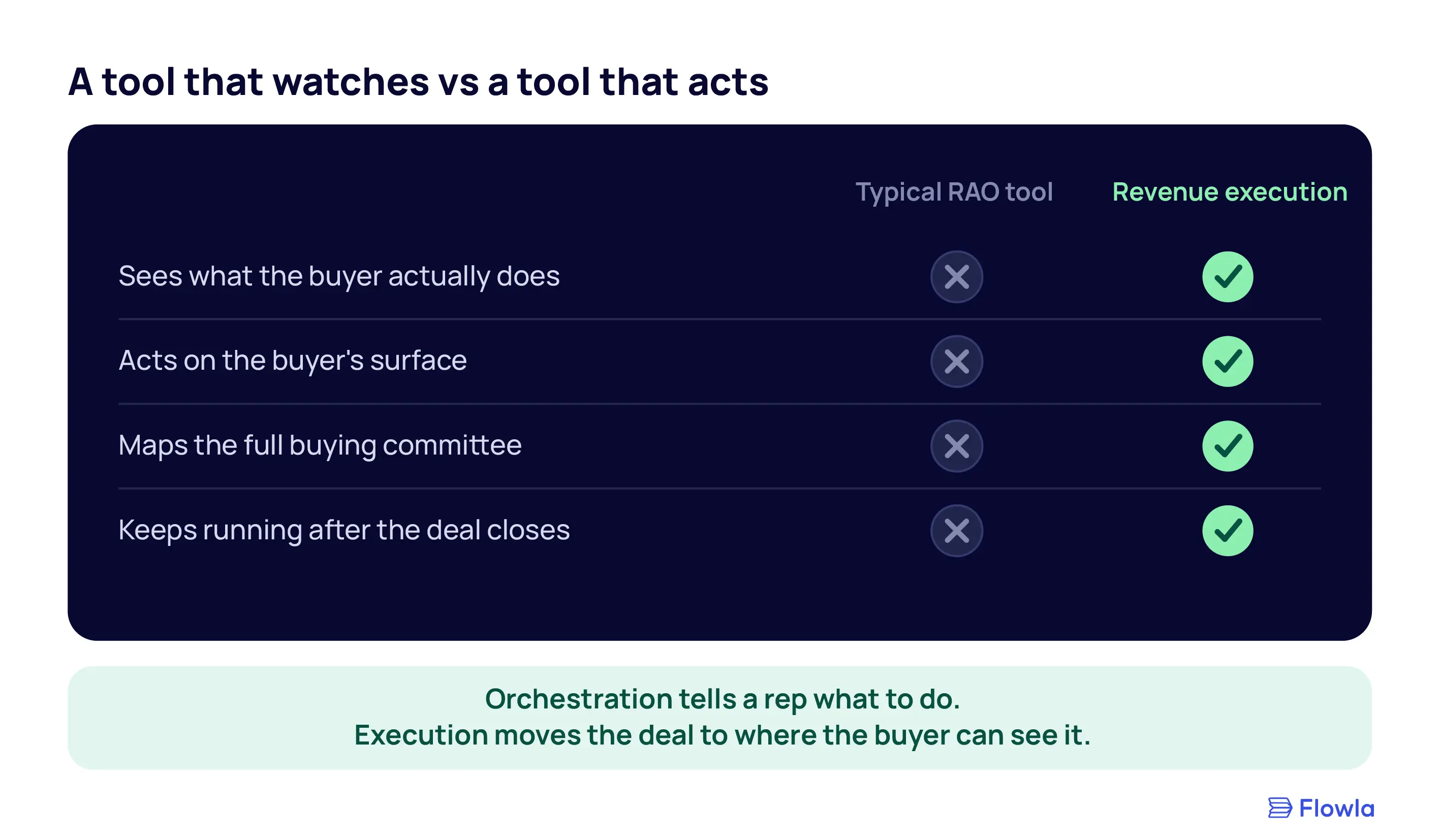
If the pattern across all four stages is the same, orchestration that stops at the seller, then the fix is a different architecture: one where the buyer surface is a first-class input and a place to act, not an afterthought. That is what Flowla means by revenue execution.
The shape of it is four pillars with one intelligence layer running through all of them: enable the team, collaborate with the buyer, understand what is really happening, and act before it is too late.
Before anything reaches a buyer, the team has to be armed. Enable is the content library, the templates, the governed proposals and documents, and the dynamic personalization that means a rep is never sending an off-brand or outdated asset. The point is standardization: quality that does not depend on which rep caught the deal. This is the layer RAO tools mostly cover well, and it is table stakes rather than a differentiator.
This is the pillar the RAO category structurally lacks. Collaborate is the deal room and the onboarding room, the mutual action plan, the inline forms and e-signatures, the shared space where the buyer and the seller actually meet. Our data explains why it matters: buyers treat the room as the real venue for the decision, returning to it repeatedly, sharing it internally, doing the evaluation there. A model of the deal that includes this surface is working from the whole picture. One that does not is working from half.
Understand is where the intelligence layer reads the deal. It is the unified data layer done right, spanning not only the seller's calls, email, and CRM, but the buyer's behavior in the room. On top of that model sit signals and identity resolution, automated stakeholder mapping, and health and risk scoring, with frameworks like MEDDPICC applied to flag blockers and competitive threats. The difference from a standard RAO data layer is the input set: because the buyer surface feeds it, the memory includes the committee the rep never met.
Act is where the intelligence layer acts on the deal, and it is where the architecture pays off. The same platform that watched the buyer can now do something the moment a signal fires: surface the next best action, draft the follow-up in the rep's voice, update the CRM, run an automated workflow, route a stakeholder the right asset. Crucially, the action can land on the buyer's surface, the live room, not only in the rep's task list. The rep stays in control, approving what goes out, and the delivery no longer depends on the rep remembering to carry the output across.
There is a fair question hanging over every "AI does the next step" pitch: how is this not generic automation? The answer is the playbook layer. You encode how your company runs a deal and an onboarding, and everything the intelligence layer does follows it. That is also what makes the system compound. The more it runs your motion, the better its model of your deals gets. A generic assistant resets with every prompt. A playbook-driven intelligence layer on a unified memory gets sharper the longer you use it.
.webp)
The demos blur together fast. These questions separate a tool that watches from a tool that acts, and they are a fair test whichever way you go. Some answers will point you toward seller-side RAO, and that is a valid outcome for the right team.
Ask what feeds the system. If the inputs are calls, email, and CRM, you are orchestrating the seller's half. Then push: when the buyer does something on their own time, in a channel the rep is not in, can the tool see it and respond? For a simple, seller-led deal that may not matter. For a nine-person committee running its own evaluation, it is the whole game.
The category's promise is action, so ask where the action lands. A drafted email a rep still has to send is a suggestion, and the buyer only gets it if a human hits send and it survives the inbox. A useful demo test: ask the vendor to walk through a stalled deal. If the recommended action is "notify the rep to re-engage," you are buying a smarter alert. If it updates something the buyer opens on their own, you are buying orchestration that closes the loop.
This decides whether anyone actually uses the thing, and our data is blunt about it: the number one reason these tools fail is reps not maintaining them, and about 48% of rooms created never get a single engagement. Ask how many minutes a rep spends per deal keeping the system current, and distrust any answer above zero. The best systems are auto-maintained, so a busy rep is never the reason the tool goes stale.
This is the Layer 3 question. A rules engine says: if the room has not been opened in three days, send template B. An agent says: the champion went quiet right after the security review, a new IT contact just appeared in the room, so the move is a tailored note to the champion and a security one-pager routed to IT. One follows a trigger. The other reads the situation. The strongest platforms offer both, deterministic workflows for the predictable steps and agentic judgment for the messy ones, and are honest about which is which.
Ask whether the same system runs onboarding on the same surface the buyer already used, or whether your team is back to manual handoffs on day one. If orchestration ends at close, so does the buyer's good experience, and renewal starts its life on the back foot.
Everything above describes RAO as it exists today. The more interesting question is where it goes as AI agents get genuinely capable, because that is the shift the whole category is bracing for, and it changes the stakes for sellers and buyers alike.
The first wave of AI in sales was the copilot: it sat beside the rep and helped on request. Summarize this call. Draft this email. Useful, and still fundamentally passive, because a human had to ask and a human had to act. Agentic selling is the next step, where the system holds a persistent model of the deal, decides what needs to happen without being prompted, and carries the action out, with the rep approving rather than initiating. The difference is the difference between a calculator and a bookkeeper. One waits for you. The other notices something is off and does something about it.
That is why the unified data layer matters so much more in an agentic world than it did for a copilot. A copilot could get away with a thin view of the deal, because a human filled the gaps. An agent acting on its own cannot. It is only as good as the model of the world it reasons over, so the completeness of that model stops being a nice-to-have and becomes the thing that determines whether the agent helps or embarrasses you. An agent that cannot see the buyer will confidently act on half a picture, which is worse than a copilot that admits it does not know.
For reps, the honest version of this is simpler than "AI replaces you": the parts of the job that were never really selling get handed off.
The rep becomes an editor and a closer rather than a data-entry clerk with a quota. The teams that win this transition will be the ones that let the agent own the routine and keep humans firmly on the judgment. The teams that struggle will either resist the handoff and drown in the same admin, or over-trust the agent and let it act on a picture it cannot fully see.
This is the part the category talks about least, and it is the most important. Agentic selling, done the common way, points all this new capability at the seller's side of the table. The buyer gets more automated follow-ups, more perfectly-timed nudges, more polished outreach. From the buyer's seat, a faster seller-side machine can feel like being managed by a very efficient robot, and buyers already prefer a rep-free experience precisely because they are tired of being sold to.
The more interesting use of agents is to make the buyer's own job easier. A buying committee of six to ten people is drowning in exactly the kind of coordination problem agents are good at. Each one runs their own research and still has to reach internal consensus with the others. An agent that surfaces the right answer inside the room the buyer is already using, keeps the mutual action plan current, and helps a champion sell internally is working for the buyer, not just at them. That only becomes possible if the agent operates on the buyer's surface, which brings the whole argument back to where it started. In an agentic world, the platform that can act where the buyer actually is holds an advantage that a seller-only agent structurally cannot match.
The record and analyze eras are finished as differentiators. The act era is where the fight is now. Expect the frontier to move toward agents that run a company's specific playbook across the full cycle, sales and post-sale, with more of the routine execution handled automatically and the rep moving into an approval-and-judgment role. The platforms that win will be the ones whose model of the deal is most complete, which is another way of saying the ones that can see and act on the buyer, not only the seller.
The individual rep saving ten minutes is real, but a smaller argument than the one that should move you: your team is making decisions, which deals to prioritize, when to follow up, which accounts are at risk, whether the forecast is real, on a picture that is missing the buyer's half.
A CRM reflects what reps enter, not what buyers do. When buyer behavior from the room flows into the model, a pipeline review changes character. A deal where the CFO opened the room three times this week is a different conversation than a deal nobody has touched in fourteen days, regardless of the stage in the CRM. Use room engagement as a leading indicator and the review stops running on rep optimism.
Most forecasting aggregates what reps believe, and reps believe what their last conversation told them. Engagement data grounds the number in behavior. A deal with the legal team active in the room is moving. A deal with silent rooms is at risk, whatever the rep says on the call. That is a forecast built on what happened, not on what was hoped.
The same visibility gap that costs deals costs revenue after signature. Churn signals (engagement dropping, a champion going quiet) and expansion signals (a new department opening the room, the pricing section revisited mid-contract) sit in the room, unseen by teams that only watch the seller's side. A system that acts on the buyer surface surfaces them while they are still warm.
Revenue action orchestration is the execution layer that turns insight into a seller's next action. A revenue orchestration platform (ROP) is the broader container, a term Forrester coined, that combines sales engagement, conversation intelligence, and revenue operations under one roof. RAO is the acting part. The ROP is the system it lives inside. Most vendors use the terms loosely.
A deal room is the surface most revenue action orchestration tools lack. RAO platforms orchestrate actions inside the seller's stack, but a deal room is where the buyer engages, so it captures real buyer behavior and gives orchestrated actions a live place to land. Without one, orchestration reaches the rep and stops short of the buyer.
The vendors most associated with revenue action orchestration include Gong, Clari, ZoomInfo, Outreach, and Revenue.io, most of which grew out of revenue intelligence or sales engagement. Gartner named Gong a Leader in its 2025 Magic Quadrant for the category. Flowla approaches it from the buyer-facing side by owning the deal room and acting on it, which it frames as revenue execution.
Revenue action orchestration is technology. RevOps is a function. RevOps is the team and process that aligns sales, marketing, and customer success around shared goals. RAO is the AI-driven software that turns revenue data into a seller's next action. RevOps teams often own the decision to buy an RAO platform, but the term describes the tool, not the team.
Flowla owns the room where your buyer actually engages, so the next step lands where they'll see it, not in an inbox they ignore.
Book a demoBook a 15-minute chat with a product expert. We'll walk you through every step of the way as you get set up.
.webp)
.webp)
.webp)


.webp)

.webp)
.webp)
.webp)




.webp)
%20(3).webp)
.webp)
.webp)
.webp)

.webp)
.webp)
.webp)
.svg)

.webp)
.webp)