.webp)
Most proposals get lost. Not misplaced, lost: they land in an inbox, get forwarded to people who weren't in your discovery call, and die quietly because nobody knew what to do with them. RAIN Group's research puts a number on it: only 47% of sellers win the deals they propose. More than half the time, the careful work that went into the proposal produces nothing.
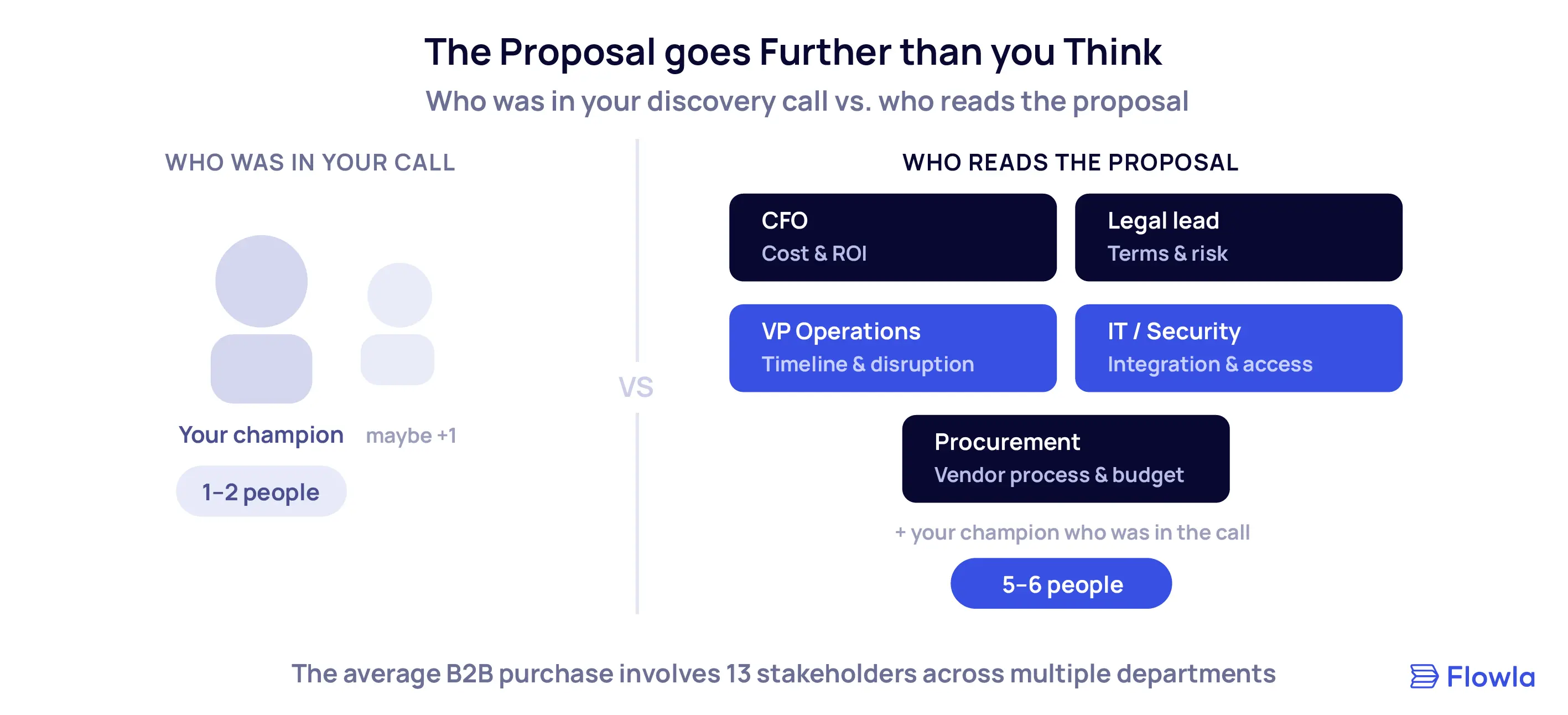
The reason is almost never the writing. It's the audience. According to Forrester's State of Business Buying 2024 report, the average B2B purchase involves 13 stakeholders, with 89% of buying decisions crossing multiple departments. Your champion reads the proposal and likes it. Then they share it with their CFO, their legal lead, and several people who've never heard your name. Those people decide, and most proposals were written as if the champion were the only reader.
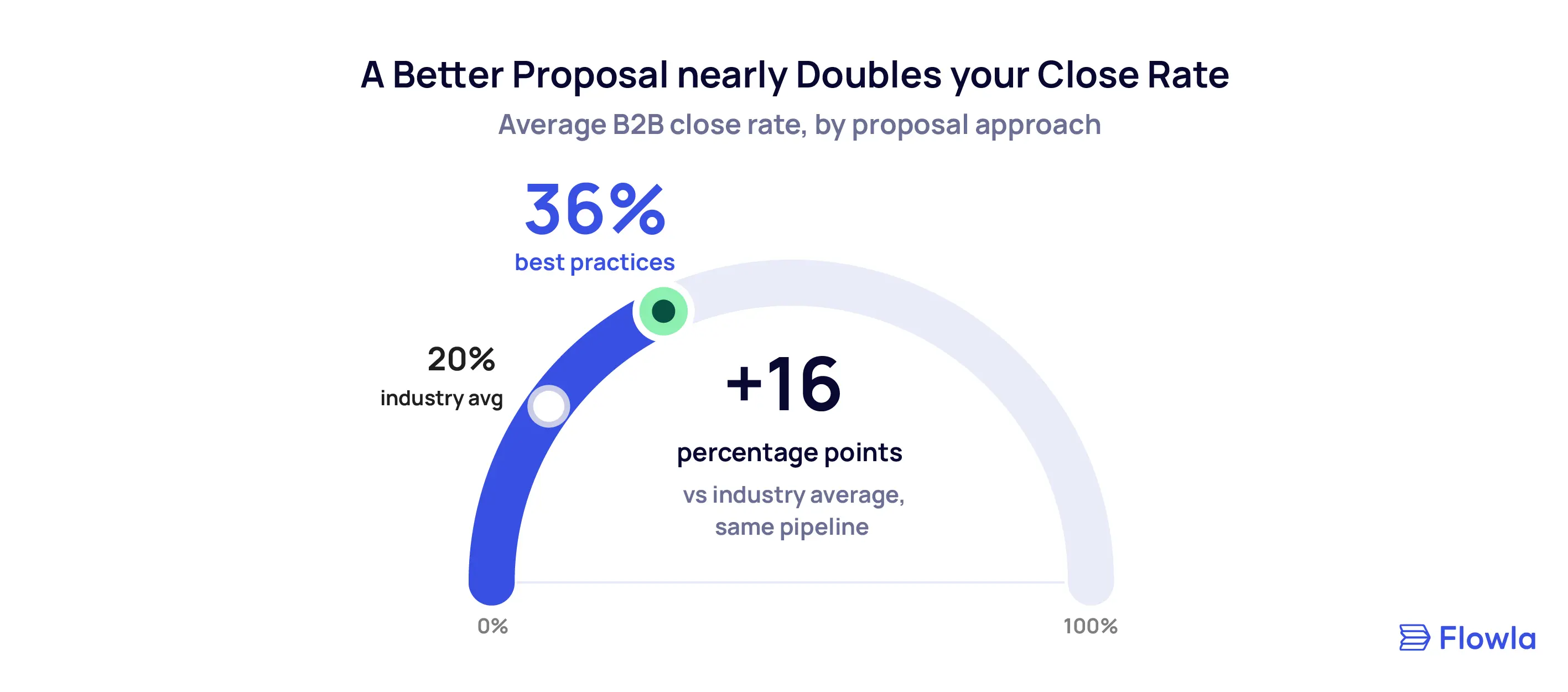
The gap this creates is expensive, and it cuts both ways. Proposify's analysis of millions of proposals found that teams applying proven proposal best practices close at 36%, against an industry average of around 20%. Same pipeline, nearly double the outcome, decided largely by how the proposal is built and who it's built for.
This guide covers what goes into a sales proposal, how to write each section so it lands with a full buying committee, the mistakes that quietly sink good proposals, and what to do after you hit send (including what to do when the buyer says yes, says no, or goes silent).
A sales proposal is a document that formalizes how your product or service solves a specific buyer's problem. It covers the problem, your solution, scope, pricing, proof, and next steps. Sales teams send it after discovery, once both sides have enough context to make the case concrete.
The proposal is not a brochure. It shouldn't describe your product in general terms or list capabilities that never came up in conversation. If your proposal could go to a different company with just the name swapped out, it isn't doing its job. A real proposal reflects a specific buyer's situation, in their language, mapped to their priorities.
A quote lists pricing and terms. A sales proposal frames why those prices are appropriate: what problem is being solved, what the solution involves, and what the buyer can expect to get back. Quotes work for transactional purchases where the buyer already knows exactly what they want. Proposals are for complex deals where the value case has to be made explicitly, usually to more than one person. Most B2B SaaS deals need a proposal, not just a quote.
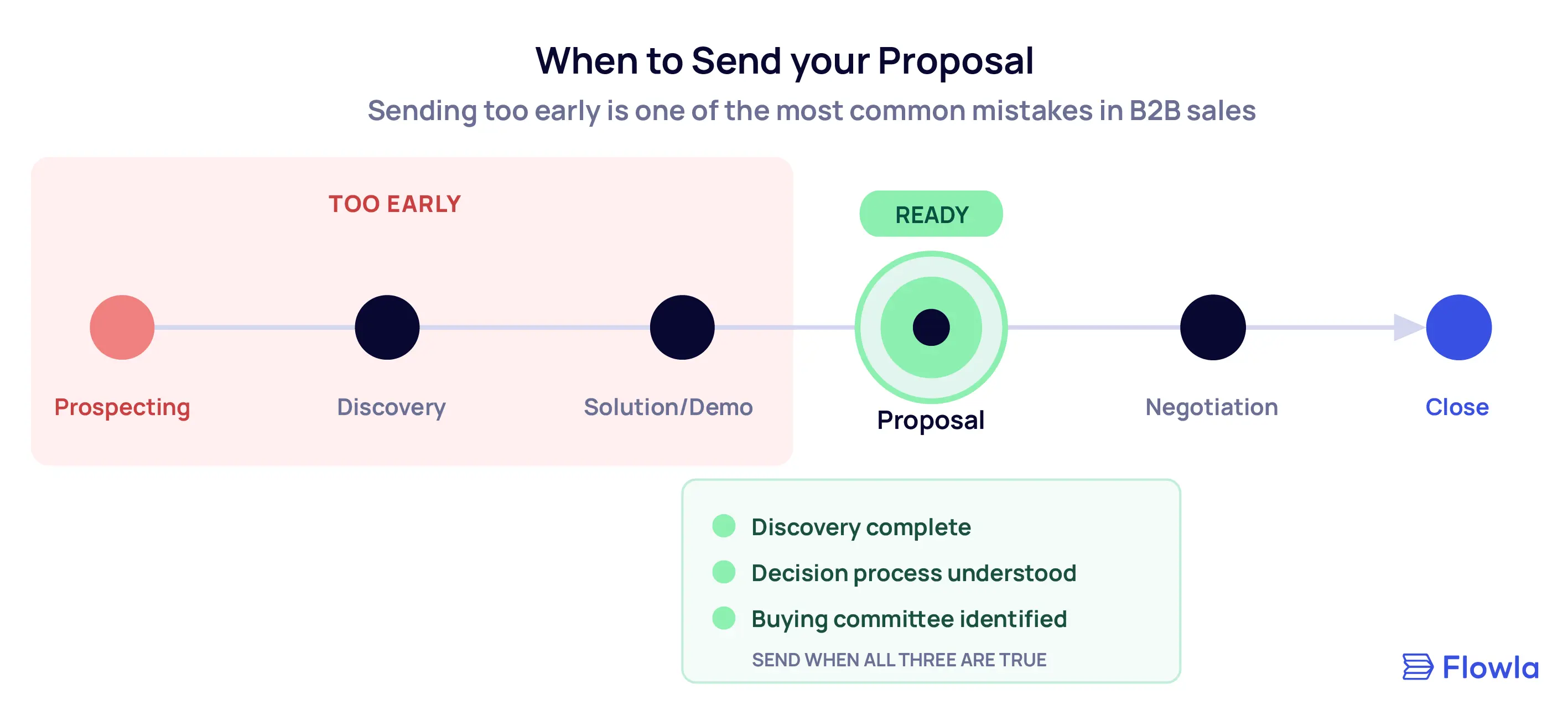
After discovery, once you understand the buyer's situation, their internal stakeholders, their timeline, and the metrics that define success for them. Sending a proposal too early is one of the most common mistakes in B2B sales, and we'll come back to it in Part 3. A proposal sent before you understand the deal is a price tag attached to nothing. The buyer reads a number before they understand the value, and every conversation after that becomes a negotiation instead of a business case.
It's also worth remembering how much the buyer already knows by this point. HubSpot's 2025 State of Sales Report found that 74% of sales pros believe AI tools are making it easier for buyers to research products on their own. By the time your proposal lands, the buying group has done its homework, formed opinions, and started comparing you against alternatives you may not even know about. The proposal isn't where you introduce your solution. It's where a committee decides whether to act on it.
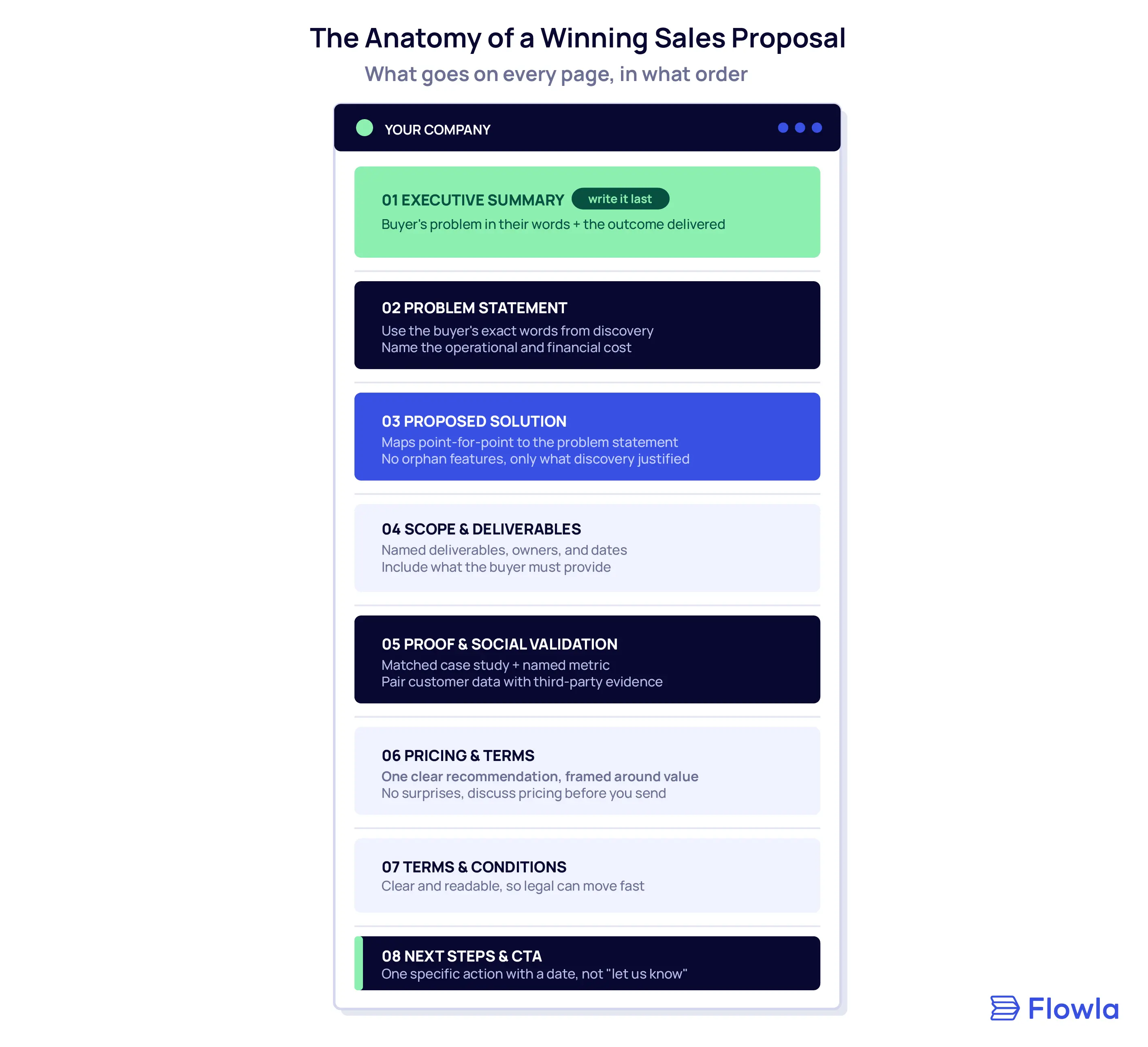
A complete sales proposal has eight components. The sections below go deep on each one, the quick-reference table is at the end of this section if you want the cheat sheet first.
The executive summary is the most important section and the one most often rushed. For senior stakeholders it's often the only section they read. Treat it as the whole proposal compressed to one page.
A strong executive summary does three things in order. It states the buyer's core problem in their own language. It frames the outcome they can expect, ideally with a number (cost saved, time recovered, revenue gained). And it points to the next step. Lead with the result, not your company background. The reader wants to know what this produces, not when you were founded or how many employees you have.
Write it last. The summary should reflect the complete argument you've built across the proposal, not your opening guess about what matters. Reps who write it first end up summarizing a case they haven't made yet.
"Acme is losing roughly 15% of new customers in their first 60 days because onboarding takes too long and stalls. This proposal lays out an implementation plan that cuts time-to-value from six weeks to two, with a projected reduction in early churn worth about $400K a year. Recommended next step: a 30-minute review with your CS and finance leads on Thursday."
It names the problem, quantifies the stakes, states the outcome, and ends with a specific action. A finance stakeholder skimming it gets everything they need in four sentences.
"Founded in 2019, [Vendor] is a leading provider of customer onboarding software trusted by hundreds of companies worldwide. Our platform offers a comprehensive suite of features designed to streamline your operations and drive efficiency across your organization." It's about the vendor, not the buyer. It leads with credentials, contains no outcome, and could be sent to anyone.
This is where a proposal reveals whether it was written for this buyer or adapted from last month's.
Pull the phrases your prospect actually used in discovery and put them in unchanged. If they said "we're losing track of what's been shared with each account," that exact sentence belongs here. If a head of customer success said "we lose customers in the first 60 days because implementation takes too long," write that down verbatim, not as "implementation delays impact retention." The first version is their problem. The second is your tidy summary of it, and the summary loses the specificity that makes someone feel understood.
A strong problem statement quantifies the problem operationally and financially. Operational is what's breaking day to day: reps wasting hours hunting for context, deals stalling after the demo, onboarding tickets piling up. Financial is what that costs: longer cycles, higher churn, revenue left on the table. Naming both signals you understand the problem at the level the economic buyer cares about, not just the end user's daily frustration. The CFO doesn't act on "the team finds it frustrating." They act on "this is costing us $400K a year."
Everything downstream (your solution, your pricing, your proof) is judged against this section. If the problem statement is sharp and recognizable, the buyer reads the rest as the answer to a problem they have. If it's generic, they read the rest as a pitch.
This section maps directly to the problem statement. It's a response to what they told you, not a feature list.
If three pain points came up in discovery, the solution addresses all three, in the same order they appeared. The buyer should be able to draw a line from each problem you named to the part of your solution that solves it. When the order matches and the language matches, the proposal feels built for them. When the solution wanders into features that solve problems they don't have, it reads as a generic package.
A useful test: for every element you propose, you should be able to point to the sentence in discovery that justifies it. If you can't, cut it or move it to an appendix. Features with no corresponding problem are noise, and they dilute the things that actually matter to this buyer. A focused solution that addresses three real problems beats a comprehensive one that buries them under twelve capabilities.
For each part of the solution, connect the "what" to the "so what." Write "automated onboarding workflows, so your CS team stops manually chasing setup steps and new customers reach value in two weeks instead of six," not just "automated onboarding workflows." The mechanism is what you do. The outcome is why they care.
Vague scope creates questions, and questions create delays at exactly the moment a deal needs to move.
Name the deliverables. If there are implementation phases, lay them out with rough timing. "Onboarding and setup" is not scope. "Week 1: data migration and integration setup. Weeks 2-3: team training and workflow configuration. Week 4: go-live and handoff to your CS team" is scope. Specificity reassures the operations stakeholder worried about disruption and gives procurement something concrete to plan against.
This is the part most reps skip, and it's where timelines quietly slip. State the dependencies on their side: data access, a technical point of contact, internal sign-offs, a list of users. Unspoken dependencies surface three weeks in, when the project's already behind and everyone's frustrated. Putting them in the proposal sets expectations early and makes you look like someone who's done this before.
Case studies, outcomes data, and customer quotes relevant to this buyer's situation. Social proof is one of the first things buyers look for and one of the strongest drivers of confidence for a hesitant committee. But generic proof does far less work than most reps think. (If you're short on assets here, our guide to the content that enables a champion to sell internally covers what to build.)
A case study from a large retail brand means little to a mid-market SaaS buyer. The most persuasive proof is matched: same company size, same pain point, ideally the same industry. Generic case studies signal that you have customers. Targeted ones signal that you've solved this buyer's specific problem before. When you have a close match, lead with that story. When you don't, lead with the outcome metric instead, because a 30% reduction in implementation time is credible regardless of the logo attached to it.
A measurable outcome with a specific number. A direct quote from the stakeholder who owned the project, not a marketing testimonial. And enough situational detail that the reader recognizes their own situation in it. "We cut their onboarding time by 60%" is fine. "A 200-person SaaS company was losing customers because onboarding took six weeks; we got them to two, and their head of CS said it changed how the whole team operated" is far stronger, because the reader sees themselves in it.
Your customer results prove you can deliver. Third-party research proves the problem is real and worth solving. Used together (market data to establish the stakes, your data to prove you address them) the proof moves from "this vendor says so" to "this is how the market works, and here's evidence we deliver against it."
Proof lands harder when you can see it. A chart showing the outcome you delivered, a before-and-after, a simple metric called out in large type: these do more than a paragraph of prose, and they survive a skim by a stakeholder who isn't reading every word. Proposify's analysis found that proposals containing images close at a meaningfully higher rate, which makes sense given how little time any single stakeholder spends reading.
Pricing deserves its own section, with framing. Present it as an answer to the problem, not a bare line-item list.
Restate the outcome right before the number. "Here is what this costs, and here is what it produces" does far more than a table floating with no context. When the reader sees the price immediately after the $400K problem it solves, the number lands differently than it would in isolation.
If a figure will surprise the buyer, that conversation happens on a call, not in the document the CFO opens alone. New line items, unexpected implementation fees, per-seat costs that feel different from what was discussed verbally: any of these can stall a deal that was otherwise ready to close. The pricing section should confirm what's already been discussed, not reveal something new.
For deals where finance examines everything, phased or milestone-based pricing can de-risk the commitment and make a large number easier to approve. Tying payment to delivered outcomes rather than asking for everything upfront gives a cautious buyer a reason to say yes now rather than wait.
Most proposal guides skip this. They shouldn't. In a committee deal, legal and procurement are stakeholders too, and a proposal that buries or omits terms hands them a reason to stall.
You don't need dense legalese in the body, but you do need clear, readable terms covering contract length, payment schedule, renewal, and anything non-standard about your agreement. Flag anything unusual upfront rather than letting legal discover it on page 14. The goal is to let the people who scrutinize terms do their job quickly, which keeps the deal moving instead of parking it in review. A clean terms section is a gift to procurement, and procurement that isn't frustrated is procurement that doesn't slow you down.
A proposal without a clear next step is an information document, not a sales tool.
Tell the buyer exactly what needs to happen and by when. If you need signatures, include the mechanism. If their side requires internal review, acknowledge it and name a check-in date. One specific action beats an open invitation every time. "Let us know if you have any questions" hands the entire next move to a busy buyer juggling other vendors. "Can we book 30 minutes Thursday to walk through this together?" gives them something concrete to say yes to. The easier you make the next step, the faster the deal moves.
| Section | What it does | What good looks like |
|---|---|---|
| Executive summary | Earns the next five minutes of attention | One page, states the buyer's problem in their words, leads with outcome |
| Problem statement | Proves you were listening | Uses the buyer's exact language from discovery, names operational and financial impact |
| Proposed solution | Connects your offer to their problem | Maps point-for-point to the problem statement, no orphan features |
| Scope and deliverables | Removes ambiguity about what happens | Specific deliverables, owners, dates, and what the buyer must provide |
| Proof and social validation | Builds confidence for hesitant buyers | Industry-matched case study with a named metric and a client quote |
| Pricing and terms | Frames cost as a function of value | One clear recommendation, no surprise line items, plain-language terms |
| Terms and conditions | Lets legal and procurement move | Clear, readable, nothing buried; flags anything non-standard upfront |
| Next steps and CTA | Tells the buyer exactly what to do | One specific action with a date, not "let us know if you have questions" |
Long enough to make the case, short enough that a busy stakeholder will actually read it. There's no universal page count, because the right length is set by deal complexity and how many people have to approve it, not by a rule. As a rough guide:
The honest test isn't page count, it's whether every page earns its place. A five-page proposal that makes a clear case beats a twenty-page one that buries it. Match the length to what the buyer's decision process actually demands.
The eight components are table stakes. What separates proposals that close from proposals that stall is how they handle the reality that a group of people, not one person, makes the decision.
This is the single highest-leverage move in proposal writing, and most reps skip it.
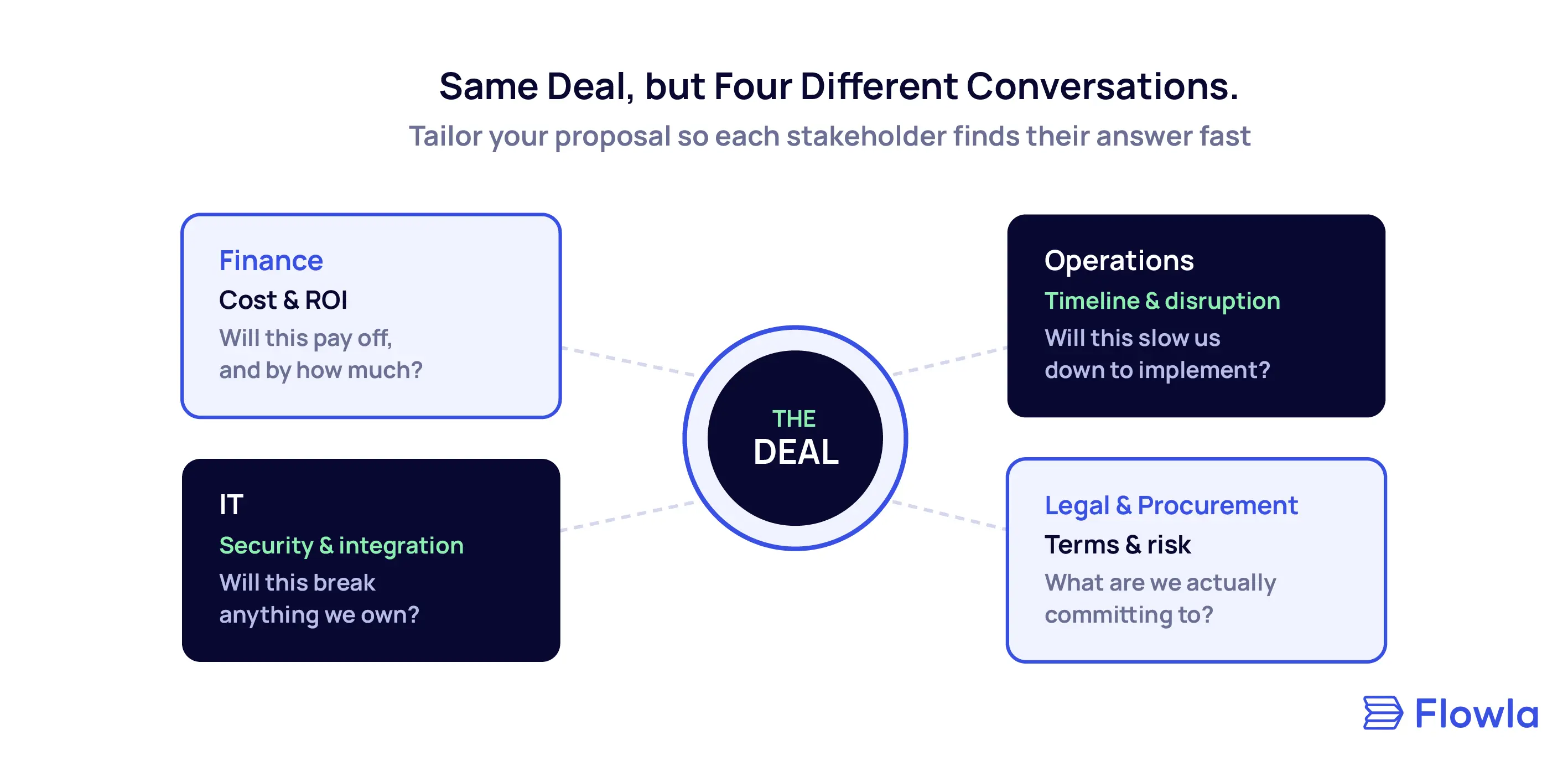
The same deal looks different depending on who's reading. Finance evaluates cost and ROI. Operations evaluates implementation effort and disruption. IT evaluates security and integration. Legal evaluates terms and risk. Your champion already gets it; everyone else is reading cold, through the lens of their own job. A proposal that speaks only to the champion's priorities loses ground with every other reader. (For a fuller map of who sits on these committees and what each role cares about, see our guide to the B2B buying committee.)
Salesforce's research found that 67% of sales professionals say personalization matters more to customers now than it did a year ago, and nothing tests that like a proposal read by five roles at once. The payoff is measurable: Proposify's research found that when more than one stakeholder views a proposal, the close rate doubles. The catch is that those extra stakeholders only engage if the proposal speaks to them. You don't need five separate documents. The practical version is one document built so each stakeholder finds their answer in seconds:
Clear headings, a summary at the top that flags where each role's concerns are addressed, and structure that lets people jump straight to their section. Same deal, different front page. The champion can then route the right section to the right person without having to translate the whole thing themselves.
Every proposal guide says "use the customer's words," and reps still paraphrase their discovery notes into something blander. The fix is literal: pull the phrases your buyer actually said and put them in the document unchanged. This isn't a soft point. Proposify's analysis of 2.6 million proposals found that fully customized proposals win at 50 to 65%, while ones built from rigid templates win at just 15 to 25%. People recognize their own words, and recognition builds trust faster than any claim you can make about yourself. It's the cheapest, highest-impact edit available, and almost nobody does it consistently.
Giving buyers three pricing tiers feels generous. In practice it shifts the conversation from "should we do this" to "which version should we get," and both are harder to close than the question you actually want answered. Worse, in a committee, three options multiply the disagreements: finance wants the cheap one, the end users want the expensive one, and now you've created an internal debate you're not in the room to manage.
Present one recommendation, the right one for this account, and build the case around whether it solves the problem. If the buyer wants to scale down, let them ask. Don't hand them a menu of ways to spend less before they've even agreed the problem is worth solving.
Gartner's research shows buyers spend only about 17% of their total buying time meeting with vendors; the rest is spent reading and deliberating on their own. Your proposal does a lot of work while you're not there, and it's competing with everything else on a busy stakeholder's desk. Short paragraphs, clear headings, bolded key numbers, and a logical flow let a reader extract the point in seconds. A proposal that requires careful reading to understand will be skimmed badly and judged on whatever the reader happened to catch.
A long proposal that hedges on every point is harder to approve than a short one that makes a clear case. Each section should carry exactly as much as it needs. Tight executive summary. Complete scope. Relevant proof. Cut anything that exists only to look thorough. Buyers reward clarity, not page count, and every extra page is another place for a stakeholder to get lost or find a reason to delay.
Most proposals don't fail because they're badly written. They fail because of timing, audience, or framing decisions made before a word hit the page.
A proposal sent too early is a price anchor with nothing behind it. The buyer sees a number before they understand the value, and the conversation collapses into a negotiation. The signal that a deal is ready isn't that the buyer asked for a proposal. It's that you've finished discovery, understand their decision process, and know who else will read it. If you can't name the buying committee yet, keep selling.
What to do instead: treat the proposal request as a discovery signal, not a finish line, and confirm you understand the full picture before you write anything.
This is the mistake behind the most painful late-stage losses. A proposal written for your champion, someone who's been in every call and is already sold, feels thin to everyone else. The CFO who skipped the demo, the legal lead checking scope, the VP asking "why now" all hit the document cold.
An account manager at a fast-growing AI infrastructure company described the underlying chaos in a recent conversation: "after three months and after 500 meetings you have no idea what you shared to who, when and who knows what." Context ends up scattered across email threads, Slack channels, and call transcripts nobody has time to dig through. The proposal has to carry enough of that context to stand on its own, for readers who have none of it.
The same buyer was candid about how the decision actually gets made internally, and it's a useful warning. Pitching one champion isn't enough: "if it's only one person out of 19 people, he's probably going to ignore it. When there's multiple people who say this is very interesting, then he would allocate time to it." Your proposal is the thing that turns one interested champion into the multiple voices a decision-maker actually listens to, but only if it gives those other people something they can act on.
What to do instead: write each section so a stakeholder who never spoke with you could understand it, and tailor the framing by role as covered in Part 2. For a practical framework on identifying every person who will touch the decision, see our guide to stakeholder mapping. It helps to know the late-stage buying signals that tell you the wider committee is actually engaging, not just your champion.
Proof sections too often become credential pages: a wall of logos, a case study from whatever industry happens to be handy. If the match is wrong, it does almost no work, and worse, it signals you're recycling.
What to do instead: lead with the closest situational match you have, and when you don't have one, lead with the outcome number instead of the company name. A relevant metric beats an impressive but irrelevant logo.
Pricing confusion is one of the most common reasons deals stall after a proposal goes out. It usually happens when the pricing section doesn't explain what's included, contains line items the buyer didn't know existed, or shows per-seat costs that feel different from what was discussed on a call. A confused CFO rarely asks for clarification. They just don't approve.
What to do instead: never introduce new information in the pricing section. Walk through anything sensitive on a call first, so the document only confirms what's already understood.
A proposal that ends with "let us know if you have any questions" leaves the next move entirely to the buyer. Busy buyers don't act on open invitations.
What to do instead: give them one specific next step, a meeting to walk through it together, a deadline tied to a real business event, or a signature request with a clear process. Make saying yes the easiest thing they can do next.
Most reps send a proposal and consider the writing finished. But deals evolve. Scope shifts, a new stakeholder appears, pricing gets negotiated. A static PDF can't keep up, and a proposal that's out of date by the second meeting undercuts your credibility.
What to do instead: keep the proposal live, in a place you can update as the deal moves, so it always reflects the current state of the conversation. This is far easier when the proposal lives somewhere editable rather than as an attachment frozen the moment you sent it.
The proposal is out. What you do next decides whether the deal closes or drifts. And most of what's possible here depends on a single choice: how you delivered it.
A PDF disappears the moment it's forwarded. You lose all visibility: who shared it, who opened the pricing section and went quiet, whether the CFO ever saw it at all.
A digital sales room replaces the attachment with a live, shareable link that stays with the deal. All the proposal content (case studies, pricing, scope, terms, next steps) lives in one place, and the buyer can share it internally without losing context. You can see every time someone opens it, which sections they spend time on, and who joined from the buyer's side. For deals that travel through 6 to 10 stakeholders (per Gartner's B2B buying data), that visibility is the difference between a managed deal and one that goes dark. Companies using digital sales rooms report closing 34% more deals.
A room also lets you carry rich media that a PDF can't: a short personalized video walking through the proposal, demo clips for the technical reviewer, a customer testimonial for the skeptic. Interactive, well-designed proposals consistently outperform static documents, and Gong's research found that multi-threading (reaching multiple stakeholders rather than one) boosts win rates by 130% in deals over $50K. A room is how you multi-thread a proposal without chasing five separate inboxes.
One caution, because the format isn't magic. Flowla's analysis of 30,000+ deal rooms found that roughly 48% of rooms created never get a single buyer view. The room itself doesn't close the deal; how you deliver and time it does. Rooms introduced during the call, with a specific reason to open them today ("I've already added the security doc your CTO asked for"), get opened fast. Rooms sent later as a generic follow-up link get opened a week later, if at all. The next two sections are about closing that gap. (More in our State of Digital Sales Rooms research.)
Engagement tells you more than replies do. If the CFO opened the proposal three times in 24 hours but nobody wrote back, that's a signal worth acting on, with a message about pricing and ROI specifically, not a generic nudge. If nobody opened it within 48 hours, something's wrong: the champion may not have forwarded it, or they've hit a blocker you should surface. Signal-based follow-up is only possible when the proposal lives in a trackable environment rather than a static file.
The worst cadence is the fixed one: day 3, day 7, day 14, regardless of what's happening. If legal opened the document on day 2, a follow-up about contracting beats a generic "any questions?" The point is to read the room and respond to what's actually happening, not to run a timer. Match your follow-up to what the engagement data is telling you, and make every touch specific to what that person actually looked at.
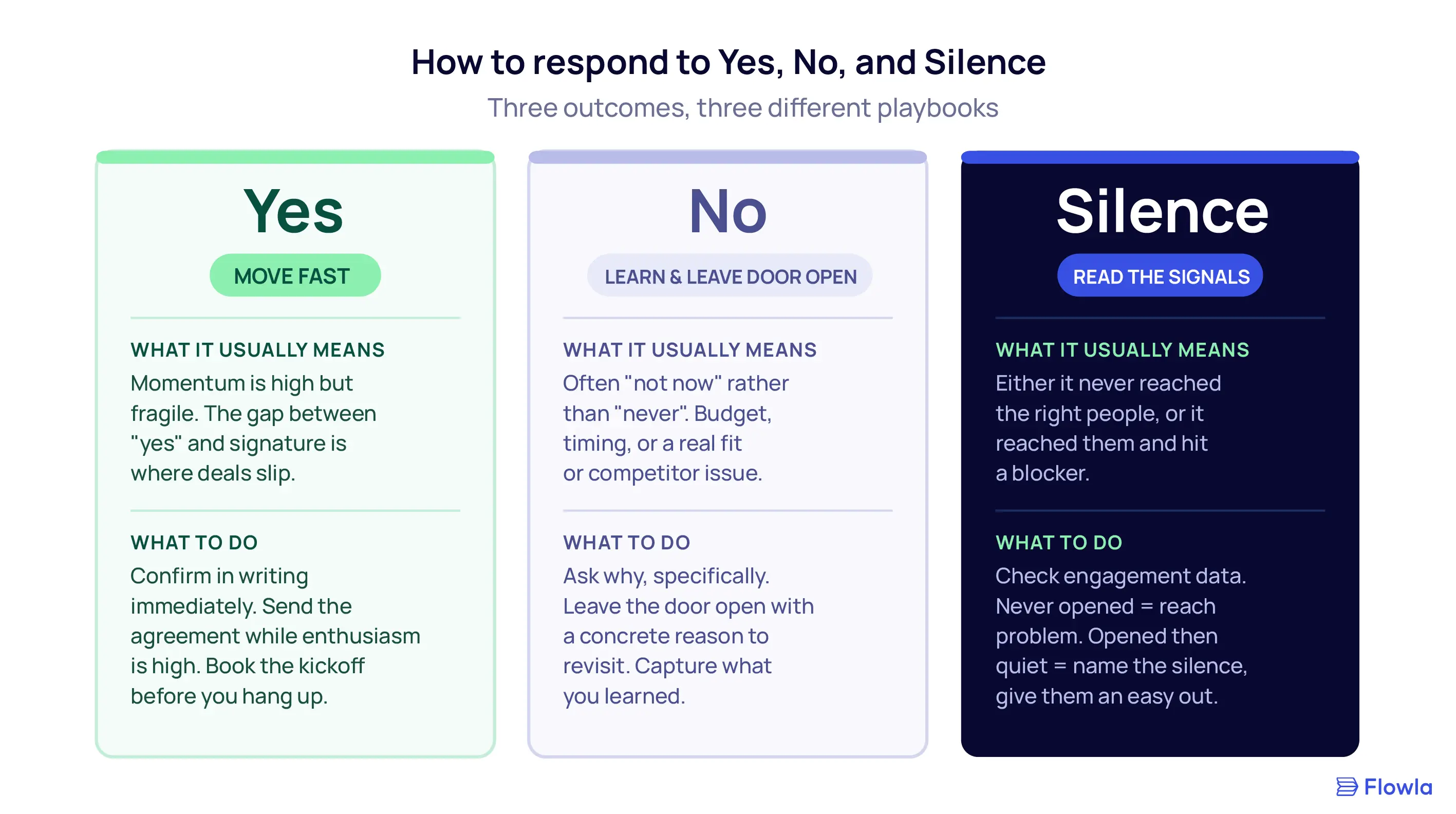
The three outcomes after sending need three different playbooks. Here's how to handle each.
| Outcome | What it usually means | What to do |
|---|---|---|
| They say yes | Momentum is high but fragile; the gap between "yes" and signature is where deals slip | Move immediately. Confirm details in writing, send the agreement while enthusiasm is high, and book the kickoff before you hang up |
| They say no | Often "not now" rather than "never" (budget or timing), sometimes a real fit or competitor issue | Ask why, specifically. Leave the door open with a concrete reason to revisit (new quarter, product release, their renewal date). Capture what you learned for the next similar deal |
| They go silent | Either it never reached them, or it reached them and hit a blocker | Use engagement data. Never opened means a reach problem (go back to your champion or find another contact). Opened then quiet means name the silence gently and give them an easy way to respond |
On the ghosting case specifically, a line that consistently surfaces the real blocker: "I haven't heard back, which usually means one of two things. It's not a priority right now, or there's a question the proposal didn't answer. Either is completely fine, just let me know which." Low-pressure, honest, and it gives a stalled buyer an easy door to walk through.
Writing every proposal from scratch is slow, inconsistent, and the main reason reps spend hours on formatting instead of selling. Qwilr's research puts it bluntly: sales reps spend around 60% of their time on non-selling activity, a chunk of it on building quotes and documents. A good template claws that time back without making proposals generic. The craft is choosing the right tool, then knowing what to standardize and what to leave open.
You have four broad routes, and the right one depends on how complex your deals are and whether you need to see what happens after you hit send.
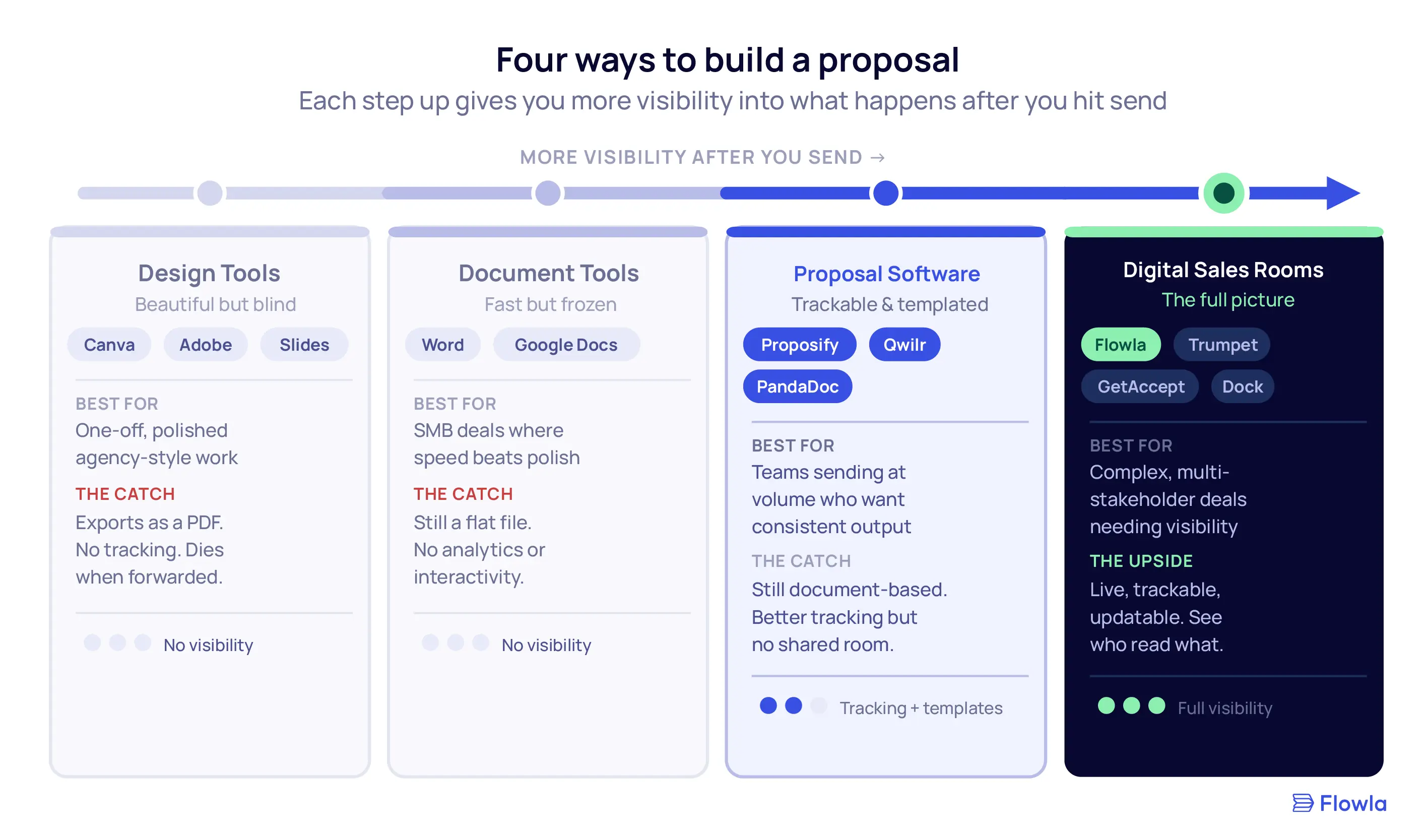
Good for visual control and a polished look, which is why agencies and brand-led teams reach for them. The catch is what you end up with. However beautiful the design, you export a PDF and email it, which drops you straight back into the problem Part 4 just walked through: no tracking, no idea who opened it, and a document that dies the moment it's forwarded. They're also hard to version-control across a team, so reps drift into editing the master file and consistency erodes. Fine for a one-off, weak as a repeatable system.
Fast and familiar, and fine for transactional or SMB deals where speed beats polish. But they break easily, they're the most common way a proposal goes out with the last client's name still in it, and like design tools, they ultimately become a PDF or a flat doc link with no analytics and no interactivity. You're writing a document, sending it into the void, and hoping. For a low-stakes deal that's acceptable. For anything with a committee, you're flying blind at the exact moment visibility matters most.
Built for exactly this job. They offer reusable templates with locked sections, content libraries, embedded video, e-signature, and engagement tracking, so reps stop rebuilding documents and managers get consistency and visibility. This is a real step up from design and document tools, because the proposal stops being a static file and becomes something you can track and update. Best for teams sending proposals at volume that want control over what goes out.
A digital sales room takes the logic of the whole guide to its conclusion. Instead of a proposal that lives as a document, the proposal becomes one part of a shared, branded space built for the deal. Everything the buying committee needs (proposal, pricing, case studies, mutual action plan, next steps) sits in one link that stays live as the deal moves. The buyer's champion can route it internally without anything getting lost, you see who's engaging with what, and the room updates in place rather than being re-exported every time something changes. It's the difference between sending a file and giving the buyer a place to make the decision.
The category has real range. Trumpet leans into collaborative, personalized buyer hubs. GetAccept is rooted in document and contract workflows with strong e-signature. Dock focuses on shared workspaces across the full customer lifecycle. Flowla sits in the room-based camp with an emphasis on automation, pulling context from your CRM and calls so the room and the proposal inside it build themselves, then keep updating as the deal progresses. For complex, multi-stakeholder deals, which is most B2B SaaS in 2026, a room is the format the rest of this guide has been arguing for: built for the people who weren't in the call, trackable once it's out of your hands, and current in the meetings you'll never attend.
Whatever tool you choose, the discipline is the same. Lock the structure, the branding, the boilerplate (company background, security and compliance language, standard terms), and your strongest proof assets. These should look the same on every proposal your team sends, and locking them stops a rushed rep from shipping an off-brand document, or worst of all, wrong pricing.
Leave open everything that has to be specific to the buyer: the executive summary, the problem statement, the solution mapping, and the pricing. These are the parts that win deals, and they should be the only parts a rep actually spends time on. A good template makes the repeatable 70% effortless so the rep's energy goes into the 30% that's personalized. Two smaller moves sharpen this further. Where it fits, reflect the buyer's brand on the cover, not just yours, which signals the document was built for them specifically. And pull buyer data straight from your CRM so the proposal starts half-built with the right name, the right context from discovery, and the right pricing fields populated. That last one saves hours and kills the wrong-name, stale-pricing errors that quietly damage close rates.
If the template lives in a room rather than a file, it keeps working after you send it, updating in place as pricing changes or a new stakeholder joins, instead of being re-exported each time. The template becomes the starting point for a living proposal rather than a one-time download.
This whole guide argues against sending a static document, so it would be strange to end with a downloadable PDF. The format we've been recommending throughout, live, trackable, updatable after you send, is what Flowla is built for. Book a demo to see what a proposal room looks like in practice, and how it changes what you can do after you hit send.
A complete sales proposal includes an executive summary, a problem statement in the buyer's own language, a proposed solution mapped to that problem, scope and deliverables, industry-matched proof, pricing framed around value, clear terms and conditions, and a specific next step. Every section should reflect this buyer's situation rather than a reusable template, and the whole document should be navigable by stakeholders who never spoke with you directly.
Write for the people who won't be in the room. Use the buyer's exact language, map your solution directly to their stated problems, tailor the framing so each stakeholder (finance, operations, IT) finds their answer fast, and make a single clear recommendation rather than a menu of options. A winning proposal doesn't try to impress. It makes the decision easy for a committee that's evaluating you without you there.
Specificity and clarity. A proposal stands out when it uses the buyer's exact language, addresses the people who weren't in discovery, tailors its framing to each stakeholder, and makes the business case in terms they care about. Most proposals talk about the vendor's capabilities. The ones that win talk about the buyer's problem and make the decision easy for a committee.
An interactive or web-based proposal outperforms a static PDF in most B2B contexts. It's easier to navigate, can be updated as the deal evolves, carries rich media like video and demo clips, and gives the rep visibility into who's engaging. If you're stuck with a traditional document, structure matters most: a one-page executive summary, clear headings throughout, stakeholder-specific summaries, and pricing presented in context rather than as a bare table.
Anchor the feedback conversation before you send it. "I'll send this over today, can we book 30 minutes Thursday to walk through it together?" gets a specific commitment instead of an open-ended wait. If you've already sent it without booking that call, follow up with one direct question ("Was there anything that raised questions?"), which is far easier to answer than a vague invitation to respond.
Usually not in the same document. A proposal makes the business case for moving forward; a contract formalizes terms once both sides agree. Combining them can create friction, pulling buyers who liked the proposal into contract review before they've committed in principle. Keep clear terms and conditions in the proposal so legal and procurement can do their part, but move the proposal and the contract in sequence rather than stapling them together.
Build one document that works for multiple readers. Open with a one-page executive summary, then structure the proposal so each stakeholder can jump to their concern: ROI and pricing for finance, implementation and timeline for operations, security and terms for IT and procurement. Use clear headings, surface key points fast, and deliver it somewhere shareable and trackable so your champion can route it internally without the context getting lost.
Follow up based on engagement signals, not a fixed schedule. If you can see who opened the proposal and which sections they focused on, make your follow-up specific to that: a CFO who lingered on pricing gets a different message than a technical lead who studied the implementation plan. If you have no visibility into engagement, the most important move happens before you send, by booking a walk-through call so there's a built-in next step rather than an open-ended wait. (For more on the post-send motion, see our playbook on boosting post-demo conversions with effective follow-up.)
The format we've been recommending throughout this guide, live, trackable, updatable after you send, is what Flowla is built for. Book a demo to see it in action.
Book a demoBook a 15-minute chat with a product expert. We'll walk you through every step of the way as you get set up.
.webp)
.webp)
.webp)


.webp)

.webp)
.webp)
.webp)




.webp)
%20(3).webp)
.webp)


.webp)
.webp)
.webp)
.svg)

.webp)
.webp)