.webp)
.webp)


.webp)

.webp)
.webp)
.webp)




.webp)
%20(3).webp)
.webp)
.webp)


.webp)
Boardwise builds governance software that digitises board meetings for large organisations across Germany. Their onboarding process involves detailed configuration, multiple stakeholders, and a high expectation for structure. As the customer base grew, the team was running it entirely through email. CSMs were spending time chasing progress, repeating information, and covering for a process with no shared visibility. After implementing Flowla, Boardwise decreased call time per customer by 63%, saving 3.5 hours of meetings per onboarding. They embedded step-by-step learning videos directly into customer rooms, automated follow-up reminders, and gave every customer a single place to track their own progress.
The problem: a manual process that broke under growth
Boardwise serves large organisations with complex governance requirements. Their onboarding involves multiple configuration phases, each requiring the customer to set up specific parts of their board environment: agenda settings, user roles, document workflows, approval chains. Each customer was requiring around 5.5 hours of calls to get through their onboarding. Across a growing customer base, that added up fast.
For a while, running this through email worked well enough. The team was small, the customer base was manageable, and CSMs could keep track of where each account stood. But as Boardwise grew, the cracks became visible. Information about what had been agreed in the sales process did not reliably make it to the CSM. Customers forgot things they had been told on calls and, with no central record, emailed their CSM to ask again. The CSM had to search back through threads to find the answer, or ask the AE, or guess.
Lea Rudinger, Customer Operations Manager at Boardwise, puts it plainly: "There was sometimes information just in the head of people, and it's not noted down anywhere in the systems. This was a lack of transparency across the stakeholders and internally."
The cost was not just time. It was relationship quality. CSMs who should have been building trust with new customers were instead explaining the same configuration steps repeatedly. The customers on the receiving end were not getting a confident, structured experience.
What they needed: structure that could scale
Lea joined Boardwise when the team was small and has watched it grow. Her role sits across internal operations and customer experience, which means she felt the problem from both sides. She was not looking for a project management tool or another CRM integration. She needed something that could carry the onboarding process from the AE handover all the way through to go-live, in a way customers could follow without a CSM holding their hand at every step.
The requirements she built before evaluating tools came down to four things: a step-by-step structure customers could navigate independently, integration with Gong and HubSpot, automation that reduced manual workload without removing human oversight, and something intuitive enough that a small CS team could adopt quickly.
Flowla met the brief. The project room structure matched the way Boardwise already thought about onboarding: sequential, milestone-based, visible to both sides. The HubSpot integration meant data did not have to be maintained in two places. The automation layer meant reminders, follow-ups, and status updates could run without a CSM triggering them manually. Boardwise is now one of many CS teams using Flowla for customer onboarding and implementation at scale.
"Flowla almost checked everything on the list," Lea says. "And while exploring it, I noticed we could do so much more than I had originally planned."

How Boardwise uses Flowla today: a room for every customer, from kickoff to go-live
Every new Boardwise customer gets a Flowla project room at the start of their onboarding. The room is structured around the configuration phases specific to Boardwise's product. Each section contains the learning videos, action items, and documentation relevant to that phase, presented in the order the customer needs to work through them.
Embedded learning videos replace live explanation
Rather than walking customers through configuration on a call or sending instructions by email, Boardwise now embeds short learning videos directly into the relevant steps of the room. Customers can watch them at their own pace, return to them when they need to, and work through configuration without waiting for a CSM to be available. The step-by-step structure means nothing gets missed and customers always know what comes next.
Automated reminders replace manual chasing
Action items in the room trigger automated reminders when they are overdue. CSMs no longer send manual follow-up emails to check on progress. Instead, they send communications directly from the room, with links to the specific step that needs attention. The customer receives a message that takes them straight to the relevant part of their room, rather than a generic email they have to interpret and act on separately. It is the same pattern behind Flowla's onboarding automation workflows, and one that other Flowla customers have used to remove manual follow-up entirely.
HubSpot stays in sync
The HubSpot integration means contact information and deal data flow between the two systems without manual entry. CSMs working in Flowla are not maintaining a separate record in their CRM. The two stay aligned automatically.
The practical result came into focus early in the rollout. One customer, working through the configuration phase for the first time, blocked an hour in her calendar, entered her project room, worked through every step, and checked each one off as she went. She did not contact her CSM once. Her feedback was direct: "It's so structured, it totally makes sense."
.webp)
The results: customers who self-serve, CSMs who can focus
The shift in how the team spends its time is concrete. CSMs are no longer explaining configuration steps on repeat. Customers who would previously have emailed to ask where they were in the process, or what they needed to do next, now have a room that answers both questions without any CSM involvement.
Each customer now needs 2 hours of calls instead of 5.5, a 63% decrease, saving 3.5 hours per onboarding. Customers now work through the steps independently in their Flowla room before getting on a call, which means the call itself is focused on decisions and questions rather than basic walkthrough. Instead of being reactive, available to answer the same questions again, the CSM team can be proactive. Check-ins become conversations about the substance of the implementation, not status updates.
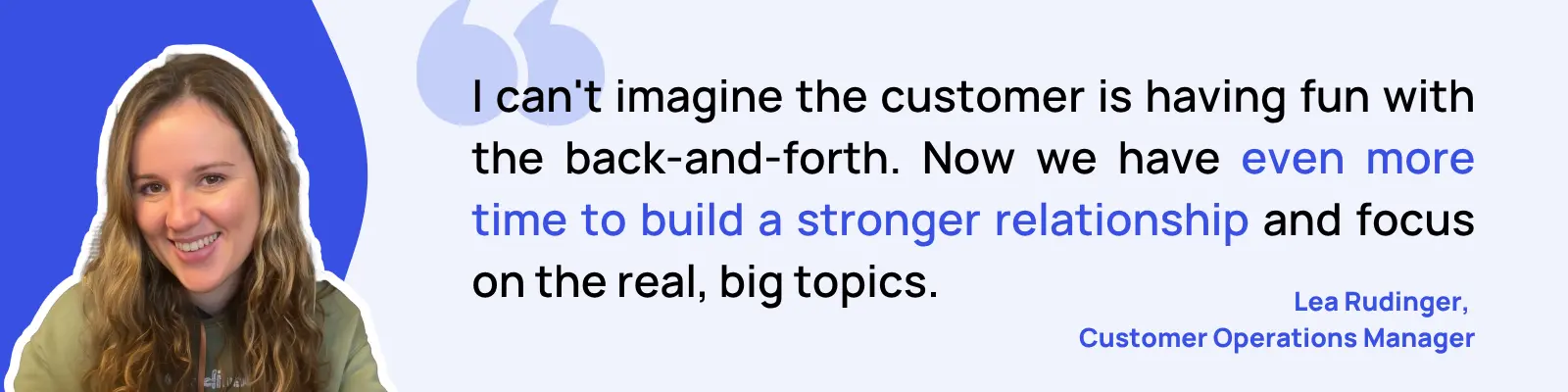
"Without having to explain one button five times," Lea says, "we have even more time to build a stronger relationship and focus on the real, big topics. I can't imagine the customer is having fun with the back-and-forth either."
For CS leaders dealing with similar problems, this breakdown of common customer onboarding challenges covers the patterns Boardwise ran into and how teams are solving them.
The AE team has also started adopting Flowla. The prospect of a unified room carrying the customer from the sales process through to onboarding, with no handover gap, is something the AEs raised themselves.
What Lea would tell someone considering Flowla
Lea's advice is practical. Start with a clear requirement list before evaluating anything. Know what you need before you see what is available, because the number of tools in the market becomes overwhelming quickly.
For CS and operations leaders dealing with fragmented processes and inconsistent handovers, her view is straightforward. The combination of structured project rooms, embedded content, and automation means customers can get to value faster without putting more pressure on a CS team to deliver it manually.
"If you have fragmented processes and no unified customer journey," she says, "Flowla is definitely a recommendation from me."
Boardwise is now expanding Flowla use beyond the CS team. The sales team is next.
.webp)
.webp)
.webp)
.webp)
%20(3).webp)
.webp)
.webp)
.webp)
.webp)
.svg)

.webp)
.webp)