.webp)
.webp)


.webp)

.webp)
.webp)
.webp)




.webp)
%20(3).webp)
.webp)
.webp)


.webp)
Mindbody is a wellness SaaS platform serving thousands of fitness studios, spas, salons, and health businesses worldwide. It is part of the Playlist portfolio of brands, which also includes ClassPass, Booker, EGYM, and Kite.
The team set out to fix a persistent problem: too many customers were either stalling mid-onboarding or never engaging with it at all. After a competitive evaluation, they selected Flowla as their customer-facing onboarding portal. Using Flowla has showed a 34% reduction in time to go live, a 66% higher onboarding completion rate, and more than double the number of customers going live within their first week.
The problem: customers were dropping out before they even started
Mindbody works with businesses of all sizes, from large fitness chains with thousands of franchise locations to single-location studios where the owner is simultaneously the yoga instructor, the front desk, and the person trying to get their software configured.
For these smaller businesses, onboarding kept breaking down. Customers were too busy running their businesses to carve out the time, and when they did try to engage, the process gave them no clear sense of where they stood or what came next.
Madeline Sylvester, Senior Director of Implementation and Customer Success at Mindbody, saw this firsthand. Her team is responsible for getting every new customer live on the software. As she puts it: "Customers told us it was difficult to keep track of where they stood. What actions they owed us, and what we owed them."
Amir Nematbakhsh, the Product Manager at Playlist who led the Flowla programme from end to end, had been tracking what that disengagement actually cost. Customers who did not complete onboarding churned at a 1.5x higher rate than those who did.
Before Flowla, onboarding was a series of emails, calls, and calendar invites, with specialists holding most of the context across internal tools. From the customer's side, there was no single place to see what was happening, what they needed to do next, or what was already done.
"Onboarding is the first real post-sale experience a customer has with us," Amir says. "If we get it right, they're set up for years of success. If we get it wrong, we've seen it flow straight through to churn."
When a customer stalled, the onboarding team had no reliable way to spot it early. Implementation, payments, and the Mindbody app team were all involved in the same customer journey, with no shared view of where things stood.
What Mindbody needed: one view, one front, no engineering lift
Mindbody had tried duct-taping existing processes together, but it was not working. Building something custom in-product would take six to twelve months, and Amir did not want to commit that time before knowing whether the hypothesis was even right.
They needed a tool that gave customers a clear end-to-end view of the onboarding process without overwhelming them, that consolidated communication across multiple internal teams, and that could handle the variety of Mindbody's customer base (different business types, software tiers, and add-ons) without an engineering lift for each variation.
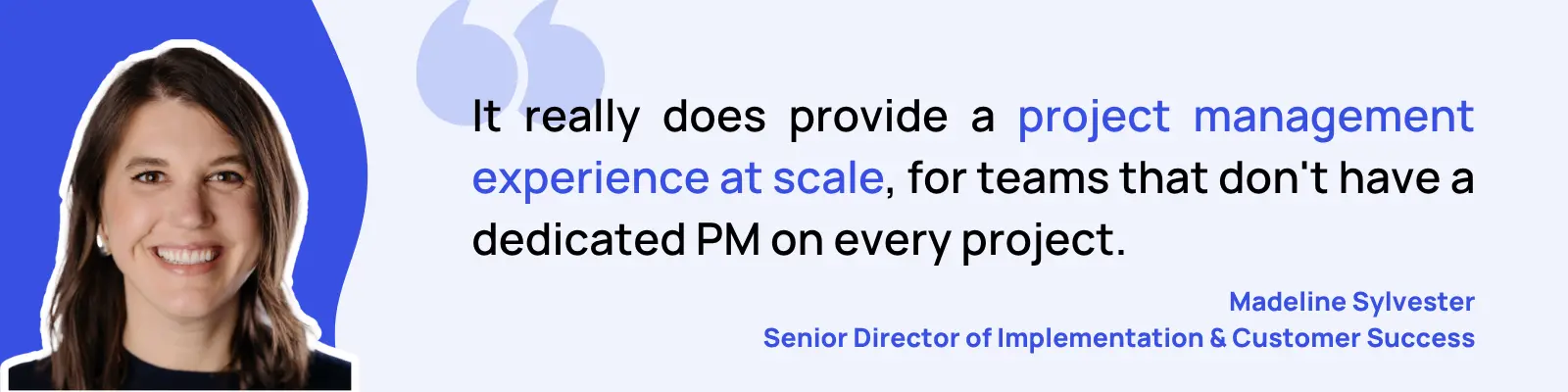
Madeline describes it: "We needed a partner that would give customers an end-to-end view of the process, presented in bite-sized chunks that were easy to absorb. And Flowla let us consolidate communication across our internal teams so we came to the customer as a united front."
Flowla stood out for four reasons: speed (a pilot in market within weeks, not quarters), flexibility (templates tailored by segment and vertical without engineering), the right investment size to test the hypothesis properly, and from the first conversation, the Flowla team behaved like a partner rather than a vendor.
"From the very start, Flowla just felt like a partner," Amir says. "Everyone on the team was collaborative and really understood our problems. They tried to dig in with us rather than just be a third party."
How Mindbody uses Flowla today: a room for every customer, from day one
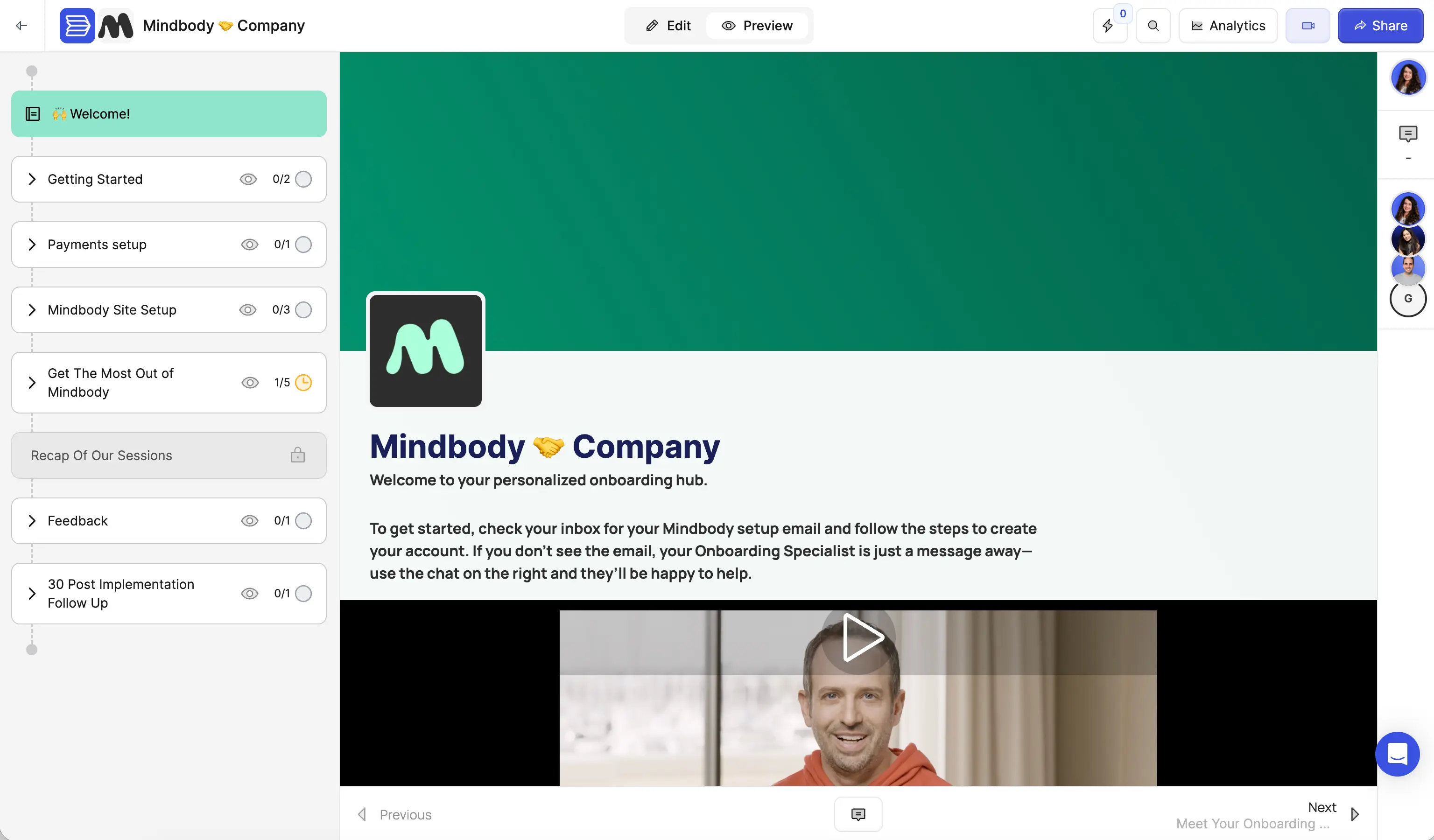
Every new customer in North America gets a Flowla room at the point of sale. Inside it they can see the milestones they need to hit, the documents required, the sessions booked with their specialist, and their progress so far.
Three workflows have had the biggest impact.
Pre-kickoff requirements gathering. Before a customer gets on a call with an onboarding specialist, Flowla is already capturing their requirements. Specialists walk into the first meeting with context rather than starting from zero. Amir points to this as one of the single biggest drivers of the reduction in time to go live.
Mindbody uses Flowla Forms extensively here. Their customers are not a uniform group, spanning very different business types and operational needs. Collecting the right information upfront means the software gets configured to match what each business actually needs. As Madeline puts it: "We're not mind readers. We can configure the software for really any type of business. But we need to understand what a customer is trying to achieve with their data before we can set them up properly."
Payments attach at the right moment. By surfacing Mindbody's integrated payments tools earlier in the onboarding process, the team saw a real improvement in how quickly customers were able to explore, and see the benefits of, using Mindbody as their payments processor. In-month payments attach rose meaningfully, a gain that translates directly into revenue.
Centralised visibility for internal teams. This was not anticipated going into the pilot. As specialists started using the portal alongside customers, they got a shared, real-time view of every active project. They could see who was on track, who was stalling, and which rooms had gone quiet. Proactive follow-up became possible in a way it had not been before.
Madeline describes the shift: "Our onboarding specialists can now keep track of where all the customer information for a given project sits. When someone goes on holiday and a colleague needs to cover, they can get up to speed immediately. Everything is already in one place, including the call recordings."
The portal also created greater consistency. Because the onboarding steps are in front of both the specialist and the customer on a shared platform, nothing gets skipped.
The results: 34% faster, twice as many customers live in week one
The pilot ran across Mindbody's North America new customer segment and went to an executive leadership team readout with strong conclusions.
Time to go live fell by 34%. A more efficient use of the onboarding team's capacity across every project.
First-week completions more than doubled. The share of customers going live within their first week rose from 4.6% to 10.5%.
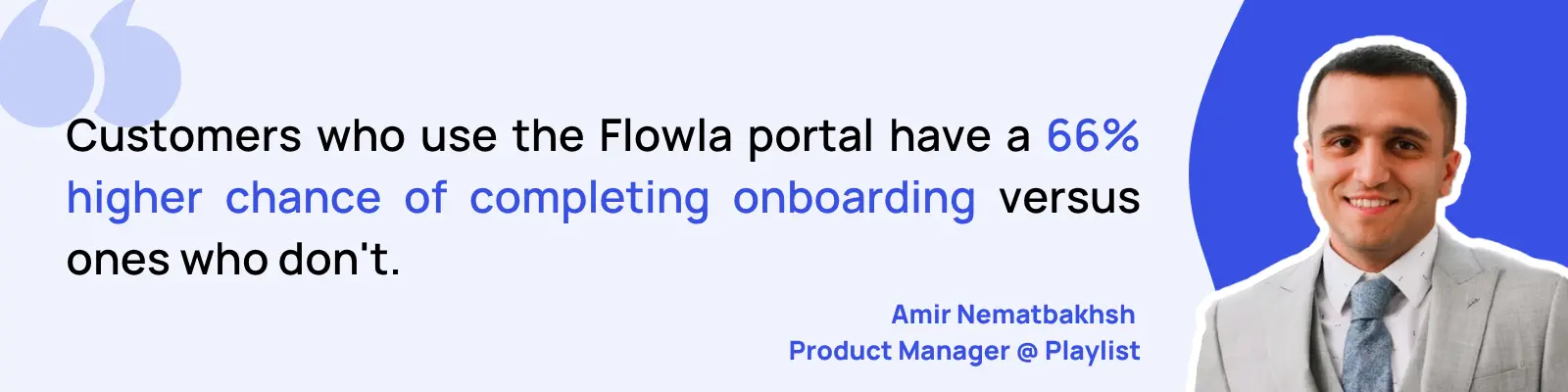
Customers using the portal are 66% more likely to complete onboarding. Within the same cohort, portal users had a 66% higher chance of completing onboarding. The clearest signal the tool was doing what it was designed to do.
80% of portal users took multiple meaningful actions. Of customers who engaged with the portal, almost 80% took multiple meaningful actions. Those customers moved through onboarding faster and with fewer stalls.
For Amir, the moment it clicked was when the data came in. "The aha moment came when I could dig into the numbers. Everything needs to go back to revenue, the reduction in churn, and onboarding completions. When I saw that, I thought: yes, this is working."
There was also an earlier signal. Amir interviewed around ten customers during the pilot, and the feedback was positive across the board, including from customers who had not fully engaged with the portal. "I was expecting some of them to say it wasn't helpful. It was quite the contrary. Even customers who didn't fill in the forms said they loved it because they knew what to expect going into every call."

On the ground: what changed for the team
At Mindbody, the rollout was faster and smoother than expected. Part of that was Flowla's intuitiveness. Part of it was that the team was brought into the process of building it.
Madeline was deliberate about this. The onboarding specialists are the ones sitting with customers every day, not her. As Flowla templates were built and iterated, their feedback shaped what went into them. Adoption did not need to be enforced.
Templates were live within weeks, with no engineering involvement needed. Onboarding specialists on Madeline's team made changes themselves, testing what resonated without waiting on a development queue. Changes were incorporated into Flowla's new releases throughout, and new functionality was built in response to requirements Mindbody had flagged from the start.
What Madeline and Amir would tell someone considering Flowla
Amir's advice: go in with a clear hypothesis, a specific set of things you want to test and a way to measure each one. Loop in your sales team from day one. The handoff from sales to onboarding is a critical engagement point, and if they do not believe in the portal, you will lose momentum right at the start. And treat Flowla as a partner from the beginning. "If you're willing to work with the Flowla team on templates, measurements, and iterations, you'll get a lot more out of it than if you just stand it up and walk away."
Mindbody is now expanding the programme to international markets and other product offerings.
*Based on internal data from the Flowla pilot (November 2025 through February 2026) for NA-based new customers. 34% faster and 2.3x figures compare pre-pilot and pilot period averages. 66% higher completion rate compares customers who engaged with the Flowla portal to those who did not during the pilot period. Results may vary.
.webp)
.webp)
.webp)
.webp)
%20(3).webp)
.webp)
.webp)
.webp)
.webp)
.svg)

.webp)
.webp)