
We looked at the 30,000 deal rooms we analyzed to see what buyers actually do when they evaluate a vendor. The average room was opened 18.8 times, usually between sales calls, often by a director or VP with no rep anywhere near it. The room is doing a large share of the selling on its own, in front of the exact people who decide the deal, before anyone reads your carefully written copy.
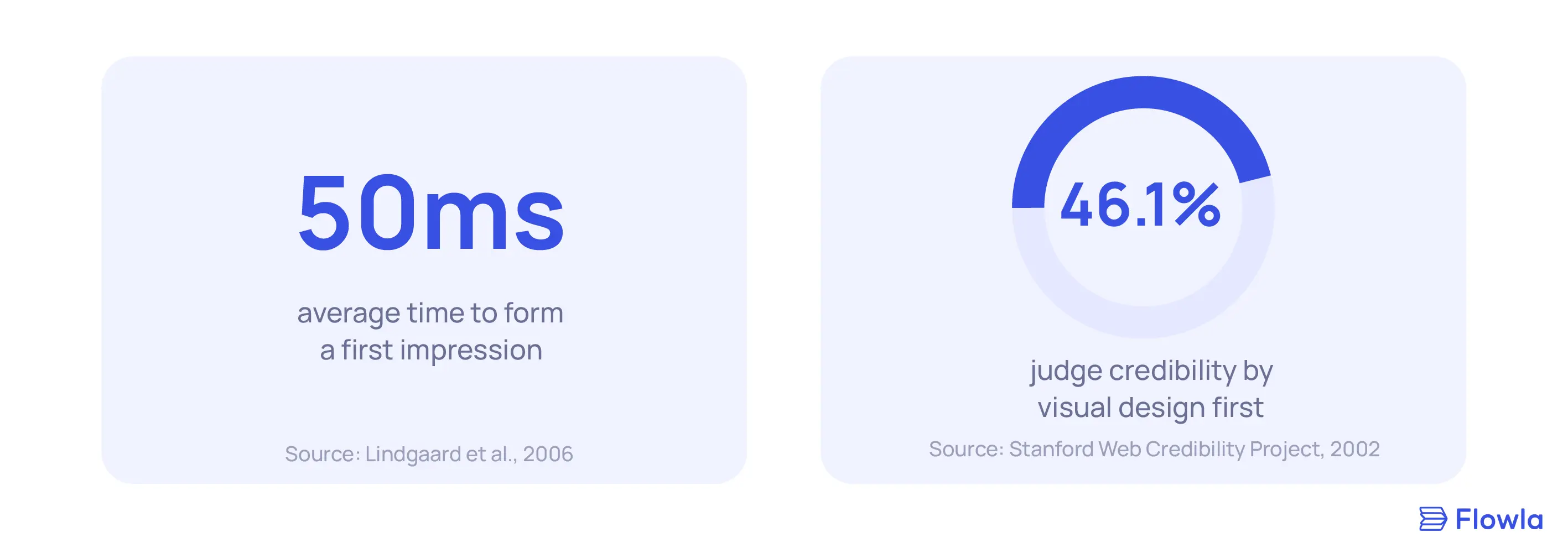
That first impression forms fast. About 50 milliseconds, faster than a buyer can read a headline, according to Lindgaard and colleagues at Carleton University (2006). A deal room is similar to a web page, and the same reflex applies.
Most digital sales rooms can already apply a target company's brand colors to a theme. What's still rare is how deep the control goes once that theme exists, whether the theme is actually generated for you rather than a template with one color swapped, and whether it holds up as new content gets added later. This piece covers what real depth of customization looks like, the psychology behind why it matters, and how Flowla Themes handles all three: element-level control, AI-generated theming, and governance that scales.
Every vendor in this category claims customization, and the basics are now genuinely common: your own logo and colors, and, increasingly, a theme that picks up the target company's colors too. Dock puts its version plainly on its own site: use your logo, colors, and custom domain "to make every workspace feel like an extension of your brand." Peony auto-applies your logo and brand color across every view once you set it up. Trumpet's AutoBrand AI generates a palette from a prospect's URL. Automatic theming to a target company is no longer the differentiator it once was.
What's still uneven across the category is what happens after the theme is applied: how far down you can actually control it, and whether it was generated with any real intelligence behind it or just recolored on top of a fixed template.
Real customization is about depth: how much of the room you can shape once a theme exists, and whether that theme was actually built for the deal in front of you.
Strip away the marketing and there are three distinct things a sales room can let you control. Most tools handle the first two reasonably well. Almost none handle the third.
The gap between a room that looks intentional and one that looks generic usually comes down to that third layer, and none of the roundups we reviewed compete on it.
Saying a room can theme to a target company is not one capability, it is two, and pulling them apart is where the real comparison lives.
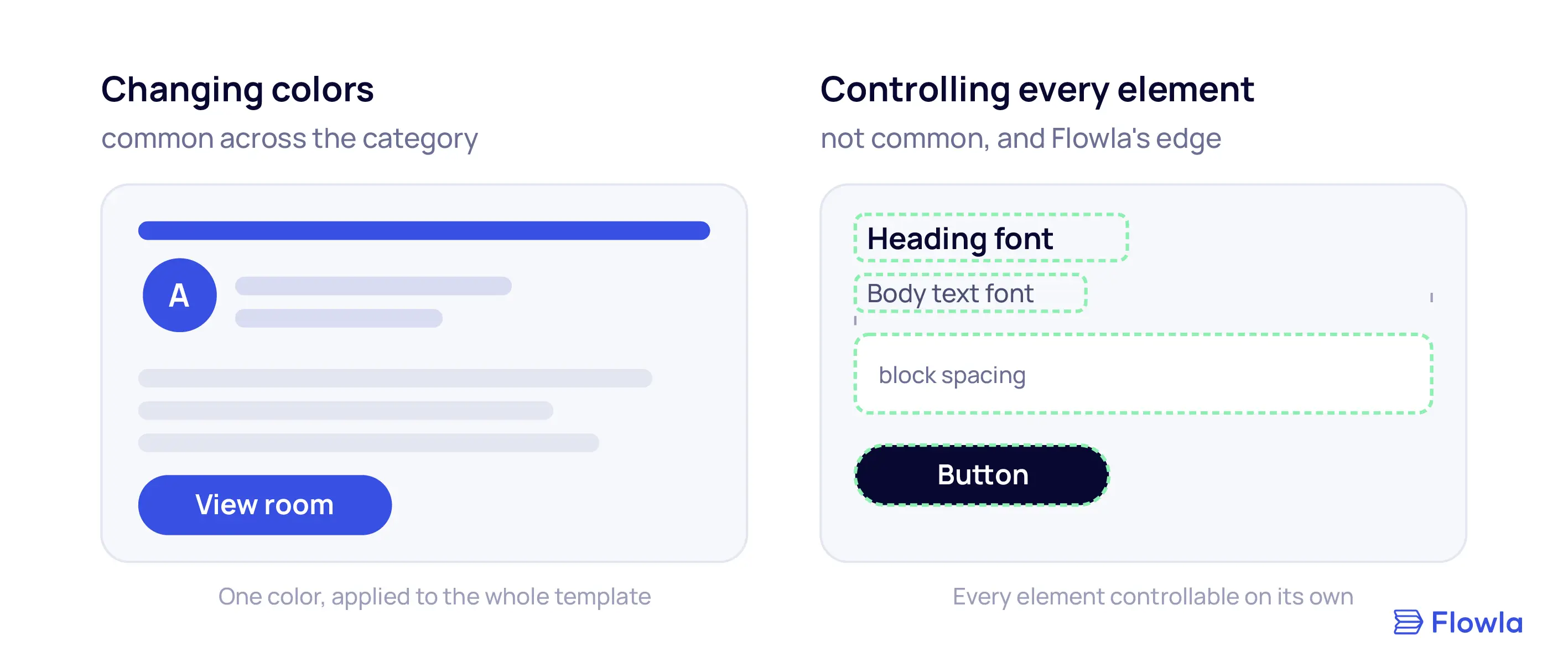
The rest of this post is about the second one, because it is where the actual work of looking considered happens.
If how a room looks changes whether a deal moves, the mechanism is worth showing. There is a large body of research on how people form judgments about interfaces, and it points the same direction. Most of the verdict is fast, visual, and made below conscious awareness.
That 50-millisecond figure carries weight beyond the number itself. In the same line of research, first impressions formed that quickly stay stable when people look longer, and they color everything that follows through the halo effect, first documented by Edward Thorndike in 1920. A single strong impression in one area bleeds into judgments of unrelated qualities. A room that looks polished gets read as more credible and more trustworthy before the buyer has evaluated a single claim.
The Stanford Web Credibility Project put numbers on it. Across more than 2,600 people, 46.1% said they judged a site's credibility first on its visual design, layout, typography, and color, ahead of the actual content (Fogg et al., 2002). A buyer will not tell you the room looked cheap. They will simply trust the deal a little less, and you will never know that was the reason.
The mechanism underneath the halo effect is processing fluency. Reber, Schwarz, and Winkielman showed that people prefer things they can process easily, and the good feeling of easy processing gets misread as a signal of quality (Personality and Social Psychology Review, 2004). A clean, on-brand layout is easier for the brain to parse than a cluttered one. That ease feels like trust.
The applied version is the aesthetic-usability effect, documented by Kurosu and Kashimura in 1995 and replicated many times since: people perceive attractive interfaces as more usable and more reliable, even when the underlying function is identical. Two rooms with the exact same content are not equal. The better-looking one gets judged as the better product. That is how the buyer's brain works, whether or not it feels fair, and ignoring it leaves value on the table.
Fluency explains why a polished room beats a sloppy one. A separate effect explains why a room in the buyer's own colors beats a polished room in yours.
The first is the self-reference effect (Rogers, Kuiper & Kirker, 1977): people pay closer attention to, and remember better, information tied to themselves. A buyer's own colors, logo, and world are self-relevant cues that pull attention in a way a vendor's brand cannot.
The second is plain expectation. B2B buyers now expect the tailored experience they get everywhere else:
A room that opens already wearing the buyer's colors is the most immediate, most visible form of that tailoring. It lands before the first sentence.
All of this compounds because buyers spend most of the decision away from you. Across our 30,000-room dataset, rooms were opened 18.8 times on average, on a roughly two-day rhythm, mostly between meetings, and frequently by senior stakeholders the rep never spoke to.
Every one of those unattended visits starts with the same 50-millisecond visual judgment, with no rep in the room to steer it. The look of the room is the only salesperson present.
Flowla Themes is one of the customization layers inside Flowla's digital sales rooms, built on one idea: you should never have to choose between a room that looks good in seconds and a room you can control down to the pixel, and it should not fall apart as the room grows. It works in four layers, and you stop at whichever one the deal in front of you needs.
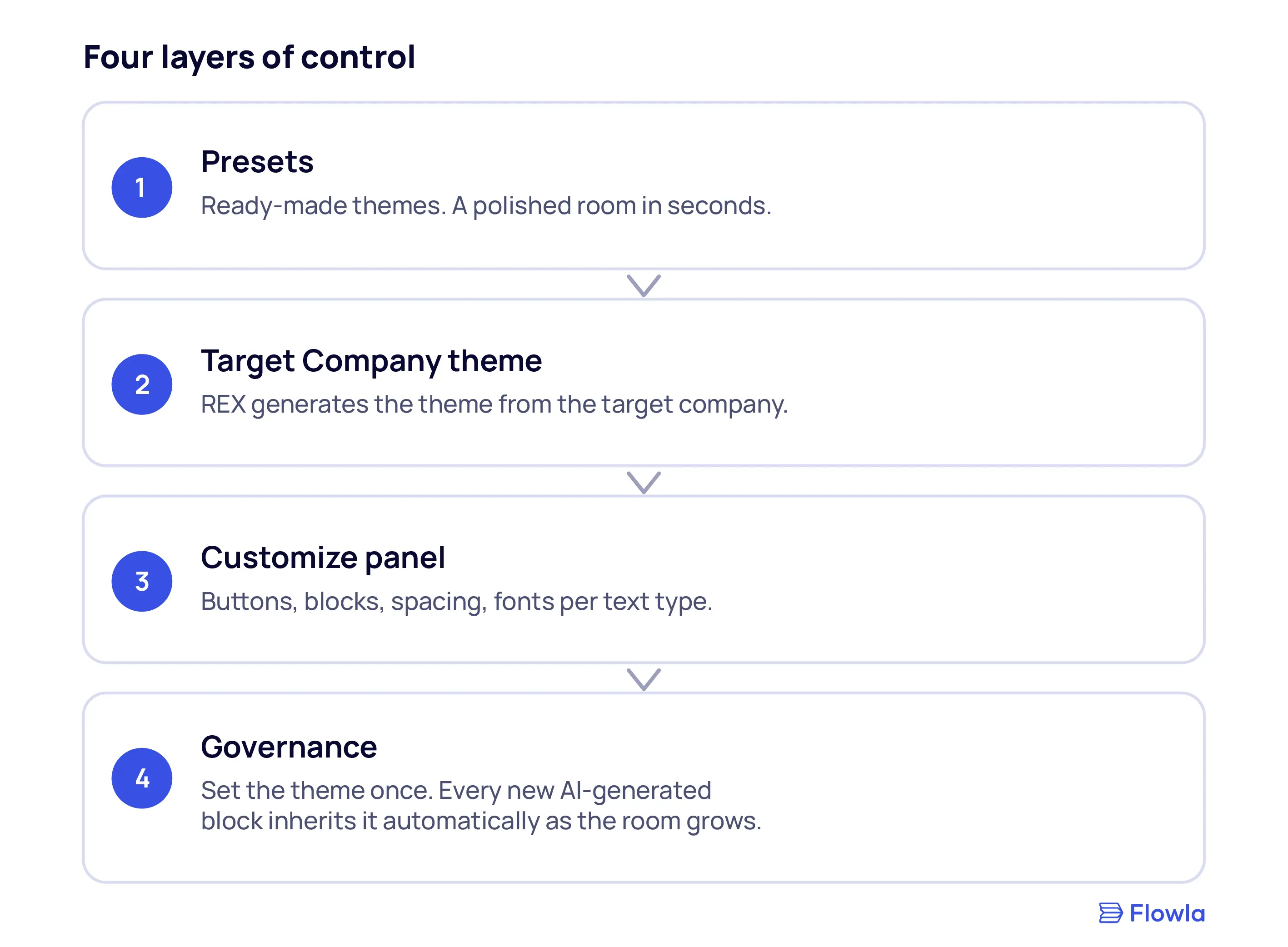
Every Flowla account ships with a set of ready-made themes. Pick one and the whole room takes on a clean, consistent look with no setup.
This is the layer for the rep who wants a room that looks considered and does not have five minutes to spend on it.
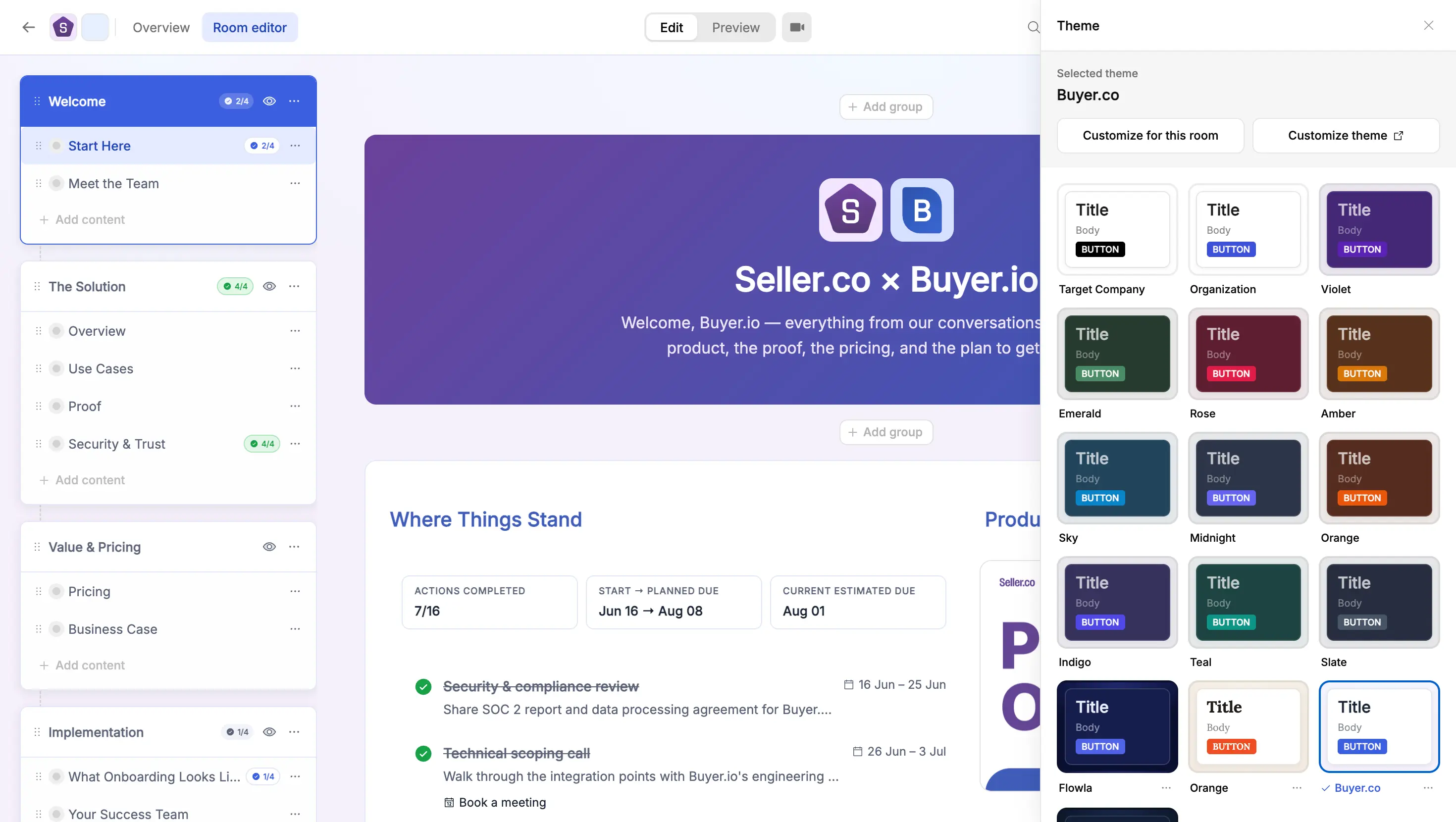
Most sales rooms can now apply a target company's brand colors, so that part of the category has caught up. What Flowla does differently is who builds the theme and how far the result can be shaped afterward.
Assign a target company to a room and REX, Flowla's AI agent, generates the theme itself, rather than swapping one accent color into a fixed template. Add HubSpot as the target company and REX builds a HubSpot-branded theme without you opening a color picker.
What that gives you:
(See New in Flowla: Themes for the original release, and how to build a perfect deal room for general room setup, though that guide predates Themes.)
Start from any theme, open the customize panel, and control it element by element: button styles and colors, block backgrounds and spacing, and font family set independently for headings, body text, and bullets. This is the layer that separates "we support the target company's colors" from actual control, and it is the one almost nobody else in the category has built.
One customer, an enablement lead at a benefits software company, described exactly this need on a recent call after her marketing team relaunched their website. She wanted the sales rooms to keep up, describing "a desire from marketing to see it more intentionally match our elevated branding." The customize panel is built for that: a full rebrand doesn't mean rebuilding every room from scratch.
That depth comes with a real tradeoff, worth saying plainly. With this many options, it is easy to get lost. One customer, an onboarding specialist at a wellness software company, told us she valued themes because of the hours she had already spent rebuilding a template by hand, and how a single change to the sidebar had "made such a difference" to the room. The lesson: depth only earns its place if the easier layers above it mean most people never need to open this one. That is why presets and automatic buyer theming exist on top of it.
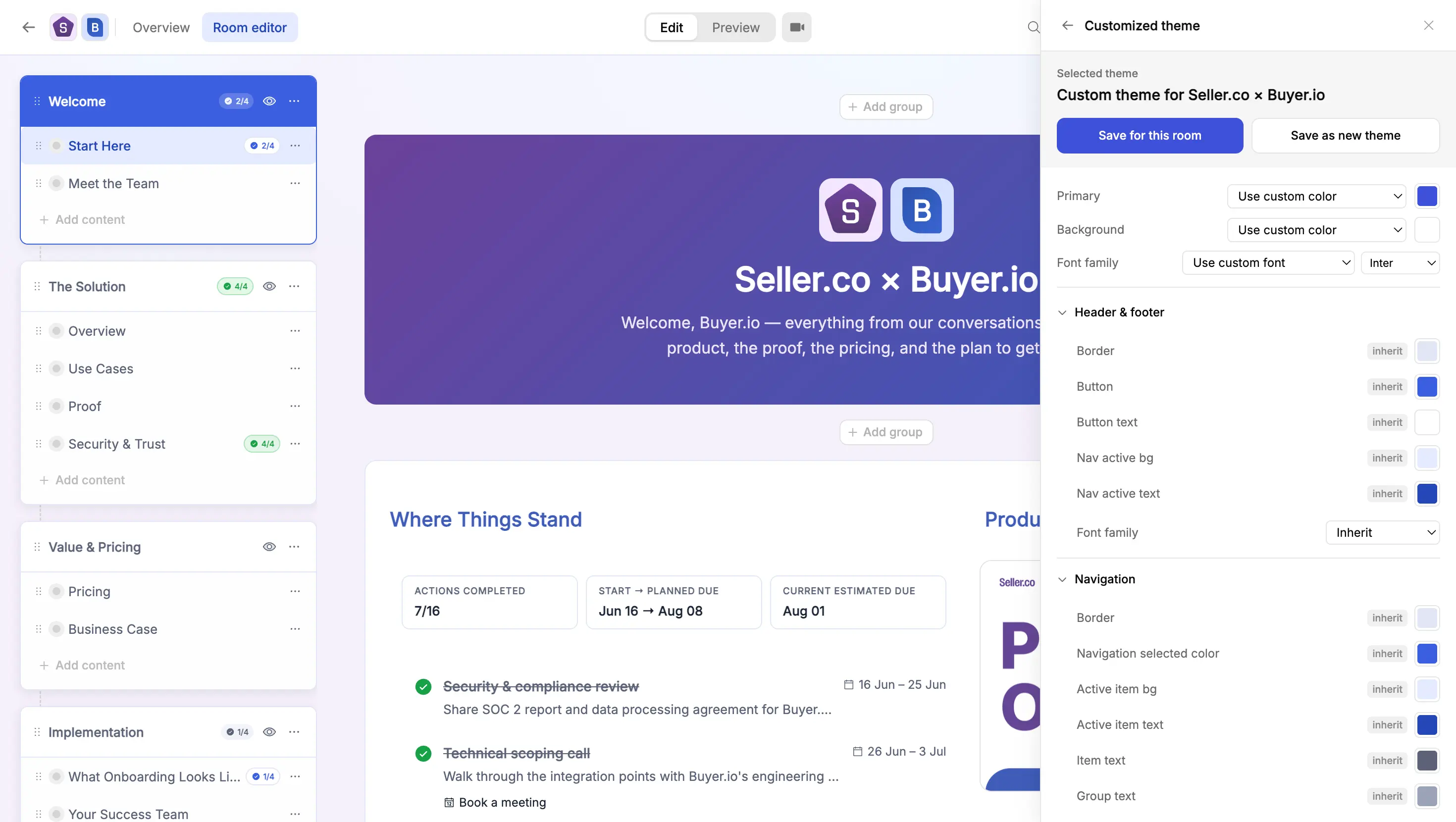
The controls above would be a chore if you had to reapply them per room. You do not.
There is a deeper reason this matters. Once a theme is set, any new block REX generates afterward, AI-drafted copy, a new page, newly pulled-in content, inherits that theme automatically. You are not re-styling every AI-generated element by hand as a room grows. That is what makes governance realistic at scale: the room does not drift out of brand as content gets added over time.
For a team that just rebranded, that is the difference between reconfiguring hundreds of rooms by hand and changing one theme. This connects to Flowla's broader Templates & Governance layer, built so every room, and everything REX adds to it later, stays on-brand at scale.
The argument gets concrete when you put it on specific deals. Here is the same set of situations, with default customization and with Flowla Themes.
A buyer is evaluating you against two other vendors and has all three rooms open in three tabs.
Your champion shares the room with a committee you have never met. Across our data, rooms average only 2.9 identified stakeholders while real committees run far larger, so most of these viewers form their first impression with no rep present.
An SMB deal that will close in a call or two. Here the honest answer is that deep customization is overkill.
The deal closes and the buyer moves from a sales room to an onboarding room.
An honest map of the category, because the claim only means something if it survives a fair comparison. Applying a target company's brand colors isn't the rare part anymore, several tools do some version of it.
What none of them do, trumpet included, is give element-level control over the result once the theme is applied: button styles, block spacing, and per-text-type fonts. And none of them extend that control forward automatically, so a theme holds as REX adds new AI-generated content to the room later. That combination, a theme REX generates rather than recolors, controllable down to the element, and governed automatically as the room grows, is what makes Flowla's customization the deepest in the category, not simply the fact that it themes to a target company at all.
Having the controls is one thing. Using them well is another. A few principles from watching a lot of rooms get built.
Good theming is mostly restraint: clean type, contrast strong enough that the next step is obvious, and one coherent color story per room.
Yes. Some digital sales rooms let you add the buyer's logo and colors by hand, and a small number apply the buyer's full brand automatically. In Flowla, assigning a target company themes the room in that company's colors on its own, so the buyer opens a space that looks built for them rather than a generic vendor template. It takes one step and no design work.
A digital sales room usually lets you customize branding such as logo, colors, and fonts, the layout and section structure, and the domain the room lives on. More advanced platforms extend that to backgrounds and spacing. Few go down to the individual element: button styles, block spacing, and font family set independently per text type (headings, body, bullets). Flowla covers all of these through themes, and the target-company theme itself is generated by REX rather than applied from a fixed template.
Buyers form a first impression of any web page in about 50 milliseconds (Lindgaard et al., 2006), and 46.1% judge credibility on visual design before content (Stanford, 2002). Through the halo effect and processing fluency, a clean, on-brand room reads as more trustworthy and more capable, which shapes how the buyer weighs everything that follows.
Yes. Nearly every digital sales room supports your own branding: your logo, your brand colors, and often a custom domain so the URL matches your site. Flowla goes further with saved themes you can apply across every room at once, so your branding stays consistent without configuring each room by hand.
Most digital sales room platforms support a custom domain, so rooms load on a URL that matches your website rather than the vendor's. White-label options vary by provider and plan. Flowla supports custom domain setup and white-labeling for teams that want the room to feel entirely like their own product.
Flowla is among the most customizable digital sales rooms available. Applying a target company's brand colors is now common across the category. What sets Flowla apart is depth: REX, Flowla's AI agent, generates the target-company theme rather than recoloring a template, a customize panel controls colors, fonts, spacing, backgrounds, and individual blocks down to the font used per text type, and any new AI-generated content inherits the theme automatically as the room grows.
Book a demo and we'll show you how a room themes itself to your target company, and holds as your team adds more content to it.
Book a demoBook a 15-minute chat with a product expert. We'll walk you through every step of the way as you get set up.
.webp)
.webp)
.webp)


.webp)

.webp)
.webp)
.webp)




.webp)
%20(3).webp)
.webp)

.webp)

.webp)
.webp)
.webp)
.svg)

.webp)
.webp)