.webp)
.webp)


.webp)

.webp)
.webp)
.webp)




.webp)
%20(3).webp)
.webp)
Full visibility into every rep & every deal
Shows what a rep has learned, and what they actually do in deals.

Teams close and onboard faster with Flowla









The two halves nobody could put together
A list of completed courses says a rep learned about discovery, but it doesn't say their discovery improved.
Leading indicator
What they've learned
The half any LMS can already show you.
Courses completed and in progress
Quiz scores and attempts
Certifications earned
Time actively spent
Lagging indicator
What they actually do
Read from real calls, emails and deal-room activity.
How they run discovery
How multi-threaded their deals are
How they follow up, and how fast
A score per skill, across every deal they touch
For the first time, a manager can see whether the learning showed up in the selling.
.webp)
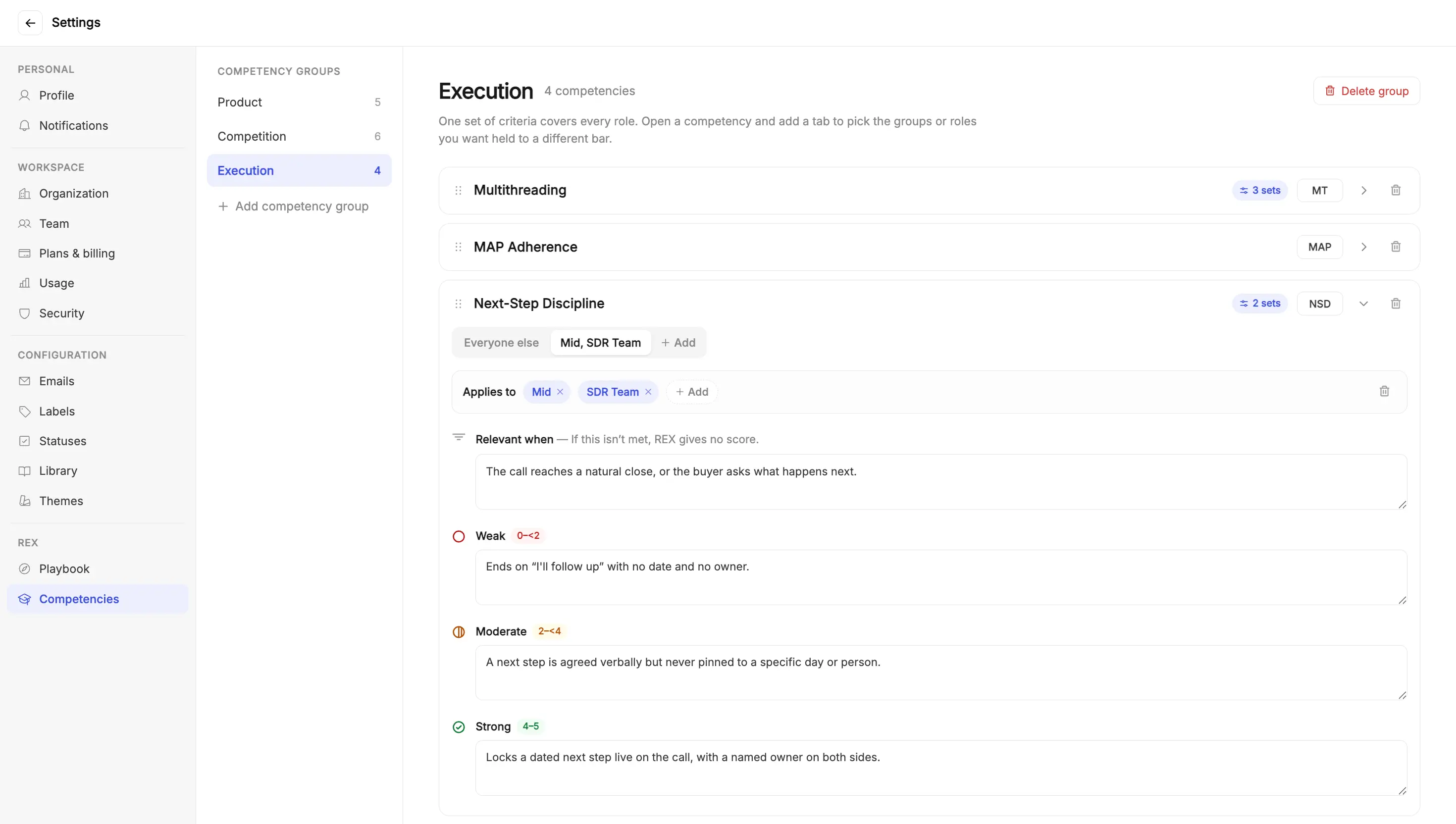
You define what “good” looks like
Every team defines “good” differently, and a pre-baked competency model fits none of them.
Tell REX what multi-threading means for your motion, and it measures against that using the data already in your CRM and deal rooms.
The gap, its cause, and its cure
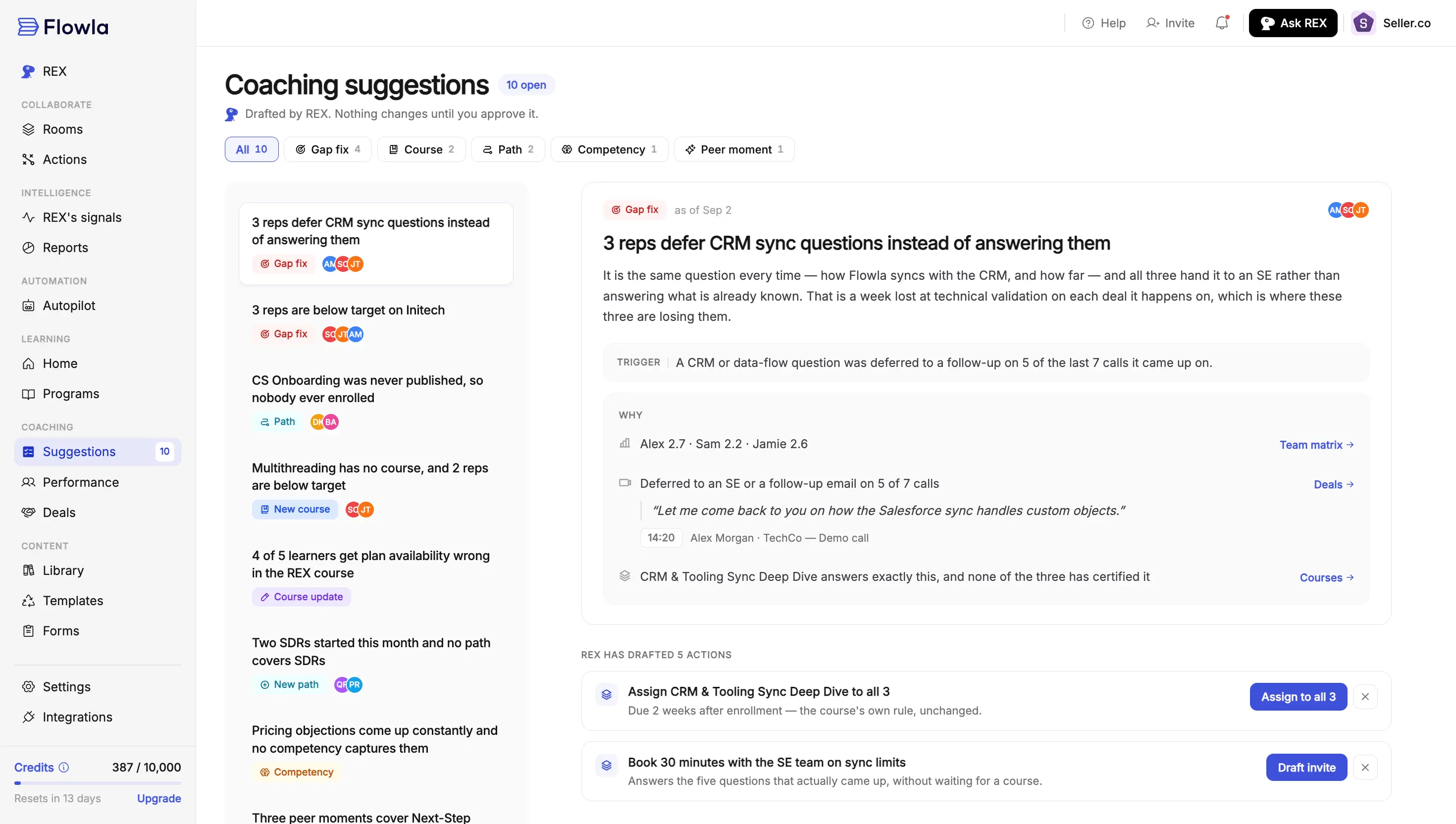
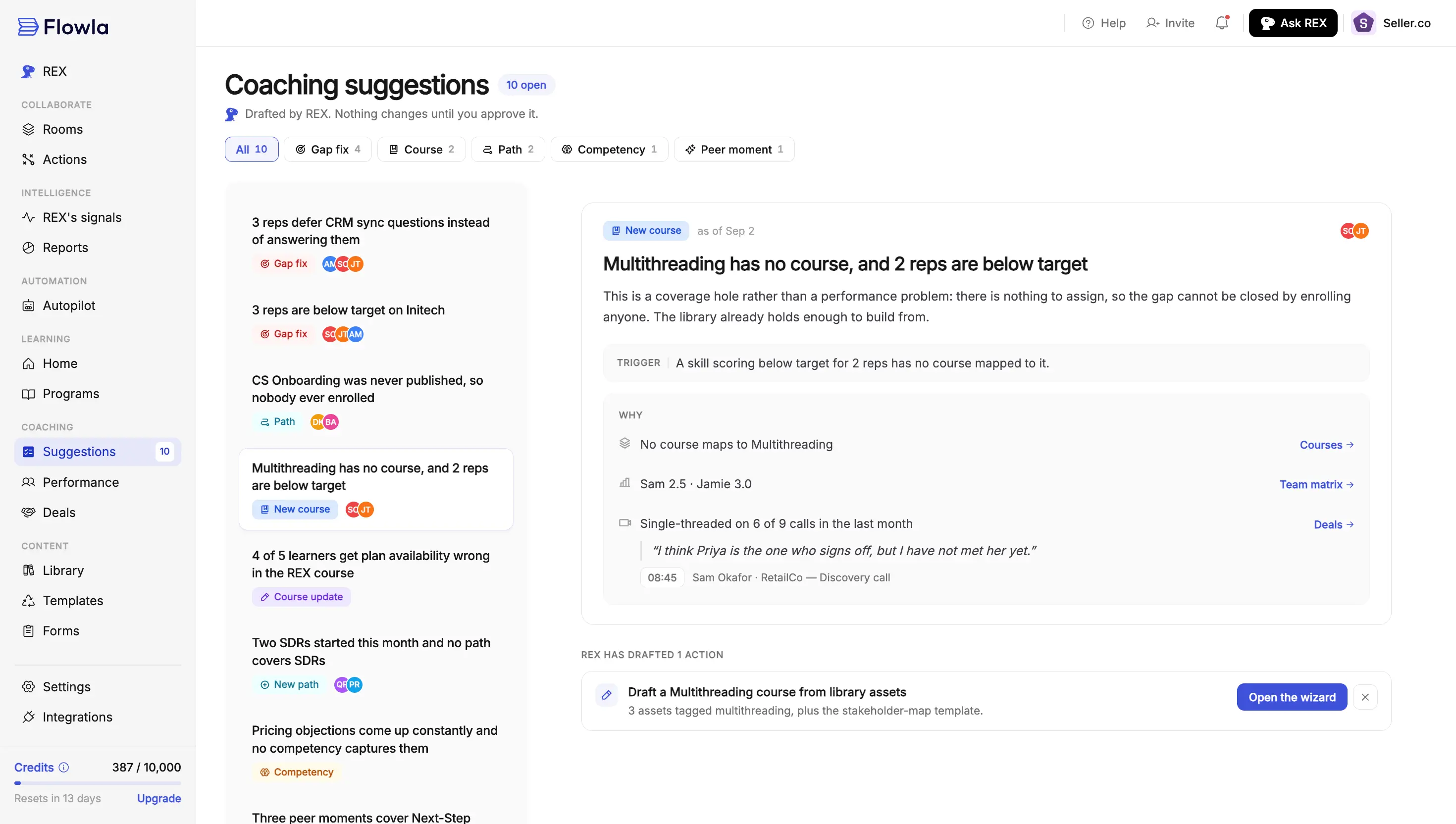
“Get better at objection handling” is not a plan.
REX assesses each rep deal by deal, and surfaces growth areas tied to the deals that evidence them. Each one comes with the course, battlecard or role-play that closes it, one click to start.
Fix it once, for everyone
When four of five reps share a weakness, coaching them one at a time is slow and blind to the pattern.
REX rolls individual scores into team-wide trends, so “most reps are behind on multi-threading” becomes a number with one fix attached: a team course, a battlecard, a group role-play, broken down per team, segment or region.
Two views, one source of truth
If feedback only arrives in a quarterly review, a rep can’t self-correct in the moment, and a manager is coaching from memory.
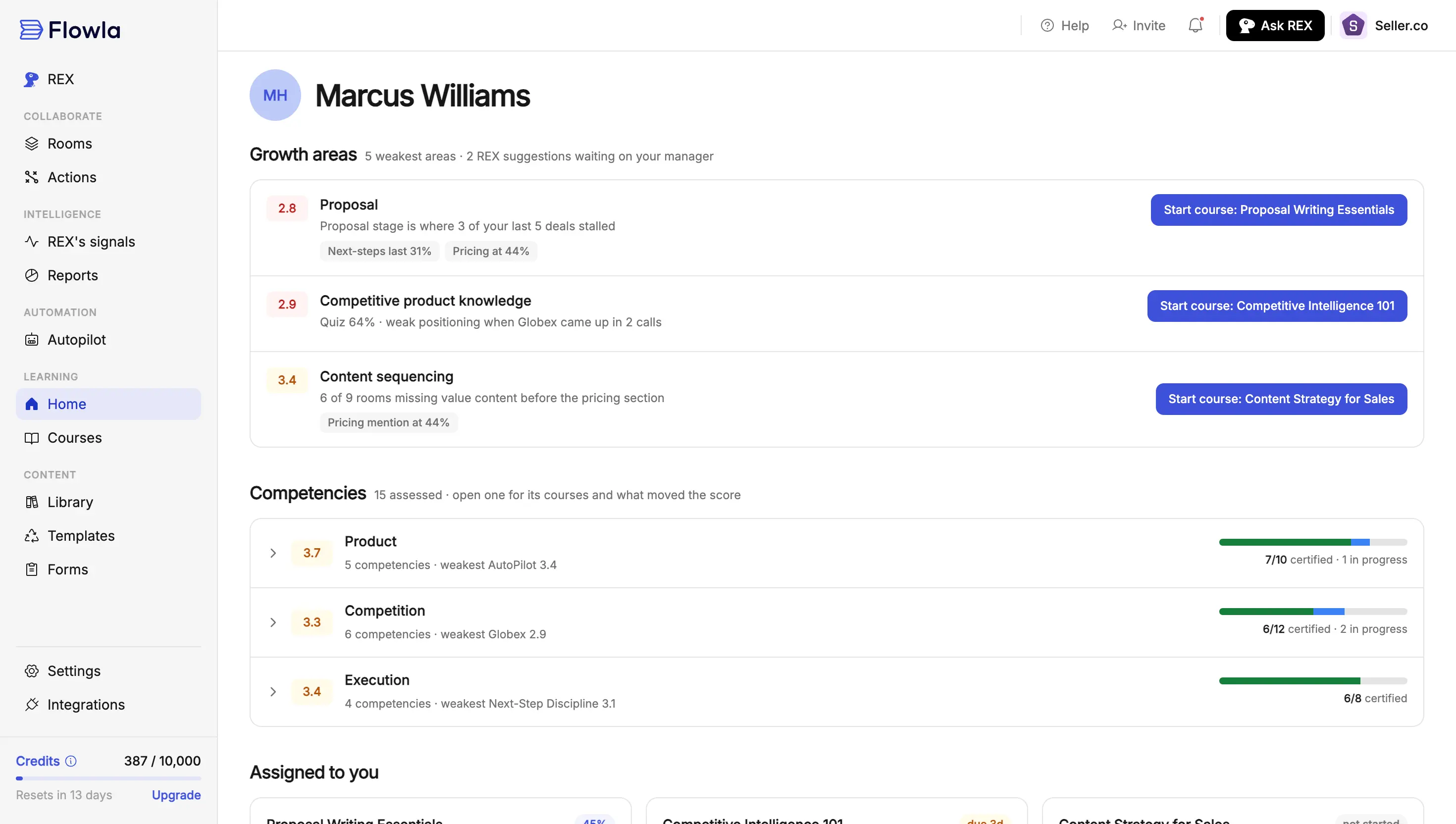
The rep’s view
Self-directed improvement
Their own courses, scores and certifications, in one place
Their growth areas, and what REX suggests working on next, so they can see themselves the way a good coach would
The manager’s view
Oversight without the guesswork
The same profile, for every rep on the team
Where each one is behind, and what’s already been assigned, so a 1:1 starts from evidence instead of anecdote
Reporting that speaks your language
Broken down the way you actually think about competency, and visible only to the people who should see it.
Every number rolls up by competency
A flat list of completions tells you who clicked, not where the team is strong or weak.
Everything rolls up by learning area, the same taxonomy behind coaching and course tagging: product, competition, execution, or your own, down to team, segment or region.
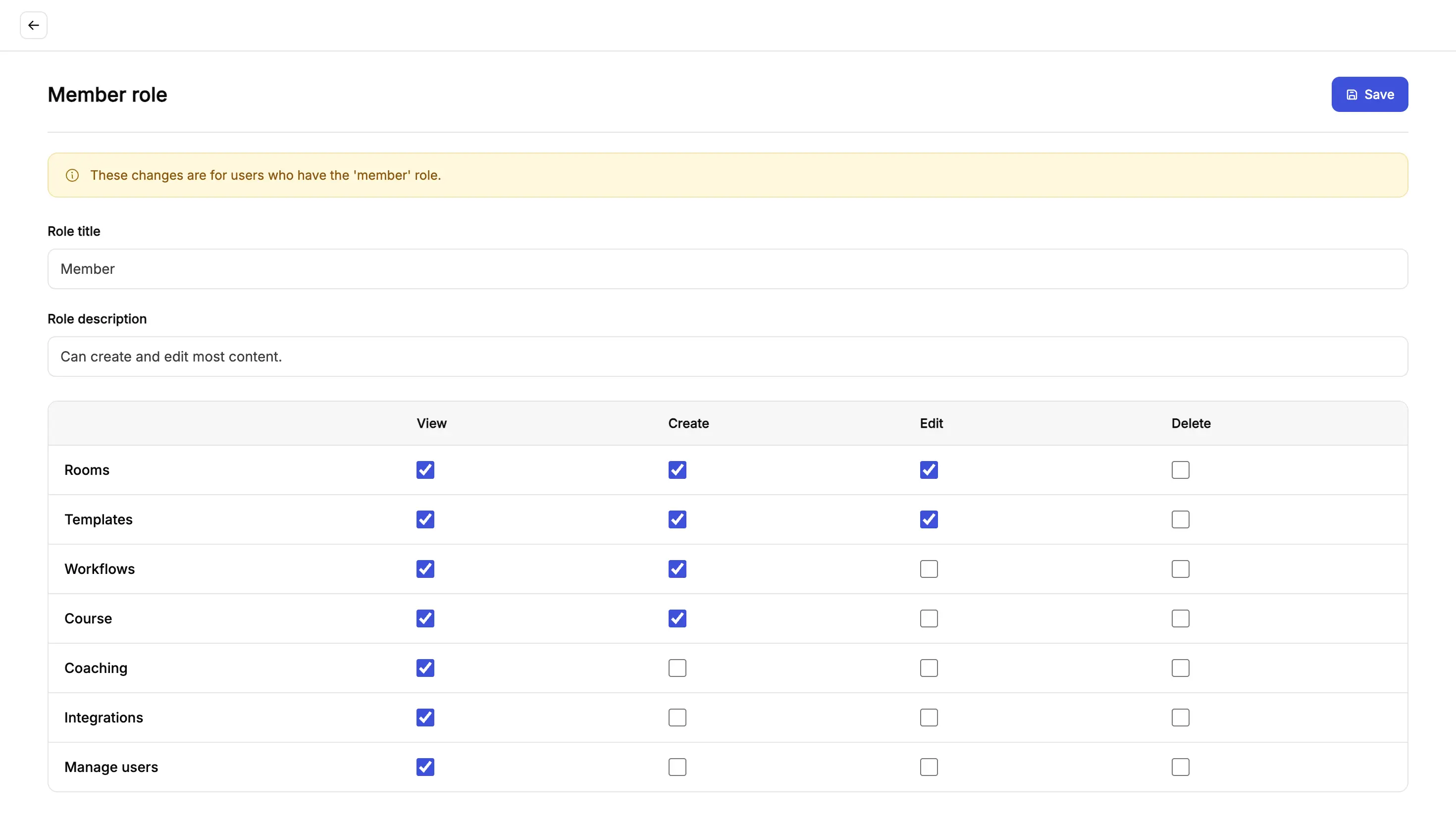
Sensitive data stays with the right people
Rep-level scores are too sensitive to be open to everyone.
Role-based access decides who sees what: managers see their teams, leadership sees the rollup.
Explore the rest of Learning & Coaching
Learning & Coaching
How the whole loop fits together: REX watches the real work, closes each rep’s gap, and proves it moved the deal.
Courses
Built from what you already trust, delivered on-brand, and graded by REX: pitch videos included.
Enterprise-grade security, out of the box
Coaching data is some of the most sensitive information you hold. Flowla meets the strictest global standards and keeps it with the people who should have it.
.webp)
.webp)

- ✓SOC 2 Type II and GDPR compliant
- ✓Role-based access to learning and coaching data
- ✓SSO (Single sign-on)
Frequently Asked Questions
What’s the difference between a leading and a lagging indicator here?

The leading indicator is what a rep has learned: courses, quizzes, certifications. The lagging indicator is what they actually do in deals, read from real calls, emails and room activity. The profile shows both, because only together do they tell you whether the learning worked.
Where does the real-deal behaviour data come from?
From the work reps already do. Calls, emails and deal-room activity flow into Flowla automatically, and your CRM data comes along with them. Nobody logs anything extra.
Can we define our own skills and learning areas?
Yes, and you should. You set the skills REX assesses against, including the underlying signals, and they roll up into your own learning-area taxonomy. It’s the same structure that drives coaching and course tagging, which is why reporting lines up with how you already talk about the team.
Do reps see their own scores?
That’s the intent, since self-correction only works if the rep can see where they stand. The same profile flips to the manager’s view, and role-based access controls who can see whose.
Isn’t this just scoring people?
A score with no cure attached is just surveillance. Every growth area comes with the skill it maps to and the course or role-play that closes it, one click to start. The point is the fix.
How often does the profile update?
It moves as the deals move. New meetings and emails get assessed as they happen, so a growth area can close without waiting for a review cycle.
Nothing about a rep’s performance stays hidden.
What they learned, what they actually do, and where the shared gaps are, all in one place, without waiting for a review cycle.
.webp)
.webp)
.webp)
.webp)
.svg)

.webp)
.webp)