Ask an enablement leader how last quarter's training went and you'll probably hear about completion rates and quiz scores. Maybe a satisfaction survey, if enough people filled it in.
Ask a rep and you'll get a shorter answer: the training was fine, but it had nothing to do with the deal they were trying to close that week.
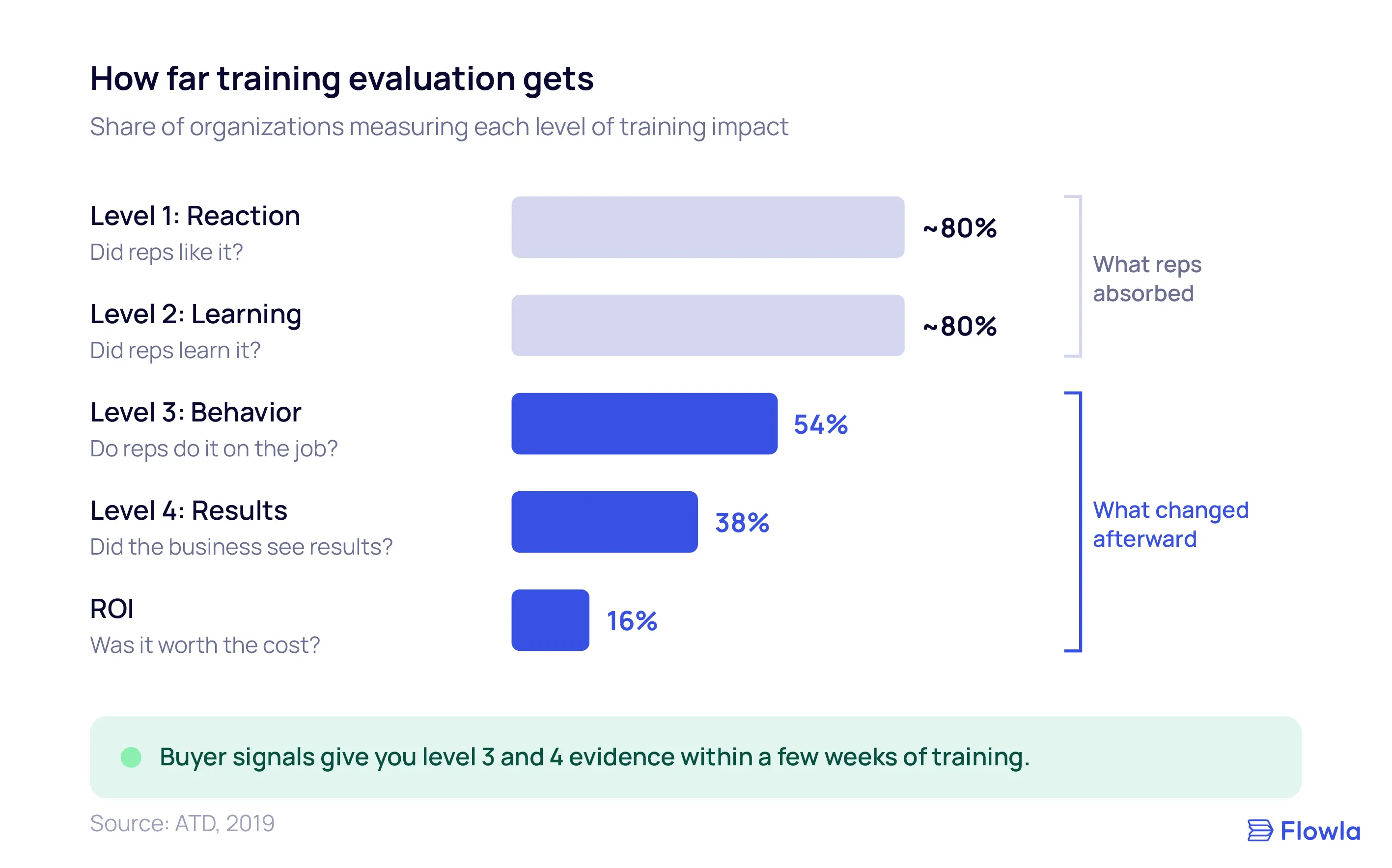
Reps tune out because the program gets graded on things they don't care about, while the thing they do care about, whether their deals move, never shows up on the scorecard. ATD's 2019 research on learning evaluation found only 38% of organizations measure training against business outcomes such as quotas met, and just 16% measure ROI.
This guide starts from the other end. It treats the buyer's side of the deal as the place to find out whether a skill landed, and works backward from there. You'll see what the usual measurement stack misses, which buyer signals line up with which trained behaviors, and how to build and run a program reps can watch working in their own pipeline.
A sales training program takes real work to build. Someone interviews the top performers, writes a playbook, builds modules and runs role-plays. Then the program gets evaluated on evidence that has very little to do with selling.
Reps notice. If the only proof a program worked is a certificate and a quiz, the program is telling them what it values, and they act on that.
Sales training is the process of teaching reps the skills, methods and habits they need to move deals forward, usually through courses, workshops, role-plays and coaching. Training only counts as effective when it changes what reps do in live deals, and the clearest evidence of that change is how buyers respond afterward.
The standard way to evaluate training is the Kirkpatrick model, which grades training on four levels: how learners reacted, what they learned, whether they changed behavior on the job, and whether the business saw results.
In practice, measurement thins out at every level. ATD's 2019 survey of 779 talent development professionals found about eight in 10 organizations measure reactions and knowledge. Just over half (54%) measure on-the-job behavior, and fewer than four in 10 get to business results.
The typical sales training scorecard ends up heaviest on the two levels reps care least about.
A rep who passes a discovery quiz has shown they know what good discovery questions look like. That's worth knowing, but it says nothing about whether they asked those questions on Tuesday's call with a VP of Finance who had 20 minutes and no patience.
Knowledge checks are cheap to run and easy to report, which is why they dominate. They also stop at the moment of training, and reps know it. A module they can pass while half-listening doesn't earn much of their attention.
Conversation intelligence was a real step forward. Teams can now score actual calls against a methodology instead of relying on role-plays, and some companies have built their own coaching layer on top.
A sales leader at a large data company walked us through her team's setup on a recent call. They built rep coaching on Claude that pulls Chorus transcripts and Salesforce data and scores each rep's weaknesses against MEDDPICC criteria. Later in the call, she raised a question about coaching tools in general:
"I'm not sure what sort of data points feed into the coaching that's being provided."
That setup runs on two inputs: what the rep said on calls, and what the rep wrote in emails and CRM notes. Both describe the seller, and neither says anything about what the buyer did next.
The obvious fix is to skip straight to outcomes and ask whether win rates went up after the training. But it's harder than it sounds.
ATD's 2016 research found one of the biggest barriers to evaluating business impact is isolating the effect of the training from everything else. A quarter's win rate moves because of pricing changes, new competitors, territory shifts and one rep having a great month. Tying a two-day negotiation workshop to that number is guesswork, and everyone in the room knows it. It's the same attribution problem that makes sales forecasting unreliable when most of the inputs come from what reps report.
Teams end up stuck between measures that come too early (quizzes) and measures that come too late (revenue). The useful evidence sits in between, and a lot of it lives with the buyer.
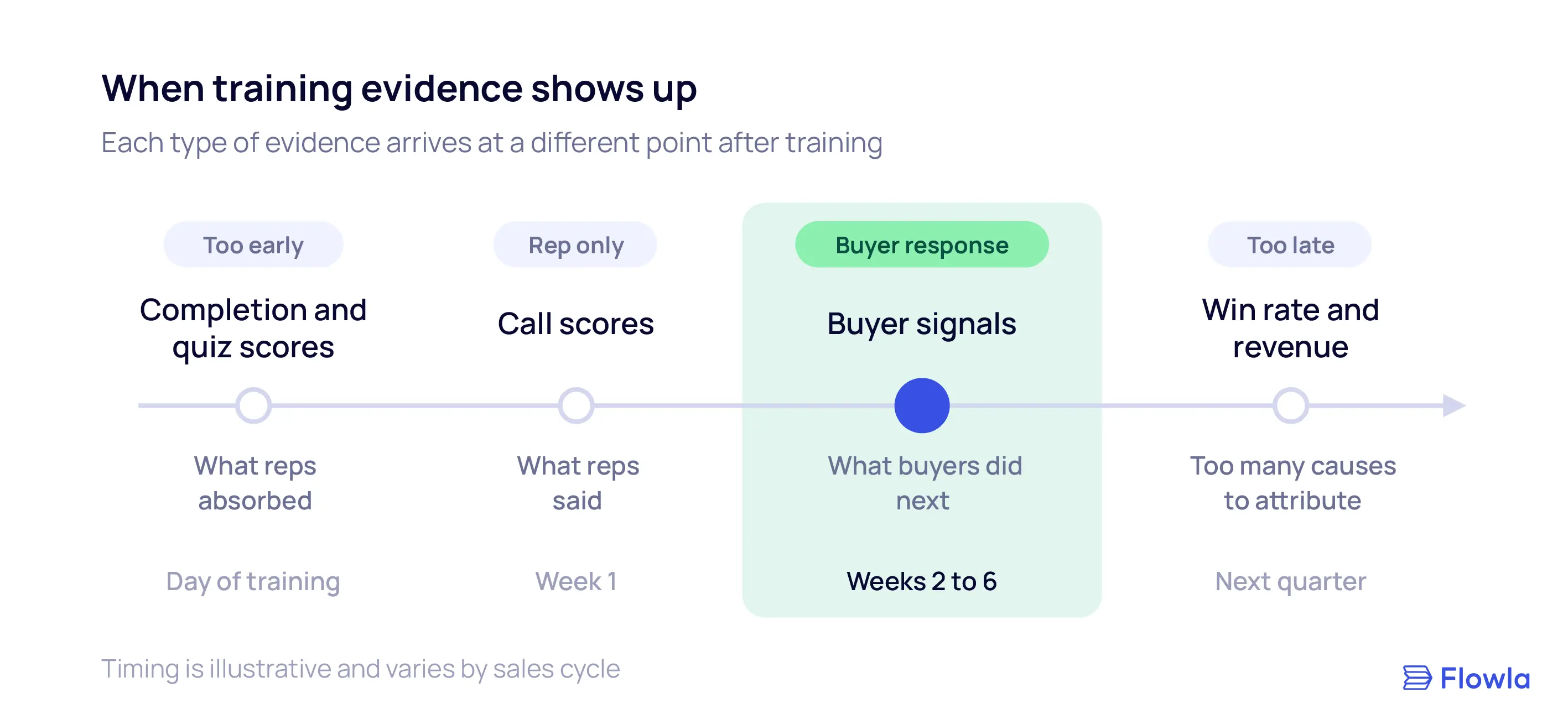
Measure sales training effectiveness by tracking the behavior the training targeted and the buyer response that behavior should produce. Completion rates and quiz scores confirm reps absorbed the material. Call scoring confirms they used it. The strongest evidence is what buyers did next, such as new stakeholders joining a deal or action items getting completed without chasing.
Every behavior you train a rep to do has a consequence on the buyer's side, and you can observe it.
A rep trained to multithread should be bringing more people into the deal, and one trained on mutual action plans should have buyers completing tasks. You don't need to guess what happened in the rep's head. Either the buyer's behavior changed or it didn't.
This matters more every year, because more of the buying happens where the rep isn't. Gartner found in 2025 that 61% of B2B buyers would prefer a buying experience without a sales rep. The share of the deal a rep directly touches keeps shrinking, and so does the share you can see in call recordings.
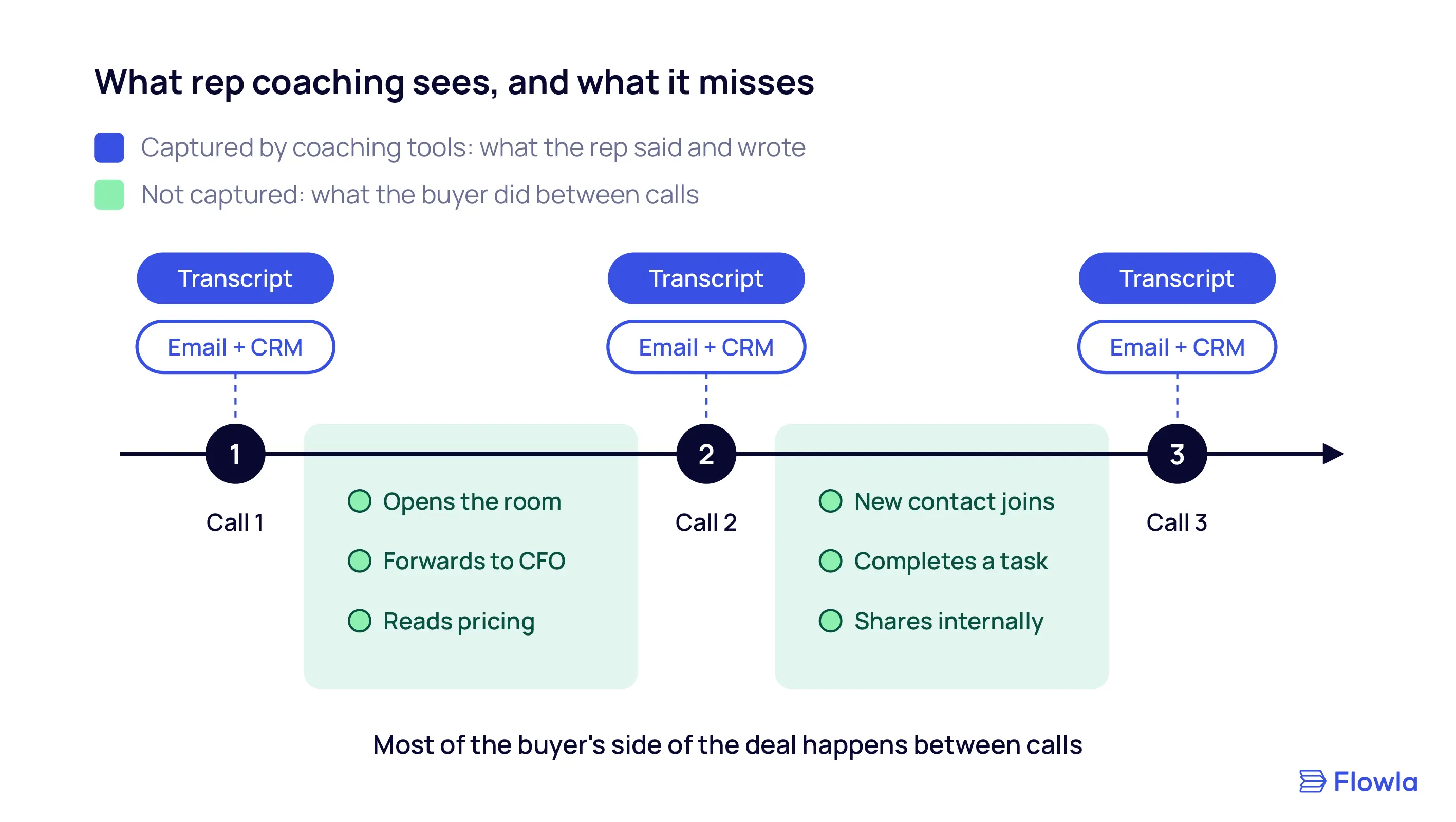
A buyer signal is any action a buyer takes that you can see and put a date on: opening a shared room, forwarding it to a colleague, completing an assigned task, booking the next meeting, adding someone new to the thread. Some of these carry more weight late in a deal, and our guide to late-stage buying signals covers which ones tend to predict a close.
Good buyer signals happen soon after the rep's behavior, usually within days rather than quarters. They're also hard to fake. A rep can say all the right words on a call without the buyer caring, but a CFO showing up in the deal because the rep asked the champion the right question is much harder to produce by accident.
A typical multithreading session ends with a role-play where the rep practices asking who else should be part of the conversation.
The buyer-side question is simpler. After the training, did more stakeholders appear in the rep's deals?
In the 30,000+ deal rooms we analyzed for our State of Digital Sales Rooms research, the average room involved 2.9 stakeholders. That's almost certainly an undercount of the real buying committee, which is why it works as a baseline. If a rep's deals sit at one or two people past discovery, you have a coaching conversation with evidence behind it. If the number climbs after training, you have proof the training did something.
For more on who those stakeholders tend to be, see our guide to B2B buying committee roles. Enterprise deals usually have the widest gap between the committee you can see and the one that decides, which we dig into in our post on digital sales rooms for enterprise deals.
It's easy to check whether a rep built a mutual action plan. The more useful question is whether the buyer used it.
The signal to watch is completion. Are buyer-owned tasks getting done by their due dates, or does every step need a nudge from the rep? Buyers working through a plan on their own is a good sign the rep set it up with the right owners, dates and reasons.
Overdue buyer tasks are easy to count, and they point straight at something coachable. Our mutual action planning guide covers what a well-built plan includes.
Training reps to enable the champion usually means teaching them to hand over material the champion can take to their own leadership. You can tell it worked if the champion passed anything on.
In our room data, the average room sees 2.4 share actions, closely tracking the number of stakeholders. A rep whose rooms get shared has champions selling on their behalf. If nothing moves past the first contact, the champion either didn't get what they needed or didn't feel confident forwarding it. Our post on assets that help your champion sell internally goes deeper on what to give them, and our guide to buyer enablement covers the wider shift toward helping buyers buy.
It's a fair objection, and the same sales leader raised it without prompting:
"one of the difficulties with the digital sales rooms is getting the buyer to adopt and to engage with the sales room"
She's right that it happens a lot. Our research found about 48% of deal rooms never get any engagement at all. If buyer signals only exist when buyers engage, that looks like a hole in the whole approach.
Look at why rooms go quiet, though. When we surveyed practitioners, the top problem by a wide margin was reps not keeping rooms updated, cited by around 60% of respondents. The average gap between a room being created and a buyer first opening it is 7 days, and rooms introduced during the call, with a specific reason to open them, get opened faster than rooms sent afterward as a generic link.
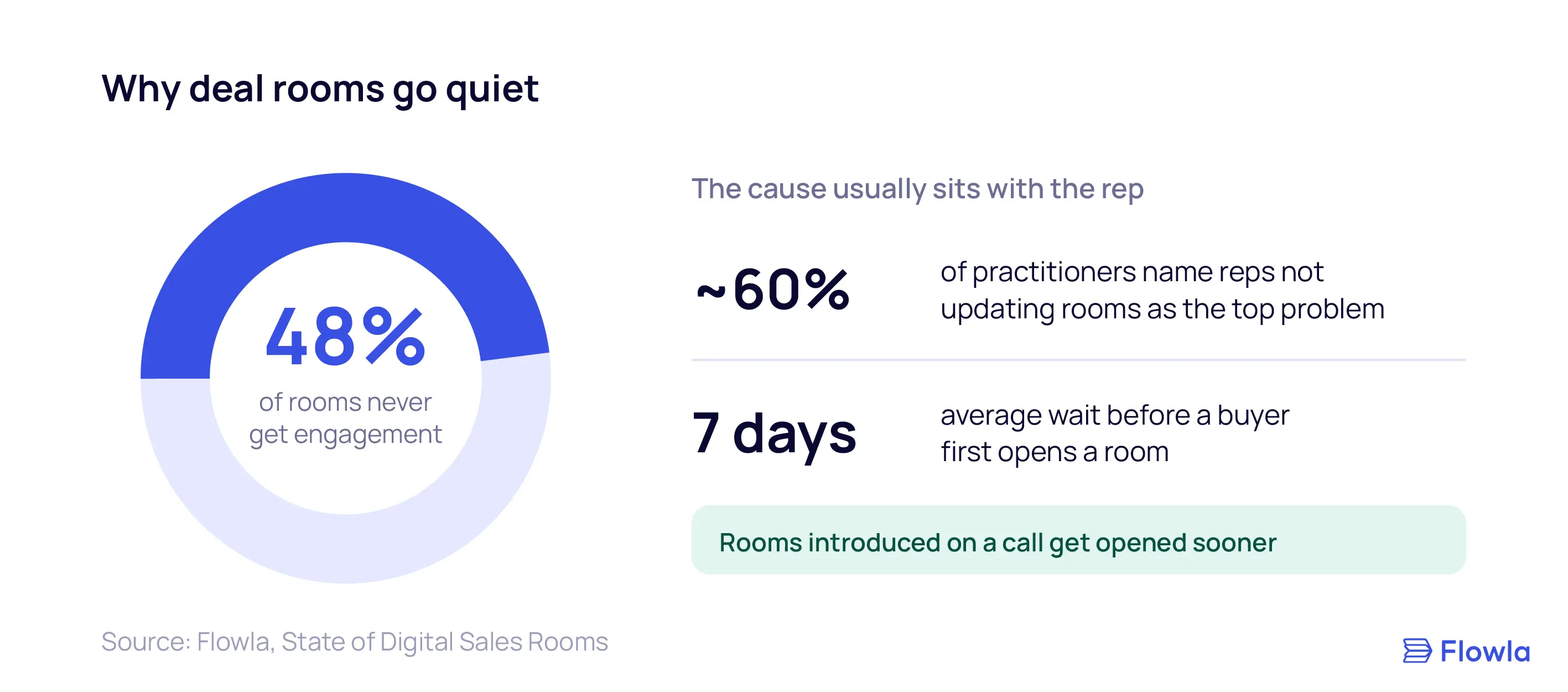
A silent room usually says something about the rep: how they introduced it, and whether they gave the buyer any reason to come back. Both are trainable, which makes buyer silence useful data in its own right.
An account executive at Flowla described the pattern on the same call:
"some reps unfortunately don't follow up very quickly. They often don't add value between meetings."
Most buyer signals happen between meetings, which is the part call recordings can't see. If follow-up speed is the gap on your team, our guide to automating post-demo follow-ups is a good place to start.
Once the evidence lives with the buyer, the design process changes order. You start with the signal you expect to move, and the content comes later.
The steps below work whether you deliver training through an LMS or through manager-led coaching. The order is what matters.
To create a sales training program, pick one behavior to change and decide what buyer response it should produce. Measure that response before training starts, then run short sessions built from real deals. Afterward, compare trained and untrained reps, and give extra coaching to anyone whose buyer signals didn't move.
Start with one behavior, stated specifically enough that you could spot it in a deal. "Better discovery" is too broad. "Asks about the decision process and who else is involved before the demo" is a behavior.
One behavior per program is plenty. Teams that try to fix five things in one kickoff session usually can't tell afterward which of the five changed, if any did.
Your best reps are the right place to look for behaviors worth training. Our guide to scaling sales processes covers how to turn what top performers do into something the rest of the team can repeat.
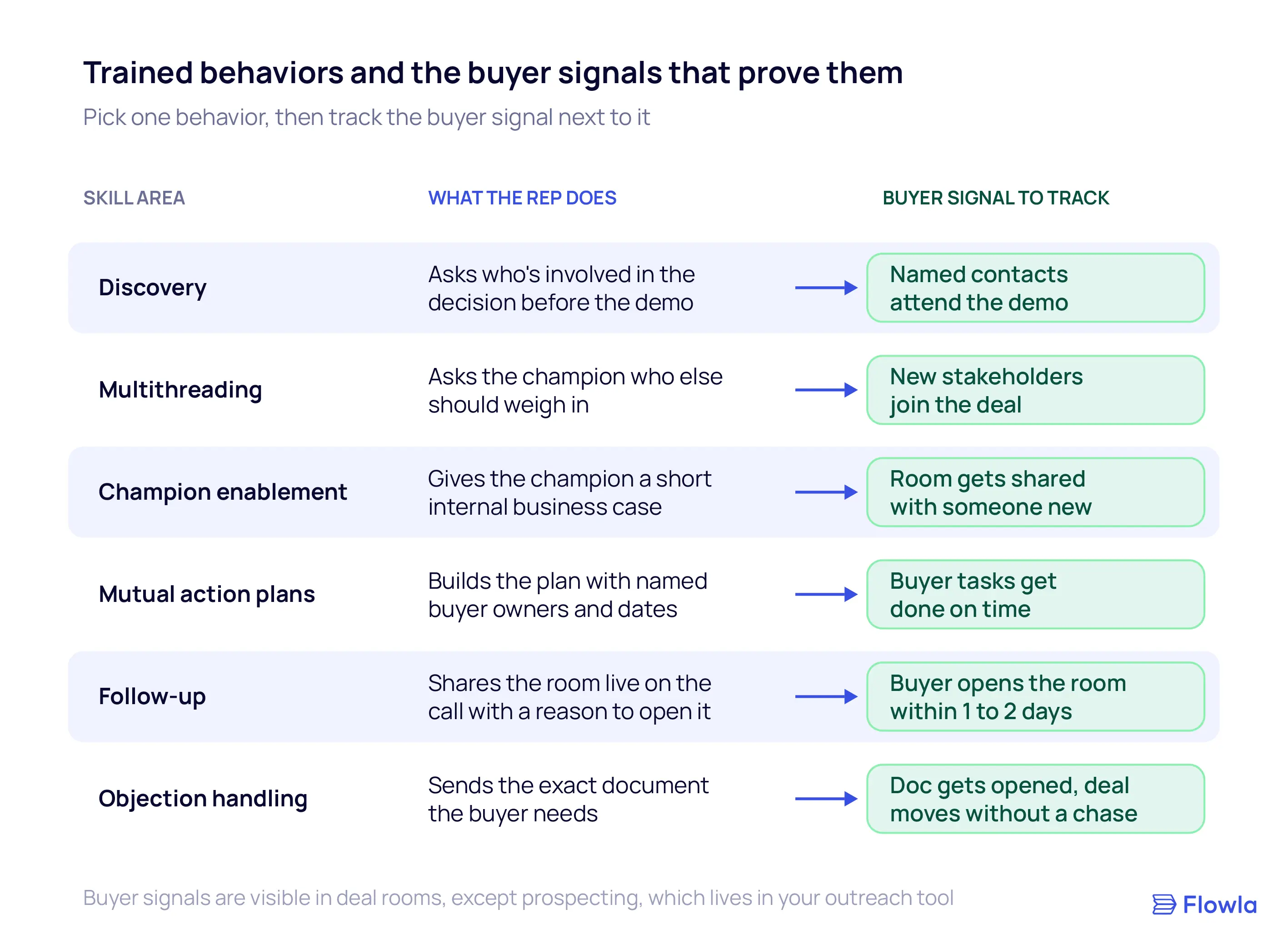
For every behavior, write down the buyer action it should produce and roughly how quickly. This is the step that makes everything else measurable.
Part 2 covered multithreading, mutual action plans and champion enablement. Other common skill areas map just as cleanly:
Prospecting is the exception. Its buyer signals, like reply rates and meetings booked, live in your outreach tool rather than a deal room, but the principle is the same.
If you can't name a buyer signal for a behavior, ask whether the behavior matters. Sometimes it does and the signal is just harder to see. More often, the training is about how the rep sounds rather than what the buyer does.
Pull the signal for every rep who'll go through the program, covering the last 60 to 90 days. Days to first view, stakeholders per deal past discovery, overdue buyer tasks, or whichever signal you picked.
Without a baseline, the post-training number means nothing. With one, you can say something specific, along the lines of "this team's deals averaged 1.8 stakeholders past discovery before the training and 2.7 six weeks after." A sales leader can act on a number like that.
Now you can build the content. By this point you already know the behavior, the signal and the baseline, so the training has one job, which is to get reps doing the behavior in their next few deals.
Use your own deals as the material. Instead of generic role-play scenarios, pull two or three rooms from reps who already do the behavior well, and walk through what they did and what the buyer did next. Reps trust examples from their own pipeline far more than a vendor's script, and they see the buyer response they're aiming for as well as the words.
Keep each session short and close to live work. One behavior, a 30-minute session, then a week of trying it on real calls. A full-day kickoff covers a lot of ground, but there's little time to practice any of it before the next topic arrives.
Show every rep their own numbers. Before the session, give each rep their baseline for the signal, something like "your rooms take eight days on average to get a first view." Afterward, show them the new number. Reps start paying attention at this point, because the training is now about their deals.
Adjust for tenure. New hires need the behavior and the context around it, so pair the session with time on a top performer's deals and let them build their first rooms from a template. Tenured reps usually know the behavior already. What they're missing is evidence that they don't do it consistently, and their baseline gives them that.
Individual reps have noisy months. One big deal or one bad territory can swing any single number. Compare the group that went through the training against the same group's baseline, and against a group that hasn't done it yet if you can stagger the rollout.
Staggering is the cheapest way to get close to a controlled comparison without a data science team. Train half the team this month and the other half next month. If the first group's buyer signals move and the second group's don't, that tells you more than a satisfaction survey ever will.
Practice sessions and manager check-ins after the training are what stop new skills from fading. When reinforcement is spread evenly, every rep gets the same weekly drill whether they need it or not.
Buyer signals let you aim it. Once the training is done, the rep whose rooms still take a week to get opened needs another practice round on in-call introductions. The rep whose deals just picked up two new stakeholders doesn't. Managers get a short list of who to coach and on what, backed by evidence from the rep's own deals rather than a hunch from one call.
The coaching conversation changes too. "Your last three rooms took nine days to get a first view" is a specific problem a rep can fix, and reps take it far better than a general note that they need to work on follow-up.
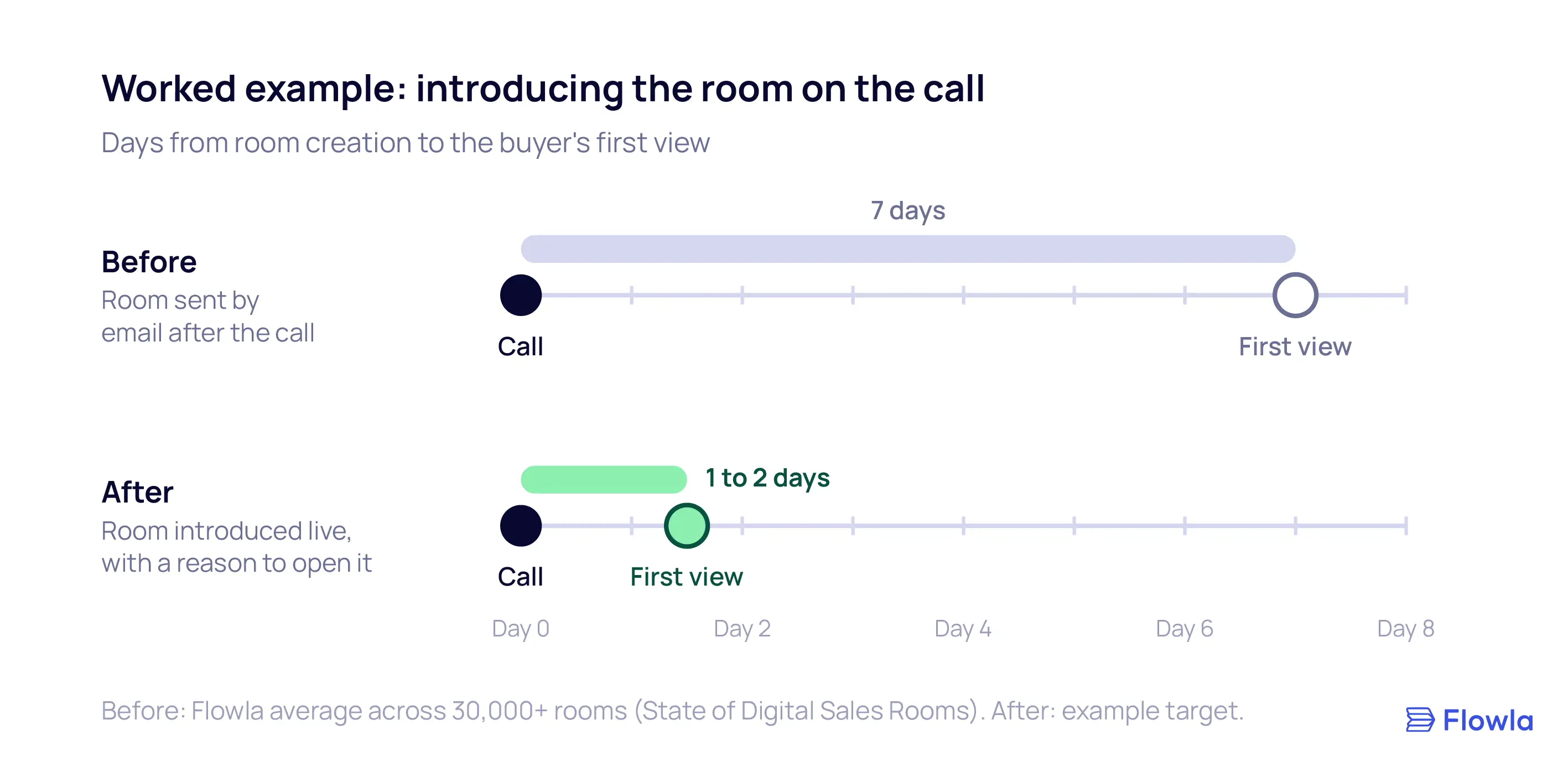
Here's the whole sequence with one behavior.
Reps introduce the deal room during the call instead of sending it afterward, and they give the buyer one specific reason to open it that day, something like "I've already added the security doc your CTO asked about."
The buyer signal is the number of days between the room being created and the buyer's first view. Our 7-day average is a useful outside reference, but pull your own team's number before you start.
The training can be short. Walk through two or three rooms where your best reps did this well, give reps a handful of specific reasons to open the room for common deal stages, then have them try it on live calls for a week.
After that, compare days to first view for the trained cohort over the next four to six weeks against their baseline.
This example works because the gap between the behavior and the signal is small. A rep changes how they introduce the room on Tuesday, and by Thursday you know whether the buyer responded. The rep can see that result too, and it's much easier to care about training when it shows up in your own deals.
Everything above depends on being able to see the buyer's side of the deal. Without a shared space for the deal, that side is scattered across email threads and forwarded attachments, and training evaluation falls back on what the rep said.
Flowla's deal rooms give the buyer's side a home. Each room shows which stakeholders are in the deal, what they've opened, when someone new starts viewing it, and which action plan tasks are done or overdue. That's the raw material for every buyer signal in this guide, captured without reps logging anything. REX, our revenue execution agent, already uses those signals to suggest a rep's next best action in each deal.
The same data feeds Learning & Coaching. REX is built to score each rep's calls, emails and room activity against the skills you define, assign the right course when a gap shows up, and then re-score their next conversations to check the training landed. Profiles & Reporting is designed to roll that up per rep and across the team, so you can see whether a trained cohort's buyer signals moved.
Sales training works when it targets one specific behavior and gets reinforced in live deals. It tends to fail when it's delivered as a one-off event and measured only on completion. According to ATD, fewer than four in 10 organizations measure training's effect on business results at all.
Sales training can show results within weeks if you track leading buyer signals instead of revenue. Behaviors like introducing the deal room on a call or bringing in new stakeholders change buyer activity within days. Win rates and quota attainment take a quarter or more to move, and many other factors affect them along the way.
Sales training teaches a skill or process to a group of reps, usually through courses or kickoff sessions. Sales coaching is ongoing and individual, where a manager or tool helps one rep apply skills in their own deals. Training introduces the behavior, and coaching makes it stick. The best coaching uses evidence from real deals.
Companies spent an average of $846 per employee on workplace learning in 2025, according to ATD's 2026 State of the Industry report, down from $1,254 in 2024. That figure covers all workplace learning rather than sales alone, and it excludes indirect costs like the time reps spend away from selling.
Sales training ROI is the value a training program returns compared with what it cost, usually expressed as a percentage. Revenue-based ROI is hard to prove because many factors move win rates at once. A more reliable approach tracks leading buyer signals, such as stakeholder growth or action plan completion, that respond to trained behaviors within weeks.
A sales training program should include a specific behavior to change, a way to measure whether buyers respond differently, practice built from real deals, and follow-up coaching for reps who haven't changed yet. Measuring the buyer's response is the part that tells you whether the training worked.
Sales training works best in short, frequent cycles rather than one or two big events a year. A practical rhythm is one behavior per month, with a short session followed by a few weeks of practice on live deals and a check on the buyer signal before moving on. Annual kickoffs help with alignment but rarely change behavior on their own.
Train new sales reps by pairing product and process basics with early exposure to real deals. Have them study rooms and calls from top performers and build their first deal rooms from a template. Then work on one behavior at a time on live calls, and measure their ramp on the same buyer signals as the rest of the team rather than course completion.
Flowla deal rooms show who's in the deal, what they've opened and which tasks are moving, so you can coach reps on real buyer evidence.
Book a demoBook a 15-minute chat with a product expert. We'll walk you through every step of the way as you get set up.
.webp)
.webp)
.webp)


.webp)

.webp)
.webp)
.webp)




.webp)
%20(3).webp)
.webp)
.webp)

.webp)
.webp)
.webp)
.svg)

.webp)
.webp)