











- If you lead a revenue team, you already have a pipeline. The question worth asking is where deals are falling out of it.
- In The JOLT Effect, Dixon and McKenna found that 40 to 60% of qualified, forecasted deals end in no decision. Most of that loss stays hidden in the CRM until the quarter has closed.
- Your CRM records what your reps do. The signs that a deal is dying usually sit on the buyer's side: a champion who has gone quiet, a deal with one contact, an economic buyer who never joined a call.
- The approach here has three parts. Build stages around what the buyer has done, audit your current pipeline for where it loses deals, and close those gaps with a weekly review and a few specific habits.
Who this guide is for: revenue leaders, RevOps, and sales managers who already run a pipeline and keep watching a healthy-looking one miss the number.
What you'll leave with: a stage framework with real exit criteria, a three-pass audit you can run this week, a list of fixes for the common leaks, and a weekly review that keeps the pipeline honest.
At the start of the quarter the pipeline looks healthy. Coverage is where it should be, every stage has deals in it, and each deal has an owner and a close date. Then the quarter ends short. When you look back through the deals that didn't close, you expect to find that a competitor took them, and usually you don't. The deals stalled somewhere in the middle, and nobody noticed in time to do anything about it.
The distance between a pipeline that looks healthy and one that converts is what this guide is about, and the cause is measurable. In The JOLT Effect, Matthew Dixon and Ted McKenna analyzed 2.5 million recorded sales calls and found that 40 to 60% of qualified, forecasted deals end in no decision. The buyer ran the evaluation, sat through the demos, brought in colleagues, asked about pricing, and then did nothing. Ebsta got to a similar figure from a separate set of 4.2 million opportunities, putting 61% of losses down to something on the buyer's side rather than a competitor.
Set those numbers next to a typical loss report, which usually blames price or a rival, and they don't line up. A lot of deals leak out of the pipeline between the stages, and the CRM is the last place it shows.
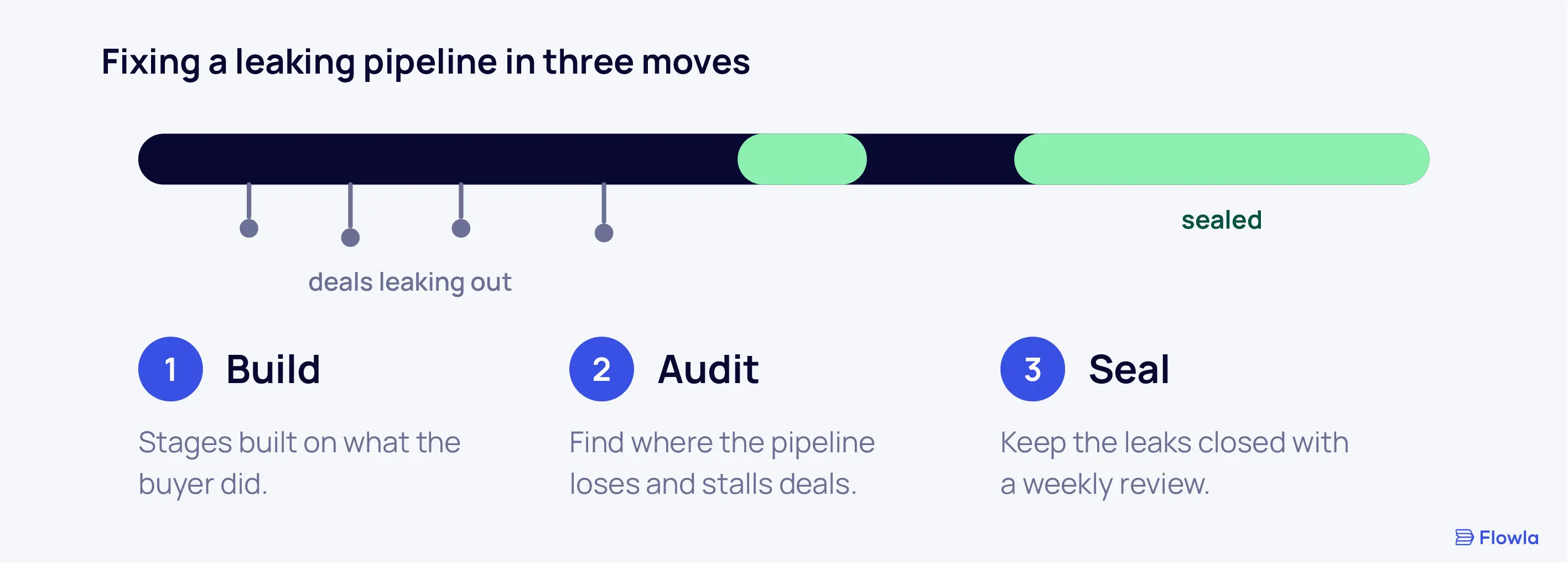
This guide assumes you already run a pipeline with stages you've used for years, so it doesn't spend much time on first setup. It covers three things: building stages that reflect what the buyer has done, auditing the pipeline you have for where it loses deals, and closing those gaps so they stay closed. The three steps are Build, Audit, and Seal, and the rest of the guide works through each one with stage tables, the math, and examples you can run against your own pipeline.
What a Sales Pipeline Is, and Where It Leaks
A sales pipeline is a shared record of where every open deal stands and what needs to happen next on it. Plenty of pipelines fall short of that. They show a list of deals sorted into stages, but a deal's stage tends to reflect the rep's read on it more than anything the buyer has done, which makes the record hard to trust for forecasting or coaching.
Two distinctions clear up a lot of confusion before the real work starts.
Sales Pipeline vs Sales Funnel
A sales pipeline tracks the seller's view of a deal: the stages a rep moves an opportunity through, from first contact to close. A sales funnel tracks the buyer's view: the number of leads at each step and the conversion between them. A pipeline tells a rep what to do next on a given deal. A funnel tells a manager where deals drop off across the whole book.
In practice you use both. The pipeline is the day-to-day view of each deal. The funnel shows which stage is weakest across everyone's deals, which is often where a manager should look first when the team keeps missing.
Sales Pipeline vs Sales Process
The pipeline is the set of stages a deal passes through. The process is what your reps do at each one. A lot of complaints that sound like pipeline problems turn out to be process problems. A stage called "Evaluation" with no agreed action behind it gives deals a place to sit, and they sit there because no one has defined what moves them forward.
Why a Healthy-Looking Pipeline Still Misses
Most articles on this topic are written for someone setting up their first pipeline with a spreadsheet. If you lead a revenue team, that isn't your situation. You've had stages for years, and your problem is the one setup guides don't cover: a pipeline that looks full on Monday and forecasts badly on Friday.
In most CRMs, a pipeline full of deals that haven't moved in three weeks looks the same as one where every deal is progressing. Closing that gap is what the three steps below are for.
Build: Stages That Match How You Sell
Best for: teams building a pipeline from scratch, or anyone checking whether the stages they already have still hold up.
A lot of leaks start at the foundation: a stage with no exit rule, a field nobody fills in, a name like "In progress" that could mean a booked demo or a dead lead. If you're building from scratch, this is the order to work in. If you already have a pipeline, treat it as a checklist, because your current setup should pass every point below.
How to Build a Sales Pipeline, Step by Step
In summary:
- Define your ICP and disqualifiers so only real deals get in.
- Map your sales process from your last five won deals.
- Set five to seven stages that match how you sell.
- Write exit criteria for each stage based on what the buyer did.
- Add the fields that predict a leak, especially last buyer-side activity.
- Set your coverage target by working back from your win rate.
- Review weekly and clear dead deals.
Each step is covered below, starting with what to get right before you create a single stage.
What You Need Before You Touch a Stage
- A clear ICP, with disqualifiers. Decide who you sell to and who you turn away. Concrete disqualifiers work best: fewer than 20 reps, no executive sponsor on the first call, a request for a feature you've dropped. A deal that hits a disqualifier never enters the pipeline, so it can't inflate your coverage later. If you're not sure who the real buyers are, start with the B2B buying committee breakdown.
- A documented sales process. A rough version is fine. Open your last five won deals and write down what happened, step by step. That sequence becomes your stages. If you can't describe how you sell, you can't build a pipeline that matches it.
- A revenue target and the coverage math behind it. If you close 25% of qualified pipeline and carry a $1M quota, you need roughly $4M in qualified pipeline to hit it. At a 40% close rate you can run leaner, closer to $2.5M. Work that figure back through your stage conversion rates and you know how many deals each stage has to hold. The sales forecasting guide covers the full calculation.
- One system of record. A CRM everyone keeps current, rather than a spread of private spreadsheets and memory. Once deal data lives in reps' heads and personal tabs, you've lost the visibility the pipeline exists to give you.
The Stages, and What "Done" Means for Each
The stages of a sales pipeline usually run prospecting, qualification, discovery or demo, proposal, negotiation, and closed won or lost, and some teams add a post-sale expansion stage. What each stage is called matters less than what it represents, which should be a real change in what the buyer has done, not a status a rep updates on a hunch.
The table below is the core of the framework. For each stage it gives the exit criteria that mean a deal is done with that stage, the warning sign your CRM won't show you, and the move that closes the gap.
How to Write Exit Criteria That Hold
Exit criteria do more for a pipeline than anything else on this list, and they're the thing most teams get wrong. An exit criterion should describe something the buyer did, not something the rep feels. Run each one through three checks: is it observable, did the buyer do it, and would two reps agree it happened. If a criterion fails those, rewrite it.
Some before-and-after examples:
- Weak: "Interested." Better: "Booked a second call and named two other stakeholders."
- Weak: "Proposal sent." Better: "Proposal opened, review meeting on the calendar."
- Weak: "Going well." Better: "Economic buyer joined a call and agreed to a mutual action plan."
When stages are named after the rep's read on a deal, the forecast inherits that guesswork. When they're tied to what the buyer has committed to, the pipeline holds up even when the news is bad, which is when you most need it to.
The Fields That Predict a Leak
Stages tell you where a deal is. Fields tell you what you know about it. A useful set stays small:
- Deal value
- Stage entry date, so you can see days in stage
- Next action and its date
- Economic buyer identified, yes or no
- Number of engaged stakeholders
- Last buyer-side activity
- Expected close date
- Win confidence
If you add only one field you don't already track, make it last buyer-side activity. A deal in negotiation that no one on the buyer's side has touched in two weeks is in trouble, whatever the stage says, and that one field catches more quiet leaks than any dashboard.
How Many Stages Should a Sales Pipeline Have?
A sales pipeline should have five to seven stages for most B2B teams. With fewer than five, you can't see where deals stall. With more than seven, reps stop keeping it current, and the forecast built on top stops being reliable. Add a stage only when it marks a real buyer commitment, such as a passed security review, and not when it marks an internal task like writing the proposal.
Audit: Find the Leaks in the Pipeline You Have
Best for: anyone who already has a pipeline and wants to find where it loses deals.
Most build-it guides skip this step. It is the one that shows you where your current pipeline loses deals. You're running three passes over your current pipeline: mapping it, measuring it, and looking for the signals no CRM field captures.
Pass 1: Map Your Last 20 to 30 Closed Deals
Pull them, won and lost, and reconstruct what happened on each one against your official stages. You're looking for where the pipeline on paper and the pipeline in practice come apart.
A few things usually surface:
- Stages that every deal skips, which means they aren't really stages.
- A stage where every deal sits for weeks, which is usually where your process has no defined next step.
- Won deals that followed a different path from lost ones, which shows you what good looks like.
Write the pattern down. Where the real path and the documented path diverge is your first clue to where deals leak.
Pass 2: Measure Where Deals Leak and Stall
Two numbers do most of the work.
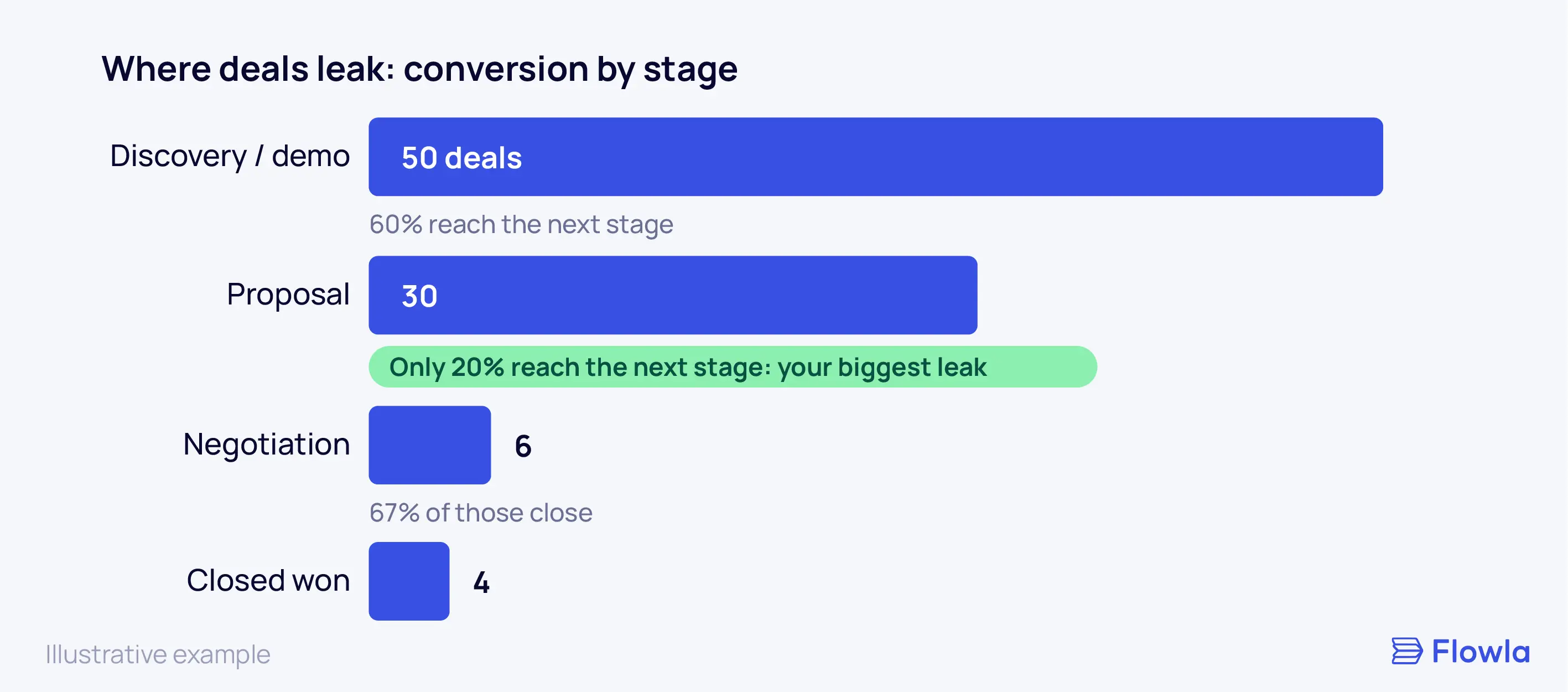
Stage-to-stage conversion shows the outright leaks. Work out the share of deals that move from each stage to the next; the sharpest drop is your biggest leak. Here is what that can look like:
In that example the lead generation is fine. The leak is at the proposal stage, and the cause is usually the proposal itself, the pricing, or a buying decision the deal isn't ready for. Lead generation takes the blame for this far more often than it deserves.
Time in stage shows the slower losses. Deals leak by sitting as well as by dropping out. If your average cycle is 60 days and a deal has been in negotiation for 90 with no buyer activity, it's inflating your coverage and your confidence. Track days in stage, set a threshold, and treat anything past it as a deal that needs a real next step or an honest loss. Ebsta and Pavilion, looking at 4.2 million opportunities, found win rates fell 67% for deals that slipped more than eight weeks. A deal that stalls loses probability while it waits.
Pass 3: The Leaks Your CRM Can't See
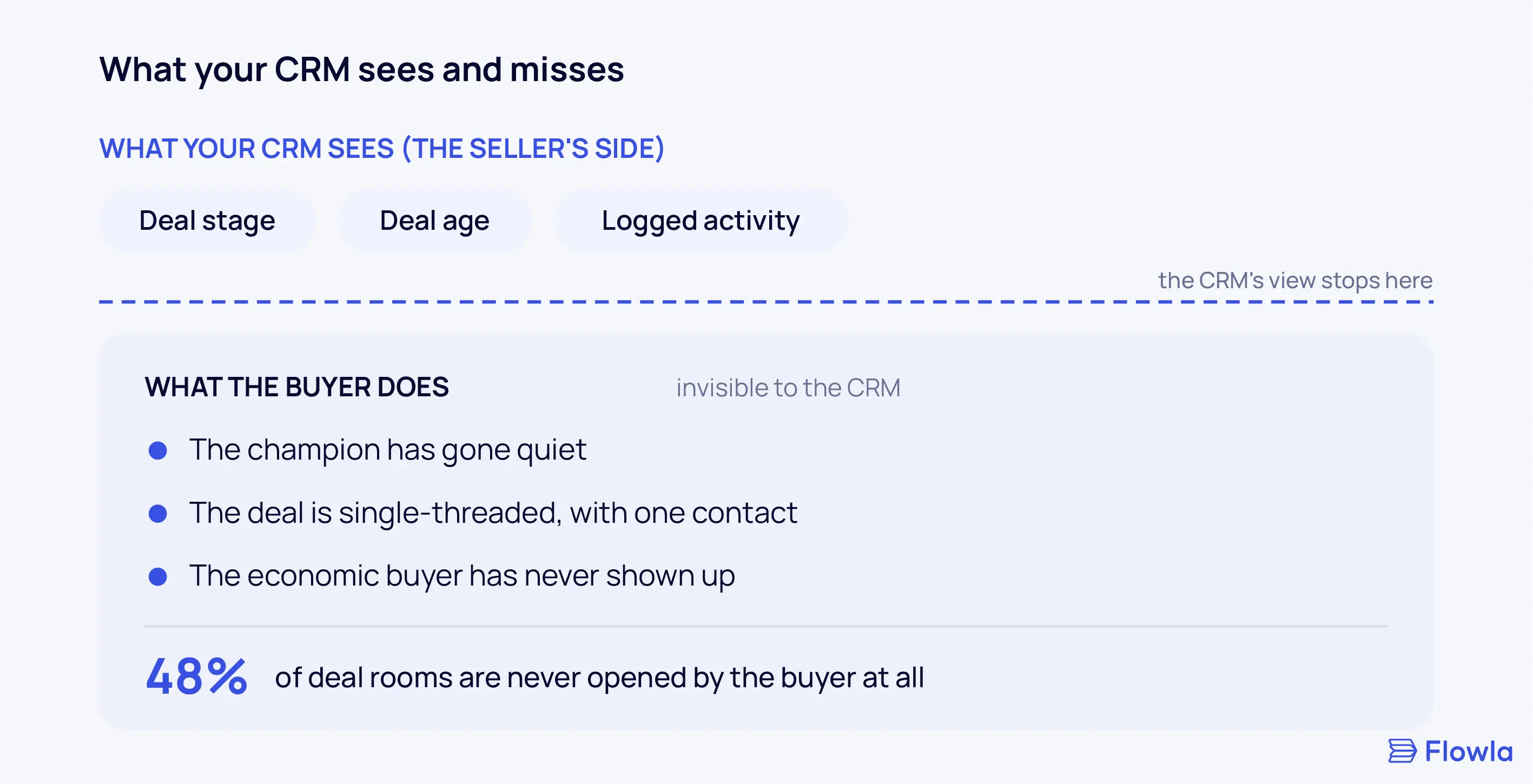
Your CRM shows you stage, deal age, and logged activity, all of it from the seller's side. It can't show you the three things that most reliably predict a leak:
- The champion has gone quiet, replying in a day one week and not at all the next.
- The deal is single-threaded, with every email going to one person.
- The economic buyer has never shown up, so you've been selling to someone who can't sign.
This matters because of where buying now happens. Gartner finds buyers spend about 17% of the journey meeting any supplier, and less than that with any one vendor when several are competing. Forrester puts the journey at roughly 70% complete before a buyer contacts a vendor. Most of the deal moves in rooms your CRM has no view into.
A pre-sales lead at a 200-person cybersecurity services firm described his own pipeline to us this way: he logs an opportunity in Salesforce, and then, in his words, "I typically don't touch that opportunity until I need to prep for my quarterly review." Visibility across his team, he said, is "either in your brain or it's in kind of like an Excel spreadsheet or a OneNote" that each rep keeps on their own. His term for what happens to deals in between was one most revenue leaders will recognize: they "fall through the cracks."
A pipeline reviewed once a quarter works as a report, not as a way to catch deals while you can still save them. The deals leak the whole time, and the review is where you find out.
Flowla's analysis of more than 30,000 deal rooms found that about 48% are never opened by the buyer. The CRM records the materials as sent and the deal as live, while on the buyer's side nothing has happened.
How Do You Measure Pipeline Health?
Pipeline health rests on four numbers rather than one:
- Pipeline coverage: qualified pipeline divided by quota. The usual benchmark is 3 to 4x, and you want it higher when your win rate is low.
- Stage-to-stage conversion: the share of deals advancing from each stage to the next, which shows where the pipeline leaks.
- Time in stage, or deal aging: how long deals sit, which shows where the pipeline stalls.
- Win rate: closed-won over total closed. HubSpot's survey of more than 1,000 reps puts the average B2B win rate around 21%, so four out of five qualified deals don't close. That is the backdrop the other three numbers work against.
The number worth calculating properly is pipeline velocity, which measures how fast pipeline turns into revenue:
Pipeline velocity = (number of qualified deals × average deal value × win rate) ÷ average sales cycle length
It gives you revenue per day moving through the pipeline, and tracked month over month it is the clearest read on whether deals are speeding up or clogging. If velocity stays flat while coverage climbs, you're adding deals that don't move.
Coverage on its own can mislead you. A pipeline can show a healthy 4x and still be mostly old deals nobody has cleared, which is how a well-covered quarter ends in a miss.
Seal: Keep the Pipeline From Leaking
Best for: the team that's found its leaks and wants them to stay closed.
Two things close the gaps: fixing the specific places deals drain, and a weekly habit that stops new leaks forming.
The three leaks that drain the most deals, and how to seal each:
1. Post-demo silence
- What it looks like: a strong demo, then nothing. On the forecast call the rep says it is still warm.
- Why it leaks: the deal has moved inside the buyer's organization, where the rep can't see it. With buyers spending around 17% of the journey with suppliers, most of the evaluation happens without you in the room.
- The fix: give the buyer a shared space they keep coming back to, so you can see engagement instead of guessing at it. A deal room does this: Flowla shows you who opened what, who went quiet, and who got pulled in, on deals the CRM lists as a flat "in proposal." Pair it with reading late-stage buying signals and a plan for re-engaging stalled deals.
2. Single-threaded deals
- What it looks like: one champion, one contact, every message to the same inbox.
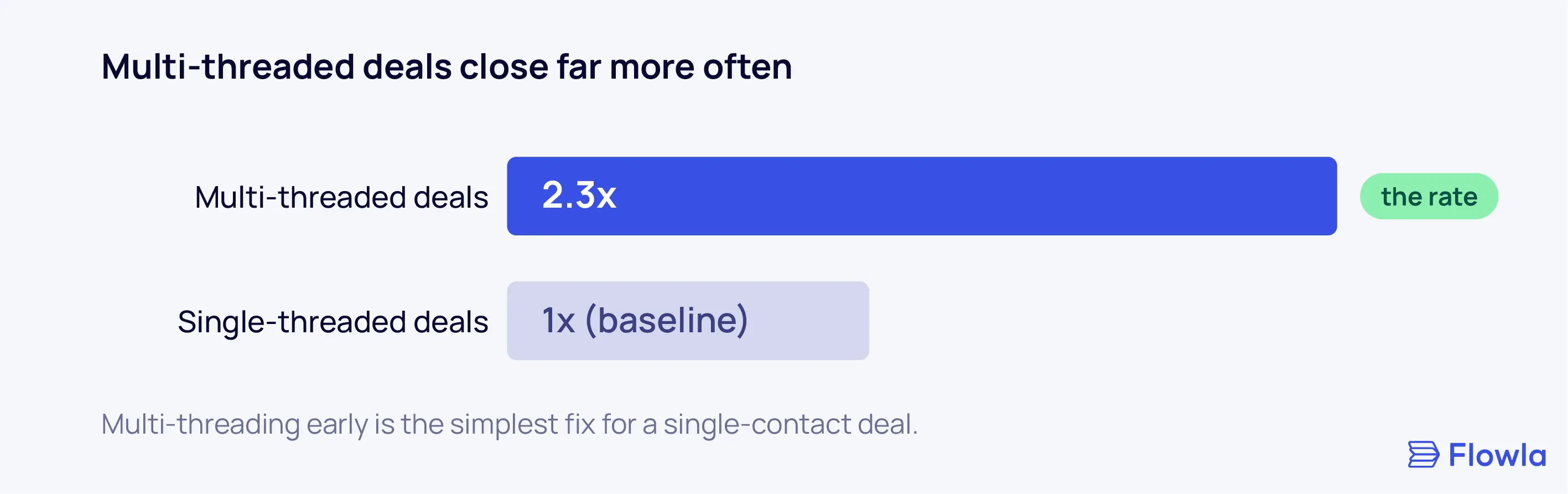
- Why it leaks: Gartner puts the complex B2B buying group at 6 to 10 people, and its 2024 data found each added stakeholder lowers purchase probability by about 10 points. A deal with a single contact has a single point of failure, so if that person changes roles or goes cold, the deal goes with them. Ebsta and Pavilion's 2025 benchmarks found multi-threaded deals close at roughly 2.3 times the rate of single-threaded ones.
- The fix: multi-thread by the demo stage. Name the economic buyer and get a second stakeholder onto the next call before you present. The guides to multithreading and stakeholder mapping cover how to do it without irritating your champion.
3. No mutual action plan
- What it looks like: no shared document of who does what by when. The next steps live in the rep's notes rather than the buyer's calendar.
- Why it leaks: with nothing holding both sides to the same plan, the deal drifts toward the no-decision outcome that accounts for 40 to 60% of qualified deals. The JOLT research found that lowering a buyer's sense of risk does more to close these than pushing harder.
- The fix: a mutual action plan both sides own, with named owners and dates through to signature. You can see how it plays out in a POC and in building a business case your champion can carry internally.
The Weekly Review That Clears Dead Deals
A pipeline review earns its hour only if it changes the pipeline. Go through it deal by deal and ask three questions of each: what changed since last week, what is the next concrete action and when, and whether the deal is still real.
The third question is the one teams avoid. Clearing a deal feels like admitting defeat, so the dead ones stay in, and a pipeline padded with them gives you a false read on where you stand. Set a rule and hold to it: no buyer activity in 30 days means the deal is marked lost with a reason. You can reopen it if the buyer comes back, but you can't forecast on deals that aren't moving.
Flowla's own team runs the review this way. In the weekly pipeline meeting, founder Erdem Gelal's rule is to "treat every deal as if it's a large deal," applying the same rigor to a five-seat deal as to a fifty-seat one, so nothing coasts through on optimism.
How Do You Manage a Sales Pipeline Effectively?
Managing a sales pipeline well comes down to reviewing it on a set cadence, holding every deal to observable exit criteria, and clearing dead deals before they distort the forecast. The teams that forecast well keep only deals that are moving, each with a dated next step and a reason to advance. A smaller, honest pipeline beats a larger, hopeful one over a full year.
How Often Should You Review Your Pipeline?
Review a sales pipeline on three cadences, each with its own job:
The weekly review prevents the most leaks. A month is long enough for a deal to go cold while nobody's watching, and by the monthly review it is usually already lost.
Common Sales Pipeline Mistakes
Each of these is common and fixable, and they share a pattern: a habit that makes the pipeline look better while making it less true.
1. Padding the pipeline with unqualified deals
- What it looks like: reps add every flicker of interest to keep coverage up.
- Why it leaks: the forecast inflates on deals that were never going to close, and reps lose hours to conversations that go nowhere.
- The fix: enforce a qualification gate with hard disqualifiers and hold reps to it. A deal enters with a named contact, a confirmed need, and a realistic next step, or it waits outside.
2. Stages with no exit criteria
- What it looks like: deals advance because they feel further along.
- Why it leaks: two reps read the same deal and put it in two different stages, so the pipeline and the forecast stop meaning anything.
- The fix: write an observable buyer action for every stage transition, using the exit-criteria list above. If you can't name what the buyer did, the deal doesn't move.
3. Tracking rep activity and calling it progress
- What it looks like: dashboards full of calls logged and emails sent.
- Why it leaks: activity tells you how busy the rep is, not whether the buyer is still engaged. A deal can show heavy rep activity and no buyer response right up to the moment it is lost.
- The fix: track buyer-side signals alongside rep activity, such as last buyer response, stakeholders engaged, and content opened, and weight them higher, since they're the ones that predict the outcome.
4. Letting deals sit
- What it looks like: opportunities parked in one stage for months, still counted as live.
- Why it leaks: old deals inflate coverage and hide the real state of the pipeline, so you plan around revenue that isn't coming.
- The fix: set an aging threshold tied to your average cycle. A deal that crosses it with no buyer activity gets a real next step this week or a loss reason today.
5. Forecasting on gut
- What it looks like: "I think this one closes" as the basis for the number.
- Why it leaks: gut calls run high in predictable ways.
- The fix: bring conversion rates, deal aging, and coverage to every review, and commit deals against stage criteria and history.
6. Treating the pipeline as a quarterly report
- What it looks like: the pipeline gets updated the week before the review and ignored the rest of the time, the same pattern the cybersecurity firm earlier was stuck in.
- Why it leaks: a pipeline updated only before the review is out of date the moment it ends, so you're steering by an old map.
- The fix: tie updates to real events, such as a call happening, a stakeholder joining, or a proposal being opened, so the pipeline stays current as part of selling.
Wrapping up
A leaking pipeline is a solvable problem once you can see where it leaks. Build your stages around what the buyer has done, so deals advance on evidence. Audit the pipeline you already have, so you know which stages lose deals and where they stall. Then close the gaps with a weekly review and a few habits that keep the buyer's side of the deal in view.
If you do one thing this week, run the audit on your last twenty closed deals. It takes an afternoon and usually points straight at the one or two stages costing you the most. The rest of this guide follows from what you find there.
FAQ
What's a Healthy Sales Pipeline Coverage Ratio?
A healthy pipeline coverage ratio is usually 3 to 4x: three to four dollars of qualified pipeline for every dollar of quota. The right figure depends on your win rate, so a team closing 25% needs closer to 4x while a team closing 40% can run leaner. Coverage built on old deals isn't real coverage, so clean the pipeline before you trust the ratio.
When Should a Deal Move to the Next Stage?
A deal moves to the next stage when it meets that stage's exit criteria. Good exit criteria are observable buyer actions: a meeting booked, a stakeholder confirmed, a proposal opened. Moving a deal because it feels further along is how forecasts drift, so if you can't name what the buyer did to earn the move, the deal hasn't moved.
What's the Difference Between a Sales Pipeline and a Sales Forecast?
A sales pipeline is the full set of open opportunities and the stages they sit in. A sales forecast is the subset you expect to close in a given period, weighted by stage and confidence. The pipeline is the raw material, and the forecast is the prediction you build from it, so a leaky pipeline produces an unreliable forecast. Cleaning the pipeline is the fastest way to fix a bad forecast.